

Some results of the excavations at the Otrar settlement
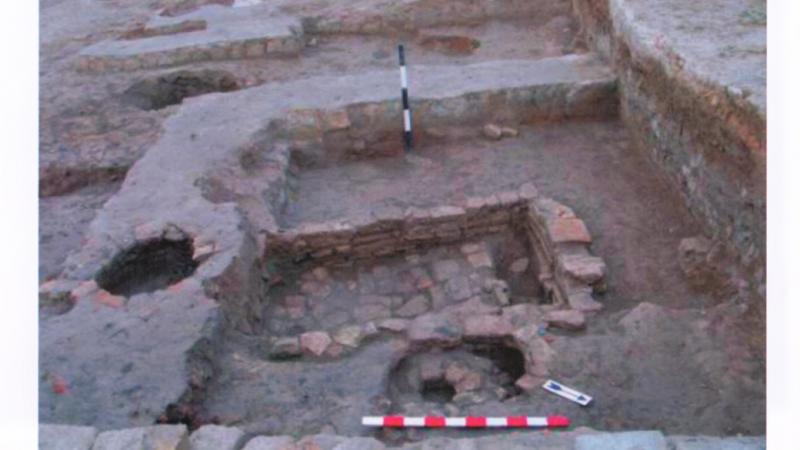
Since 1971, studying the late medieval layers of the Otrar settlement has been the main task of the South Kazakhstan complex expedition of the Academy of Sciences of the Kazakh SSR. In 1974, an excavation site (7,500 sq. m.) was chosen on the settlement location to the east of the central street that connects the two main entrances to the city. Four city quarters fell into the area of the excavation; others were partially excavated.
Unlike the excavations of previous years, which were brought to a depth of 0.5-1.5 m and unearthed layers of the second half of the 16th-18th centuries, this year's excavation was buried in a large part of the area. As a result, a layout of another construction period was obtained. (the first half of the 16th century), which is repeated almost unchanged in the layout of later construction periods. The direction of the main walls of the houses has been completely preserved; redevelopment concerned only rooms with bins, the location of tandoors in rooms, doorways (some of them were laid, others were cut through again), and the functional purpose of the rooms themselves changed.
Peculiar features characterize the construction period of the first half of the 16th century. The walls were preserved up to 1-1.5 m high. The inner surfaces of the walls were carefully plastered, moreover, more than once. A layer of yellow clay plaster is 3-5 cm thick. The house's interior is almost the same as in the previous time: a tandoor with a chimney embedded in a sufa; tashnau platforms in front of its mouth, lined with burnt bricks; a table for coals, khums and jugs, bins with clay walls and cellars. However, the better preservation of the walls made it possible to find niches for household and decorative purposes in them. In three cases, the furnace mouths of the tandoors were decorated with tiles that repeated the shape of the furnace. They have a relief ornament in the form of curls and pearls.
During the excavations, it was possible to more clearly identify the functional purpose of the premises in the house. Some houses have courtyards. They are usually located closer to the street. Part of the courtyard occupied by the sufa was covered with a canopy. There were one or two pear-shaped open hearths on the sufa. Another part of the yard is open. It is usually paved with burnt bricks, one or two tashnau are provided for the runoff of meltwater and rain.
Also, in 1971, the handicraft specialization of some quarters was noted. Then one of the excavated residential areas was identified as a quarter of bakers. This season, the potters' quarter was excavated. Of interest is a large pottery workshop in a complex with living quarters, which consisted of four rooms and a courtyard with an area of 45 square meters. There were three pottery kilns in the workshop: two in the yard, which worked in summer, and one in a room with a tandoor, which functioned in winter. Two workshop rooms were intended for storing clay and drying products before firing.
A complex of premises with a central hall, with an area of about 100 square meters, was also excavated. A gutter in the form of a burnt brick gutter, starting in the adjacent utility room with a hearth-fireplace, is arranged through the entire room near the northeast wall. Behind the central hall there are several narrow rooms, one of them with four tashnaus. The floors are paved with burnt bricks. The facade of the building overlooks a small square formed by the intersection of two streets. The complex with the hall can be considered the remains of a mosque.
Ceramics mainly represents the finds of this year. There are a lot of non-irrigated dishes - hums, khumchas, jugs, kumgans, tagars, bowls. A storage pit filled with vessels (19 jugs, five tagars, and three khums) was cleared next to the pottery kiln. 135 coins were found in the rubble, on the floors and on the sufas of the premises. A treasure trove of copper coins was found along with blanks. These coins are reminiscent of those minted by Yasa in the second half of the 16th century. Jewelry is represented by glass beads, carnelian, garnet, lapis lazuli pendants. The collection of bronze rings has been replenished. Several bracelets were found (in fragments and intact).
These are the preliminary results of this year. Together with the results of past years, they provide an opportunity to recreate a real picture of the life of the late medieval Otrar.