Information
- Location
- Karaganda Region, Karkaraly District
- Period
- 1801 – 1900
- Type
- Mazar
- Kind
- Buildings of monumental art
Sources
- Қазақстанның киелі орындарының географиясы: Табиғат, археология, этнография және діни сәулет өнері нысандарының тізілімі / Жалпы редакциясын басқарған ҚР ҰҒА академигі Байтанаев Б.Ә. – Алматы: Ә.Х. Марғұлан атындағы Археология институты, 2017. – 1-шығарылым. – 904 б.
Description
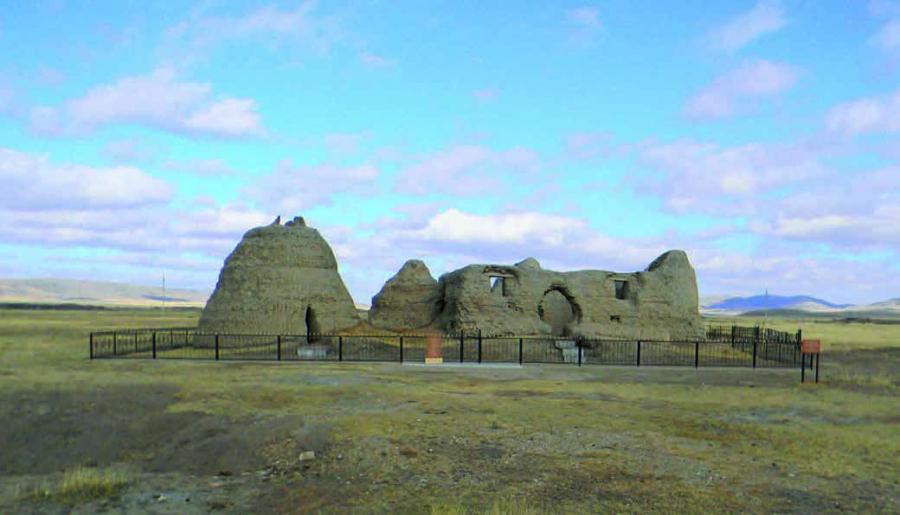
Kusbek, the mausoleum. It is a monument of history, cult architecture. Located in the valley of the Taldy River, 2 km north of the modern village of Burkitti (Karkaraly district, Karagandy region). The mausoleum is connected with the name of Sultan Kusbek Bukeykhanov (in the papers of the tsarist departments of Taukin), who lived in the XIX century as a historical person, a prominent figure of Central Kazakhstan. In fact, Mazars is a tribal tomb of representatives of one branch of the Bukeykhanovs, who traditionally lived in the area of the Bokty and Kent mountains, in the valley of the Taldy River.
The mausoleum was built in the second half of the XIX century, after the death of Sultan Kusbek, buried near his father's grave Tauke Bukeykhanov. Sultan Tauke Bukeykhanov may have been the first person to be buried at the site of the mausoleum. According to available information, Tauke Bukeyhanov, his sons Kusbek, Tubek and Ismail (Ismailhan) Bukeyhanovs, as well as their wives and some other relatives rest here. Opposite the mazar there is the grave of the famous poet Shozhe Karzhaubayuly (1808-1895), who, according to the local oral tradition, wished "to lie near Kusbek after his death, who rendered him many good services" (Zhaksylygyn kop korgen Kusekem zhanyna koiyngdar degen). Mausoleum is a raw structure of rounded, yurt shaped, which has side dome extensions. The entrance opening is rectangular, 1.4 m high. The inner diameter of the tomb is 8 m, the thickness of the walls is 1.2 m.
Sultan Tauke, son of Bokey Khan from his third wife, was the administrator of the Kara-Aitimbetov parish of the Karkaraly duan (area). His eldest son, Sultan Kusbek Taukeuly Bokeikhanov (Taukin) (1802-?) replaced his father in this position, then twice was an elder-sultan of the Karkaraly duan. Between the two terms of his election, Kunanbai Uskenbayev, Abai's father, was elected to this position once, in 1849-1853. In the construction of an ancient mosque in the city of Karkaraly there is a merit of Kusbek Bokeykhanov. Many approvals from the Omsk administration and rural municipalities, the choice of a place for the mosque, as well as the initial stage of construction were carried out during the life of Kusbek Bokeykhanov as an elder-sultan. Construction of the mosque was completed in the summer of 1951 under the new elder-sultan - Kunanbai Uskenbaev.
Sultan Kusbek Bokeykhanov visited Omsk, Semipalatinsk and St. Petersburg. According to the data, the descendants of Sultan Tauke Bokeykhanov in the person of Kusbek and his other sons were not only rich and influential officials, but also kind people who enjoyed respect among the people. Representatives of this line of the Bokey Khan wintered in the gorges of Burkitti, Karasha, Kent, and Bokty mountains, and the valley areas of the Taldy River were places of summer camps. According to the data of F. Shcherbina's expedition, there were togans on the river Taldy, arranged by sons of Sultan Tauke. One of them is known as "Arystanbek's togan".
The authority of Kusbek Bokeykhanov was equated with such figures of Saryarka as Alshynbai Tilenshin, Kunanbai Uskenbayev, Musa Shormanov, Tattimbet Kazangapov. Being an elder-sultan of the Karkaralinsk duan, sultan Kusbek often met with the administrator of the Tobykty parish Kunanbay Uskenbayev. In 1845, when Kunanbay decided to open a school in Tobykty parish and called to find a teacher for the school in two languages, Kazakh and Russian, elder-sultan Kusbek Bokeykhanov, who personally supported this idea, himself signed and sent the necessary letter dated January 12 of this year, to the Border Master. Abai Kunanbayev, being a rural municipality, often used Kusbek's administrative skills in the affairs of people's management.
The mausoleum of Kusbek was first photographed in the late 1890s by S.M. Dudin, an employee of the Kunstkammer (St. Petersburg). The monument has reached our days in its entirety, with small losses. As part of the mud brick, inclusions from cut horsehair can be clearly seen. According to the legend about the construction of the mausoleum, it was built in a huge congestion of people, and the water on the Taldy River decreased from their horses (tort bolystyng adamy kelgen, attyng koptiginen Taldynyng suy sarkylgan), and during the memorial ceremony 40 mare, whose tails and manes, chopped up finely, were added, with mare's milk in the clay used to make bricks, were sacrificed. This clay of 40 girls, selected from among the inhabitants of the parish, was kneaded barefoot (informant G. Sarsenbayev, born in 1902, Kent village, note by A.Z. Beisenov, 1986).
At the initiative of the Karagandy Regional Department of Culture, conservation and improvement works were carried out at the mausoleum in 2009. The cemetery was fenced with a metal fence and a security board was installed.
The mausoleum is located on the Karagandy-Ayagoz highway. In addition to the village of Burkitti, the district center of Karkaraly and the village of Egindybulak are located nearby. Such location of the monument is favorable for visiting it by numerous pilgrims and tourists. Excursions of schoolchildren from the settlements of Karkaraly district are organized.