Information
- Location
- Karaganda Region, Shet District
- Period
- 0
Sources
- Қазақстанның киелі орындарының географиясы: Табиғат, археология, этнография және діни сәулет өнері нысандарының тізілімі / Жалпы редакциясын басқарған ҚР ҰҒА академигі Байтанаев Б.Ә. – Алматы: Ә.Х. Марғұлан атындағы Археология институты, 2017. – 1-шығарылым. – 904 б.
Description
The monument of archeology is located on the territory of Taldy rural district of Shet district of Karagandy region, on the left bank of Taldynura river. The area is a wide, rich in grass, comfortable valley of the Taldynura River. To the east and south-east is the Kyzyltau mountain massif.
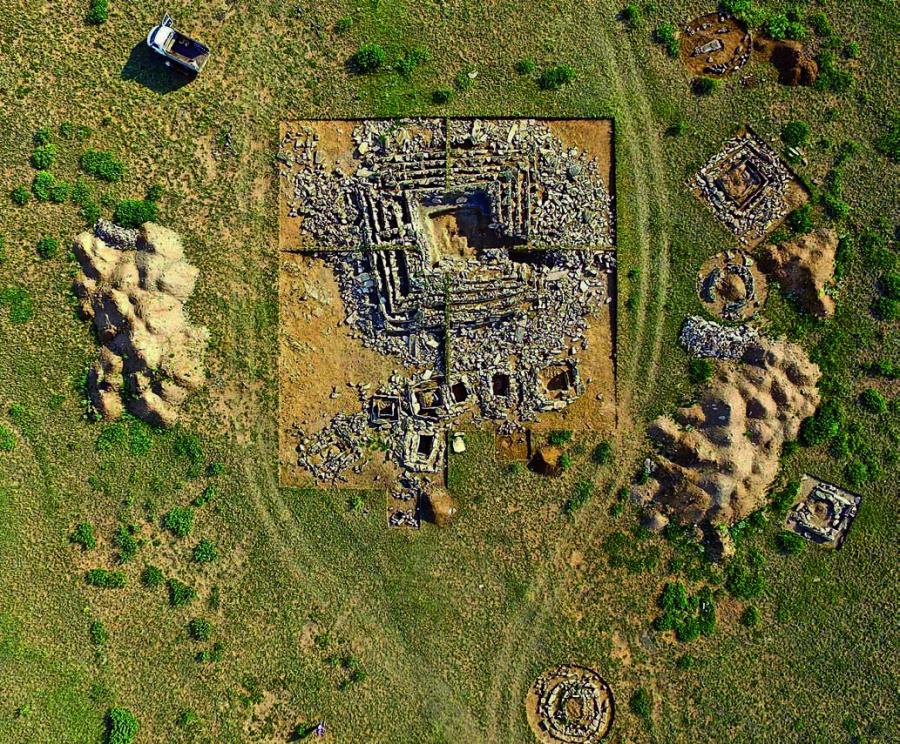
The burial ground includes 32 structures of the Late Bronze Age of Begazy-Dandybay culture. The central position is occupied by a large stone mausoleum, which has a pyramidal-stage construction, around which the burials of ordinary people in the form of small fences and boxes are located.
Excavations were carried out in 2016-2017 (by I.A. Kukushkin). After the study was completed, in 2017, recultivation works were carried out at the burial site and the Karazhartas mausoleum was restored. The scientific concept of the monument restoration was created by I.A. Kukushkin, and the works were carried out under the supervision of A.Z. Beisenov (head of D.B. Duisenbay's team). Thus, the monument has been researched only recently, so nowadays the research materials are intensively put into circulation. Before the excavations, the mausoleum was a 30×20 m high, braided earthen hill with a height of about 2 m, on the surface of which there were stone rows of walls and edges of facing slabs. After removal of the embankment, the funeral structure acquired the appearance of a stepped pyramidal structure of a sub-square shape, oriented by corners on the sides of the world and consisting of 5-6 rows of walls, where each row of walls retreating to the center was higher than the previous one. The length of the outer perimeter of the walls is 13.5-14 m, the height of the masonry - up to 15 layers, the width - up to 0.34 m. From the outside it was lined, like many other mausoleums of Begazy-Dandybayev culture, with large slabs installed vertically. The dimensions of the plates reached 2.5×0.8×0.1 m.
At a distance of 0.5 m from the cladding slabs was a fence of flat laid slabs up to 0.3 m high. The inner space of the central perimeter of the walls was a ground-type burial chamber, which was built of muddy soil. Its dimensions along the inner edge were 4.8×3.25×3.65×4.15 m and its height was 1.88 m. The burial chamber is oriented similar to the fence walls and was almost completely plundered in ancient times. Individual human bones and ceramic fragments were found in the fillings of the grave.
It was impossible to establish the details of the funeral rite, but, as paleo-anthropological definitions have shown, the remains of at least one adult individual were placed in the grave. Sheep and horse bones fixed at different levels of the grave filling may be linked to sacrificial food destined for the deceased. The surviving portion of the inner chamber slabs showed that the inner chamber had a flat, large-plate cobbled outer surface that formed a similar platform. In the centre of the site was originally a rectangular or square stone structure crowning the "pyramid". Taking into account the fact that the structure was destroyed, the total height of the "pyramid" was probably about 3 m.
In the process of removing the embankment, cleaning the walls of the building and sampling the filling of the burial chamber, numerous fragments of late-bronze ceramics were noted. The metal equipment found in the mausoleum is represented by an arrowhead and a unique golden ring.
In terms of size, the Karazhartas mausoleum is currently one of the largest among the stone tombs of the Begazy-Dandybay nobility. The mausoleum of Buguly-3 is comparable with it in its parameters. Quite unusual is the construction of the funeral chamber, which had a bund with a muddy soil. It is possible that these are the remains of the cheese-osamanous walls. In this perspective, we can point to some similarities with the complexes of Northern Tagisken (Tugisken) in the Aral Sea region and Karaoba in the Irtysh region, which had clay structures.
The calculations of the construction material used allow us to state that their total weight could reach 650-700 tons, and the real labor costs exceed the ordinary burials by more than 1,000 times. Taking into account the complexity and labor intensity of the construction works, the obtained indicators give a real picture of the high socio-economic differentiation of the Begazy-Dandybay society, bringing the buried leader closer to the "royal" rank.
Construction of elite mausoleums on the territory of Central Kazakhstan (Buguly-3, Begazy, Dandybay, Aybas-Darasy, Sangiru, Karazhartas, etc.) testifies to the fact that this region was the largest center of Begazy-Dandybay culture in antiquity. Construction of such grandiose burial monuments in the Bronze Age was possible only with the exclusive consolidation of human and material resources, which could only be afforded by the leaders of large tribal associations with great power, status and wealth.
To the east and south-east of Karazhartas, a group of Late Bronze Age settlements is located at a short distance, the most famous of which are Baybala, Akkezen, Akkezen-2, Shortandybulak and Shokpartas. These settlements and the burial ground of Karazhartas, as well as a number of other monuments, are left by one large community, a tribal association, which inhabited the valley of Taldynura in ancient times. It is highly probable that the ruler, the leader of this society, was buried in the Karazhartas mausoleum. In the valley of Taldynura, near the burial ground of Karazhartas, there are a significant number of other bright monuments, including large, "royal" barrows of the Saka time. There is also a mazar of the famous Batyr and Bi Senkibai Orazgululy ("Bi ata"), which enjoyed great respect in life among the people. The area is visited by numerous pilgrims and tourists. It is advisable to create here, in the valley of Taldynura, a single historical and archaeological park or wildlife preserve.