Information
- Location
- Karaganda Region, Aktogay District
- Period
- 1250 – 1300
- Type
- Mausoleum
- Kind
- Buildings of monumental art
Sources
- Қазақстанның киелі орындарының географиясы: Табиғат, археология, этнография және діни сәулет өнері нысандарының тізілімі / Жалпы редакциясын басқарған ҚР ҰҒА академигі Байтанаев Б.Ә. – Алматы: Ә.Х. Марғұлан атындағы Археология институты, 2017. – 1-шығарылым. – 904 б.
Description
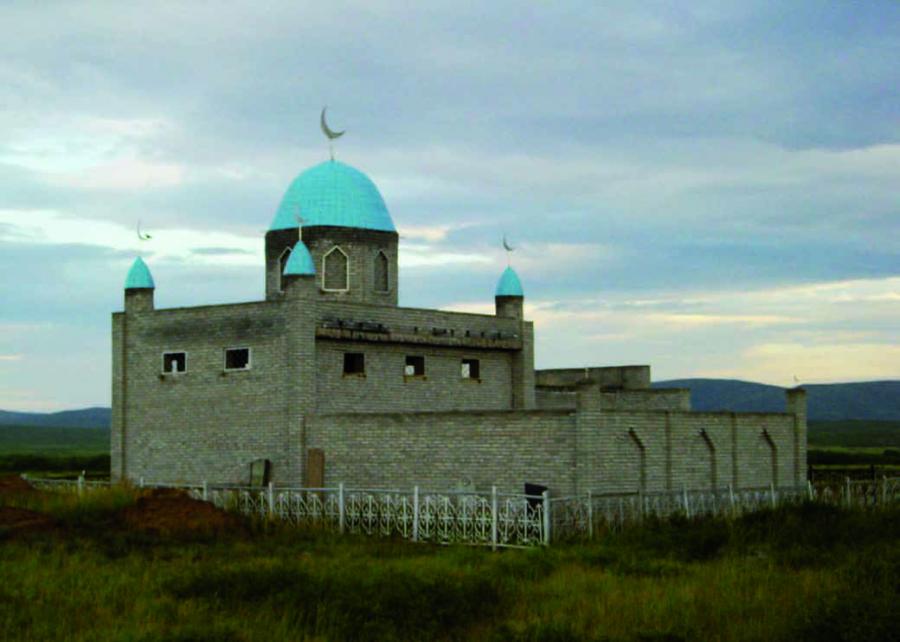
It is located 6 km north-east of Aktogay settlement (Aktogay district, Karagandy region). Located at the confluence of the Aktas River in Tokyrauyn, in the area called Karamende ayrygy (Karekeng ayrygy). The mausoleum was built at the end of the XVIII century. Karamende Shakauly is a famous bi of the Middle Zhuz, the orator (sheshen), in the opinion of the people endowed with the qualities of a clairvoyant and saint.
During the period of the Jongar invasion, such famous figures, historical persons, who came from among the people as Kanzhygaly Bogenbay, Karakerey Kabanbay, Shakshakuly Zhanibek, Basentiyn Malaysary, Bayan, Baigozy, Dos, Karamende, Olzhabay, Taylak, Sanyryk batyrs and many others, were in the front ranks of the Kazakh troops, rallying thousands of brave soldiers around themselves. In folk tales among such heroes, the name Karamende Bi often appears. He is both a Batyr and a wise Bi.
The great Abai grew up on the wise edifications of Karamende Bi, heard from his father, Kunanbai. He especially liked the words heard during his visit to Karkaraly with his father:
"The deserted land is an orphan,
And the lake without birds is an orphan.
Without a leader the country is an orphan,
And a Batyr without a country is an orphan.
Without relatives the girl is an orphan.
The lonely old man is an orphan.
The word is an orphan without meaning."
Kunanbai has always said these words to his children, thus explaining the inextricable connection between people and their native land, their families, as well as with the environment, who know how to appreciate wisdom.
Karamende Shakauly lived in 1707-1797. Karamende Bi and Zhidebai Batyr were peers who maintained good relations for a long time. Zhidebai, who had seen many things in his life, lost his sight as an elderly man. One day, he sent a young man from his village to a remote village in Karamende with seven points of mystery: 1) He remained in the hands of a Muslim enemy; 2) he is struggling to find the cattle of five grandfathers; 3) 61 horses will not let go of their joint without a stallion; 4) no matter how many 70 sparrows they chirped, they will not have enough strength to do any work; 5) 80 chickens like to make a nest (sit in a nest); 6) it is not known when 90 eggs will split; 7) there are five needs - there is hope in four, one without hope.
The young man arrived in the village of Karamende Bi, and conveyed the message of Zhidebai. Karamende's response included the following explanations: 1) to stay in the hands of a Muslim enemy means that aksakal lost his wife and stayed with his son and daughter-in-law; 2) means that he lost his sight and became blind, he is unable to find what he himself put somewhere; 3) 60 is the age for a mature man, at this time there is respect among relatives, among people; 4) no matter how many 70 sparrows chirp, they will not have the strength to do the job - it means that at 70, no matter how much the old man says, his words do not have the same weight in society; 5) at 80, a man prefers to sit and lie down more than to participate in the affairs; 6) it is not known when 90 eggs will split, so it is not clear on what day the 90-year-old man will die; 7) five needs in the life of a man, their essence is really, in four there is hope, one without hope. The first is a little boy hoping to grow up and be a strong man, the second is a poor man hoping to get rich, the third is a rich man hoping to become even richer, the fourth is a lonely man always hoping to be in the midst of his surroundings, sons, grandchildren, friends, because life is not in place, and one without hope is old age, which really has no hope. "The Afterlife" is hopelessness.
Then Karamende asked the young man to give Zhidebai the following advice: "If the famous Batyr Zhidebai remained in the hands of a Muslim enemy, he must keep his mouth shut. If he is blind and cannot find "the cattle of five grandfathers", i.e. things and objects around him, he should sew his side and breast pockets. He is 60 years old, but he, Zhidebai, believes that the Almighty did not reward him with happiness at that time. At this age, he lost his close peers and feels the anguish of orphanhood, i.e. loneliness. 70, 80, 90 are milestones in a man's life, one way or another it is what is sent down. Let the bravest Zhidebai not run away from it.
In this form, adopted among the steppe sages, Zhidebai wanted to tell Karamende about himself, who he considered to have surpassed him in wisdom, as well as to know what his own thoughts were. Instead of complaining about fate, instead of life's grievances, a mystery was sent. The solution to all this communication is simple: Zhidebai and Karamende, who in their youth "side by side" went to the enemy, took part in many fierce battles, thus once again supported each other in the sunset of life; Karamende, giving an answer to Zhidebai, comprehends his life, he also answers to himself.
According to the data, the wise Karamende was buried with a huge crowd of people near the grave of a man named Sadyr who had died earlier and who was considered one of his mentors during his lifetime. Sadyr kozha was an educated man, and he was often consulted for advice. A simple tomb of Karamende was eventually surrounded by a rectangular log cabin. In the 1920s, a dilapidated wooden structure was surrounded by walls made of samanna brick (informant Tungyshbai Mukan, born in 1946). In 1993 in Aktogay village there was held a big celebration in honor of Karamende Bi, a funeral repast was held. During the restoration of the monument, a modern mausoleum made of white brick was built, square in plan, in the corners are located turrets, a small dome over the construction towers. One of the villages (former Enbek) of Aktogay district was named after Karamende Bi.
As it was shown by the survey of the area in 2008 (by A.Z. Beisenov, with the participation of A.E. Kasenalin, K.A. Zhambulatov), the grave of Karamende Bi, as well as the earlier grave of St. Sadyr, appeared initially on the sacred place, where in ancient times the burials of persons of high social rank were carried out, rituals and ceremonies were held. The burial ground of the early Iron Age in Karamende includes seven objects. Large barrows No. 1-4 with a diameter of 25-40 m and a height of 2-4 m are built of earth and stone and belong to the Early Saka period (Tasmola culture). The largest of them, barrows No. 1-3 occupy the northern part of the territory of the burial ground, while the largest, "royal" barrow No. 2 with a diameter of more than 40 m and a height of 4 m is located on the western side of the mausoleum, not far from it. Barrow No. 6 is a well-known in archeology of Kazakhstan cult ritual complex with "mustache" (type 1): the embankment diameter is 12 m, the height is 0.5 m, stone ridges with the length of about 100 m are oriented to the south-east. In 110 m to the NNE from it is located a small barrow number 5 with a diameter of 4 m and a height of 0.15 m. Perhaps, this object belongs to the Middle Ages.
Nowadays the territory of the burial ground and mausoleum is a place of pilgrimage. In addition to people coming from different places, groups of pilgrims, the mausoleum is often visited by local residents, where crowded prayers are held during religious holidays. Tourists from Kazakhstan and abroad also come here.