Information
- Location
- Karaganda Region, Shet District
- Period
- 1400 BCE – 1000 BCE
- Category
- Historical and cultural monuments of republican significance
- Type
- Сomplex
- Kind
- Archaeological sites
Sources
- Қазақстанның киелі орындарының географиясы: Табиғат, археология, этнография және діни сәулет өнері нысандарының тізілімі / Жалпы редакциясын басқарған ҚР ҰҒА академигі Байтанаев Б.Ә. – Алматы: Ә.Х. Марғұлан атындағы Археология институты, 2017. – 1-шығарылым. – 904 б.
Description
The monument is located 10 km north-west of the village of Shopa (Nurataldy rural area, Shet district, Karagandy region). The area is a picturesque valley of the river Shopa, flowing from south to north.
The valley is bordered by a system of uplands: high mountains of Buguly in the south and ridges of hills in the north and east. The components of the complex are located on both banks of the river Shopa. The settlement and burial ground of Buguly-1, as well as the settlement of Buguly-2 are located on the right bank of the river, not far from each other. The burial ground of Buguly-2 is located in the western part of the complex, on the left bank of the river and occupies an open space area opposite the settlement of Buguly-2. In the northern part of the complex, on a flattened hill, there is the mausoleum of Buguly-3. In the area of monuments two dams belonging to the ancient epoch, as well as two single menhirs in the form of bear (ayutas) and ram ( koitas) figures have been fixed.
Buguly complex was opened by A.Kh. Margulan in the course of field researches of the early stage of activity of the Central-Kazakhstan archeological expedition. He probably visited the area at the end of the 1940s, when he carried out a continuous reconnaissance on the territory of Central Kazakhstan. The main excavations were conducted in 1952, 1955-1956, 1963. It was then that all five parts forming the complex were studied. A. Kh. Margulan, A. M. Orazbayev, M. K. Kadyrbayev, T. N. Senigova took part in the research of different monuments of Buguly. The first materials and conclusions were covered in a number of articles by A. Kh. Margulan, as well as in large monographs in 1966 and 1979. Based on the materials of Buguly A.M. Orazbayev carried out a scientific reconstruction of a dwelling of the Bronze Age, which does not lose its significance at the present time. The data obtained during the study of Buguly monuments played an important role in the study of the ancient culture of Central Kazakhstan. At the present stage the development of new directions is actual, one of which important points should become specification of date of monuments with application of methods of natural science disciplines.
According to available data, the Buguly valley was first mastered by the Neolithic tribes, as evidenced by the findings of stone tools and fragments of ceramics in the area of Buguly-1 settlement. Materials of the Andronov epoch demonstrate developed forms of cattle breeding, metallurgy and crafts, house-building techniques.
At this time, in the first half of the II millennium BC, here lived the tribes of Nura culture. In the second half of the II millennium BC the number of inhabitants of the valley increased, at the same time the Begazy-Dandybay culture flourished, whose tribes inhabited the vast expanses of Saryarka. In 1998, A.Z. Beisenov and V.G. Loman made new excavations at the settlement of Buguly-1. At the settlement of Buguly-1 on an area of 372 m2 the main part of one dwelling of rectangular shape with the size of 9,5×10 m was opened. One of the important results was the discovery of Dongal ceramics in the cultural layer of the dwelling, which is proof of the existence of the settlement at the very end of the Bronze Age. A.Z. Beisenov excavated one barrow of Tasmola culture, located near the mausoleum. The burial of a woman with a stone altar was opened in the underground grave.
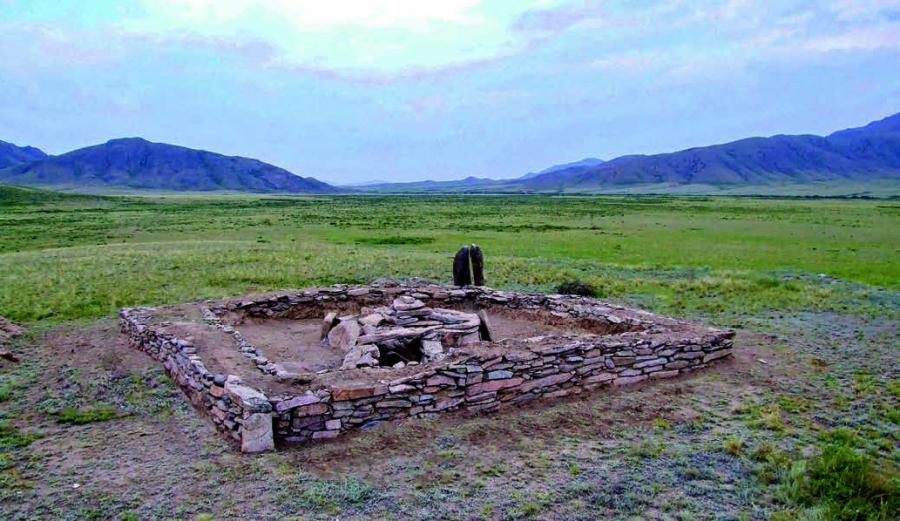
Buguly-3 mausoleum is one of the largest spacious tombs built for burial of representatives of the ruling top of the Begazy-Dandybay society. Before the research it was an earthen barrow. Two tall menhirs have survived in the southwest corner. In the course of excavations under the embankment was found a powerful stone structure with a square shape in terms of dimensions of 15×15 m, oriented by walls on the sides of the world.
For the masonry of the walls, the ancient builders used elongated stones 40-70 cm long, over 20 cm wide and 10 cm thick. The walls were erected by masonry method in several rows up to nine rows. In the central part of the mausoleum there is a burial chamber in the form of a square-shaped stone box with the dimensions of 4.1×4.4 m, composed of large, vertically installed, processed slabs. The funeral chamber was covered with stone blocks in the form of a stepped vault. The total height of the grave with a pyramidal top reached more than 3 m. From the northeast corner of the stone box to the wall of the mausoleum, a 3.3-metre long dromos corridor was laid out at an angle. The floor of the corridor was covered with an ash layer up to 25-30 cm. The monument was heavily plundered in ancient times. In addition to the main burial, there were three more children's burials in small stone boxes. Fragments from several ceramic vessels and fragments of bronze needles were found among the objects of the accompanying complex. To the north of the mausoleum there is a group of small pits connected, apparently, with the ritual actions carried out here.
According to modern data, the large stone tombs of the Begazy-Dandybay culture are located in areas with particularly favorable natural conditions. In such places, where bright and significant monuments are concentrated, including large settlements and burial grounds, large late Bronze Age communities lived. In all likelihood, the ruler, the leader of one of such large communities, was buried in the Bugulinsky mausoleum. In the modern era, the complex, located in a picturesque valley, is actively visited by numerous tourists. The presence of a nearby highway of national and international importance Almaty - Astana - Yekaterinburg is favorable for the development of tourism.