Information
- Location
- Karaganda Region, Aktogay District
- Period
- 1200 BCE – 800 BCE
- Category
- Historical and cultural monuments of republican significance
- Type
- Necropolis
- Kind
- Archaeological sites
Sources
- Қазақстанның киелі орындарының географиясы: Табиғат, археология, этнография және діни сәулет өнері нысандарының тізілімі / Жалпы редакциясын басқарған ҚР ҰҒА академигі Байтанаев Б.Ә. – Алматы: Ә.Х. Марғұлан атындағы Археология институты, 2017. – 1-шығарылым. – 904 б.
Description
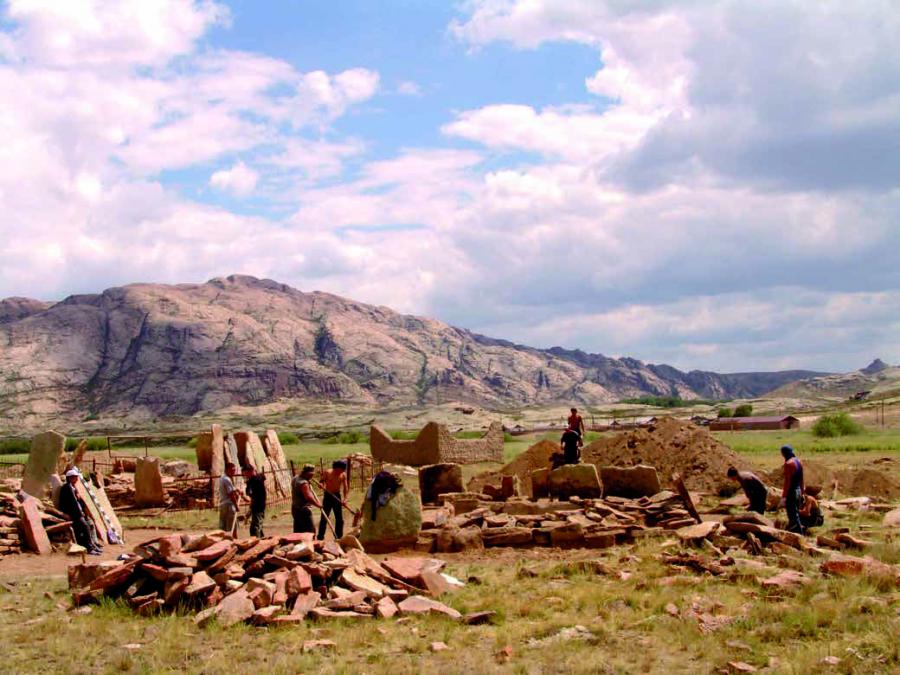
It is a monument of archeology and history. It is located 40 km south-east of the district center of Aktogay village, on the right bank of the Karatal river, near the mountain of the same name (Aktogay district, Karagandy region). The burial ground of Begazy was discovered by A. Kh. Margulan in the course of field research of the Central Kazakhstan archeological expedition in 1946. Archeological research was carried out in the period of 1947-1952 with the participation of K.A. Akishev, A.M. Orazbayev, L.R. Kyzlasov. In 2003-2010 the complex researches of monuments of Begazy tract were continued (A.Z. Beisenov, A.E. Kassenalin). The territory of the burial ground occupies a total area of about 10 hectares. The main part of the facilities is located along the chain in the direction of SW-NE. There are Andronov fences, stone mausoleums of Begazy-Dandybay culture, barrows of the Saka era, numerous small stone graves and three mud mazars of the Kazakh time. The earliest monuments are typical small fences made of vertically placed slabs with a tomb pit in the centre. Out of 50 such objects 18 were excavated by the Central Kazakhstan archeological expedition. Begazy gained wide popularity in science due to the studied stone tombs - mausoleums of the late Bronze Age. The Begazy burial ground was the second monument after Dandybay, which gave materials of then unknown new culture of the late Bronze Age. Mausoleum 1 had the size of 9.6×9.6 m, i.e. it was square. Its walls were made of granite slabs laid on clay mortar. The width of the wall is up to 2 m, the remaining height is up to 1.3 m. The outer perimeter of the walls was covered with vertical slabs that reached a height of 3.5 m. The entrance to the tomb was from the eastern side, and a corridor 9 m long and 4 m wide led to it. The walls of the corridor were made of stone. According to the description, inside the mausoleum between the outer walls and the walls of the burial chamber there was a bypass gallery, in which more than 40 clay vessels were found. In the burial ground there was a podium-altar with menhirs. Mausoleum 2, located next to the previous one, also had large dimensions.
All the six stone mausoleums studied were heavily looted in antiquity. In the course of excavations, ceramic vessels used by the rich top of society, as well as bronze spears and arrowheads were found in them. Articles of stone and bone, remnants of meat food in the form of horse's bones, cow's bones, ram, deer, maral and argali were found. The materials of these monuments played an important role in the discovery of the bright and original Begazy-Dandybay culture of Saryarka. Tombs of the steppe elite from such burials as Dandybay, Begazy, Sangiru-1, Buguly-2 and Buguly-3 formed the first circle of monuments, the materials of which in the first half of the 1950s were the first formulations of the new culture among specialists.
As a result of the survey of the 20 km long strip along the Karatal River, dozens of monument locations were recorded. Of great importance is the discovery of a stone sculpture of Saka time on one of the barrows of the Begazy burial ground.
Materials of Begazy together with data of a number of other monuments have allowed to draw a conclusion on existence in the late Bronze Age in steppes of Saryarka of socially developed society with accurately allocated layer of elite - the ruling leaders possessing military power and strong authority. Such rulers, for whose burial stone mausoleums were built, were at the head of large communities. Techniques in the construction of mausoleums, the use of massive slabs up to 2-3.5 m high showed the high development of construction business.
New research has shown that the Begazy burial ground forms the core of a significant group of monuments located in this area. Currently, it is planned to create a historical, cultural and natural reserve "Kyzylarai-Begazy", in the borders which includes 150 locations - over 570 objects. A "group of Begazy's monuments" consisting of 85 locations is singled out. In addition to archeological objects, there are numerous Kazakh mazars and remains of winter camps.
Modern materials on the issue of the Begazy burial ground, including the data of new excavations and the results of radiocarbon analyses, allow us to clarify the place of the Begazy burial ground mausoleums in the chronology of the Begazy-Dandybay culture. It is possible that the stone tombs of the nobility belong to the late stage in the development of Begazy-Dandybay culture. If this is the case, then they should be considered as the predecessors of the "royal" barrows of the Saka era.
In the Kazakh time, the Begazy burial ground area was a rather densely populated territory. Here lived groups connected with the surroundings of the well-known bi from the generation of Sarym Shabanbai Kalkamanuly ( mid XVIII - early XIX centuries). First of all, these were winter camp area.
Sacralization of the Begazy valley took place during the period of dense settlement of the area by the tribes of the Bronze Age. Large stone tombs of the Begazy-Dandybay culture emphasize the role of the ruling nobility, which stood out from among ordinary community members. The construction of such structures required a huge amount of human labor, the skills of craftsmen and builders, as well as cycles of rites and rituals carried out by the highest priests, which had been established and turned into the norm. The Begazy mausoleums allow us to judge the civilizational level of this society, which was at the stage of formation of the early form of statehood.
The rite of burial and architecture of mausoleums allow us to suppose certain ideas about the structure of the cosmos, about the place of man in the world, about the other world, developed worldviews, ideology. The understanding of the Earth and its form, which dictated the architectural forms of mausoleums, took its place in them. The orientation of the deceased man's head to the western sector indicates the existing ideas about the afterlife, their connection with the Sun, the cult of their ancestors. All ancestors were destined to certain sacrifices, performed complex ritual actions, so, the remains of the feasts in the form of fragments of ceramic vessels. In the monuments of Begazy we see the origins of the steppe civilization, which was formed in the subsequent Scythian-Saka era.
According to local elders, the Begazy burial ground has always been sacral. According to the preserved oral traditions, ancient constructions, especially large mausoleums of Begazy-Dandybay culture, were considered burials of ancient heroes who protected these places from enemies (Begazyny zhauga bermegen batyrlar koiylgan). It is noteworthy that one of the mausoleums was considered to be the burial place of a young female warrior (Bireui zhauga shapkan batyr kyzdiki deydi).
Currently, the burial ground is a place of worship and pilgrimage. It is visited both by numerous tourists and amateurs of antiquity from cities of Kazakhstan and abroad, groups of schoolchildren from the district center, as well as from Balkhash and other large settlements often come here.
The toponym Begazy A. Kh. Margulan connected with the tribe of Az, treating it as a place where the Beks from this tribe lived (Bek-Az). According to numerous informants, there is no data available on a person named Begazy who lived in the area among Kazakh communities. Nor is there a mazaar by that name. All informants agree that this is an ancient toponym. Some opinions refer to a female warrior named "Bigazy/Begazy" (Bayagyda osyny keibireuler ayel deushi edi), although it is more suitable for a man.
The first publication of Begazy's materials was made by A. Kh. Margulan and L.R. Kyzlasov in 1950. More complete coverage of them is reflected in the monographs "Ancient culture of Central Kazakhstan", "Begazy-Dandybay culture of Central Kazakhstan". Further in numerous works of researchers materials of burial ground of Begazy were involved, that continues and now.