Information
- Location
- Karaganda Region, Ulytau District
- Period
- 1901 – 1950
- Category
- Historical and cultural monuments of republican significance
- Type
- Mausoleum
- Kind
- Buildings of monumental art
Sources
- Қазақстанның киелі орындарының географиясы: Табиғат, археология, этнография және діни сәулет өнері нысандарының тізілімі / Жалпы редакциясын басқарған ҚР ҰҒА академигі Байтанаев Б.Ә. – Алматы: Ә.Х. Марғұлан атындағы Археология институты, 2017. – 1-шығарылым. – 904 б.
Description
Monument of history and cult architecture. It is situated in 110 km to the north-east from Zhezkazgan town near Malshybay - Algabas highway (Ulytau district, Karagandy region).
According to the available data, Ayranbay Kulshykuly was a famous and fair bi, which was highly respected by the people. He was elected as a rural administrator of the Atbasar hermit. Archival documents contain information about him, his closest relatives and family. Ayranbay bi together with his father Kulshyk Isalin, brothers Sabek, Tubek and Tulekbay, son Tulak, lived in the valley of the Sarykengir river, visited Atabasar and other cities. According to the data, in 1859 he was 56 years old, which means that he was born in 1803. The United Nations Educational, Scientific and Cultural Organization (UNESCO) has also promoted and supported education and spirituality among the poor and disadvantaged. His grave became a holy place, and after a while a mausoleum was erected here with a large gathering of people.
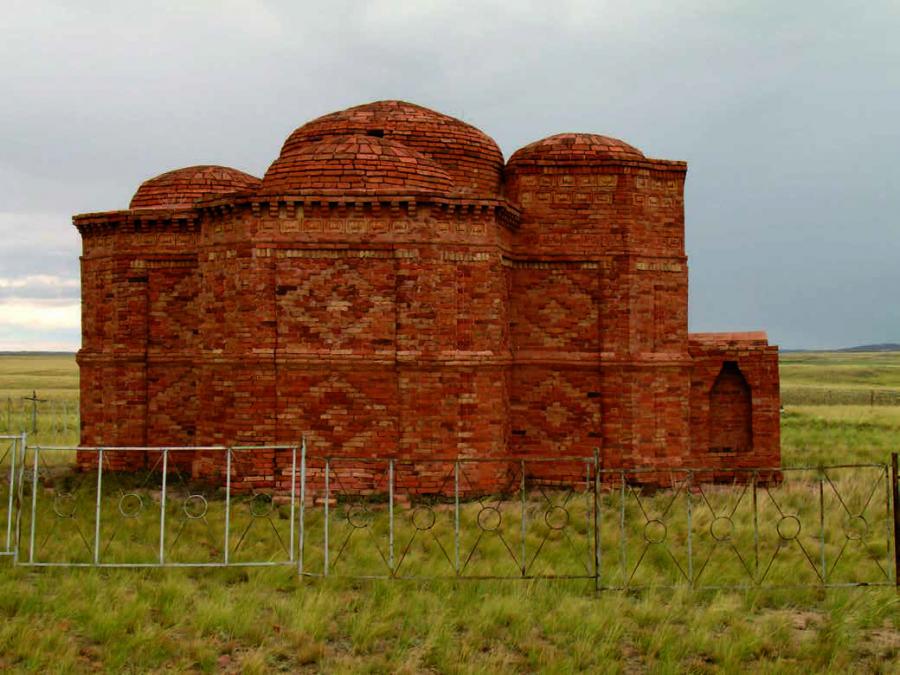
The monument is a very rare type of multi-dome mausoleums in Central Kazakhstan. The cruciform layout of the building as a whole brings it closer to the raw and stone mazars of the same plan, well known in the region (mazars of Zhamantay khan, sultans Tulek, Asan, etc.). The height of the building, its monumentality, domes, appearance create a solemn look of the whole building, erected with some imitation of medieval mausoleums of Zhoshy khan, Alasha khan and others. The entrance is made from the east side of the building in the form of a small annex, which is very typical for many mazars of the XIX century in Central Kazakhstan. Outside on the wall there is an Arabic inscription, read by A.Z. Beisenov. According to this inscription, made in the ancient style of "kadym", the mausoleum was erected in 1911 by the administrator Adikarim Zhanadiluly. According to the stylistic peculiarities of the inscription, it can be assumed that it is applied by a master who owns the local tradition of Arabic script. Therefore, it is very close to inscriptions on numerous kulpytases (koktas) of Central Kazakhstan. Thus, the mausoleum is a monument built in the local traditions of cult architecture of Central Kazakhstan.
In 1974, the monument was examined by the Central Kazakhstan expedition of the Ministry of Culture of the Kazakh SSR, which included M.A. Mamanbayev, M.K. Sembi, M.S. Nurkabayev. The five-domed mausoleum has a cruciform shape and is made of mud brick with dense exterior cladding of burnt brick. On facades there are the diamond-shaped ornaments executed from bricks of light and dark tones. The materials of the expedition of the Ministry of Culture show the dimensions of the building: 9.75×8.25 m. According to the data of the expedition of the Karagandy Regional Center for Protection of Historical and Cultural Heritage, the height of the central dome is 5.2 m, the thickness of the walls is about 0.7 m.
The monument, which is one of the unique objects of historical and cultural heritage on the territory of the Ulytau reserve, is intensively visited by pilgrims and numerous tourists. It is included in the list of monuments of national importance.