Information
- Location
- Kostanay Region, Sarykol District
- Period
- 1904 – 0
- Type
- Mausoleum
- Kind
- Buildings of monumental art
Sources
- Қазақстанның киелі орындарының географиясы: Табиғат, археология, этнография және діни сәулет өнері нысандарының тізілімі / Жалпы редакциясын басқарған ҚР ҰҒА академигі Байтанаев Б.Ә. – Алматы: Ә.Х. Марғұлан атындағы Археология институты, 2017. – 1-шығарылым. – 904 б.
Description
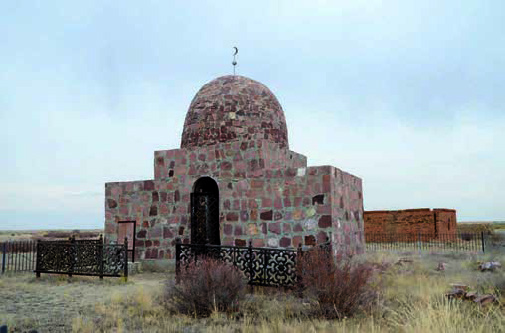
Located near the facilities of Yekidin in the Sarytorgay rural district. The mausoleum of the legendary folk hero Zhauke Batyr towers among the old burials in the steppe. This man is known for his military exploits.
Zhauke Batyr comes from the Torgay land. As a Batyr and a defender, he spent most of his life in campaigns and battles, in the saddle, as a true steppe warrior. Zhauke Batyr was seriously wounded far from his homeland, but was taken to his native places, where he found his last refuge.
Zhauke Nazargululy (1822-1904) - Kazakh Batyr, commander, one of the leaders of the armed resistance against the colonial policy of the Russian Empire. He was a descendant of the Argyn tribe of the Middle Zhuz of the Tolek clan. Batyr was born on the territory of the modern Amangeldy district of Kostanay region. Zhauke Batyr grew up in a family where men's character and military honor were brought up. His childhood took place at a time when the Kazakh land was gradually colonized, uprisings broke out and the resistance movement intensified. At a young age in 1838, Zhauke Batyr joined khan Kenesary Kasymov. Especially Batyr distinguished himself in the capture of the Akmola fortress, which was first entered by soldiers led by him. Thanks to Zhauke's persistence in 1842, Kenesary came out with an army on the bank of the Torgay River. Later here was moved the headquarters of Kenesary khan.
Zhauke Batyr fought with the troops of Sultan Akhmet Zhanturin, who was on the side of Russia and suffered a defeat in the battle (1844). Batyr died on the battlefield in the campaigns of Khan Kenesary far from his native places. The name of the historical hero is found in the trilogy novel "Nomads" by Ilyas Esenberlin, in the poem "The Raven" by Nurkhan Akhmetbekov. The name of Zhauke Batyr is also mentioned in the research of the famous Kazakh historian Yermukhan Bekmakhanov "The National Liberation Movement of the Kazakh People under the leadership of Kenesary Kasymov".
In October 1994, in the village of Sarytorgay, where the Batyr was born, fellow countrymen celebrated his 175th anniversary. In honor of their famous ancestor, the descendants installed a sculptural memorial structure in the form of a stylized military helmet on the hill. It is visible from afar, it serves as a reminder to travelers of the brave defender-batyr. Not far from the mazar there is a mosque built in the late XIX century by one of the sons of Zhauke Batyr. It served to perform prayers and rituals for believers, as well as a school for aul youth. There was a madrassa at the mosque, where Kazakh children were taught Arabic letters and the basics of Islam.
The sacred significance of the grave of the burial of Kazakh Batyr is the belief that Kazakh people as a single ethnos is preserved forever. In the village of Amangeldy, a monument to Batyrs Iman, Zhauke and Koshkar was erected. One of the streets in the district center of Amangeldy is named after him.