Information
- Location
- Almaty District, Panfilov District
- Period
- 1892 – 1895
- Category
- Historical and cultural monuments of republican significance
- Type
- Mosque
- Kind
- Monuments of urban planning and architecture
Sources
- Қазақстанның киелі орындарының географиясы: Табиғат, археология, этнография және діни сәулет өнері нысандарының тізілімі / Жалпы редакциясын басқарған ҚР ҰҒА академигі Байтанаев Б.Ә. – Алматы: Ә.Х. Марғұлан атындағы Археология институты, 2017. – 1-шығарылым. – 904 б.
Description
In 1887, at a meeting of the Muslim community in Zharkent, a proposal was received from the merchant of the first guild, Wali Akhun Yuldashev, to build a new mosque. He also made the first contribution and organized the collection of donations from Muslims. The chief architect in charge of the construction and decoration of the facade and interior of the mosque was the Chinese master Hong Pike (Mukan), who was assisted in the construction of the mosque by Uighur folk masters Hasan Imanov, Ushurbaki, Tair Ismailov, Nasretdin Kary, Zainutdin, Abdukadyr and others. According to the legend, the Chinese architect accepted the proposal of Wali Yuldashev completely free of charge, as he had long dreamed of building a Muslim mosque in the Chinese style, but in China, the local authorities did not authorize the construction.
In 1892-1895, a mosque and the main portal entrance with a tower were built in Zharkent, then in 1903-1905 a small mosque, a madrassah and a fence were built. The powerful earthquake of 1910 in Zharkent (magnitude of tremors 8.2 on the Richter scale) led to significant destruction. Both decorative towers collapsed, the tops of the domes fell down, through cracks were formed in the domes, etc. During the Soviet era, the mosque building was used for various purposes: there were warehouses, granaries, and barracks for border guards, and then a cinema and teahouse.
After the inspection of the mosque by a special commission in 1948-1949, the complex was given the status of an architectural monument under the protection of the state. In 1965, Panfilov (now Zharkent) covered a powerful hurricane, but the museum complex was practically not damaged. In 1969, as part of a comprehensive inspection of the mosque, engineering communications and the condition of construction structures and decoration were studied. In 1975-1978, restoration works were undertaken at the Panfilov Mosque, after which a proposal to establish a museum was made. The Architectural and Art Museum in Panfilov was opened in accordance with the decree of the Council of Ministers of the Kazakh SSR dated March 24, 1978, signed by the Chairman of the Council of Ministers M.B. Ashimov. Already in the period of independence in 2001-2004 the roof and the main portal of the mosque were reconstructed.
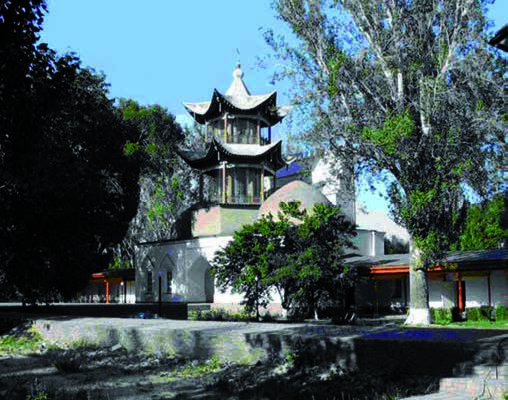
The " Zharkent Mosque " museum complex is represented by the following constructions: a mosque, the main entrance - a portal with a tower, Zharkent small mosque, madrassah, side entrance gate, stone fence, on the northeast side there is a small courtyard. The total area of the mosque is 28×54 m, its height is 14.5 m, and the height of the minaret is 19 m. The mosque was built in the architectural style of Central Asia, but with the use of elements of a Buddhist temple. The minaret is surrounded by 52 columns. The mosque complex is fenced with a stone fence 2.3 m high. The gates are installed on the southern and northern sides.
During the construction of the museum complex, local materials were used mainly: the Tian Shan spruce was used for the construction of a mosque, columns, a tower and a tower of the main entrance-portal, raw brick - for madrassah, burnt brick - for the erection of the portal and the adjoining three-dome room, fence, tin - for the roof. According to information, at fastening of wooden components of a cult construction nails were not applied. The trunks of the Tien Shan spruce, which served as the main building material, were cut down in the Aksu and Ketmen mountains, dried and processed on sawmills in Zharkent. To ensure the stability of the mosque building, a dense stylobate of compacted soil was created, and several oxen teams were used to install massive columns.
The influence of Chinese architectural traditions finds expression in the design of the soaring roof, which has curved upwards ends of the slope, making the building elegant and airy. The mosque consists of two floors. Cylindrical columns without capitals and with a large cornice (52 in total) form a gallery encircling the building; 122 wooden columns are fastened by a system of beams and nozzles, forming the frame of the mosque building. The peculiarity of the mosque is the abundance of decoration (wood carvings, polychrome paintings in saturated colors), enlivening the surface of arches and walls of the main hall of the mosque for faithful Muslims, the entablature. The interior ornament is dominated by floral motifs, Arabic ligature, elements of Uighur ornament, but there are images of birds, fish, animals, including fantastic ones.
Sacredness of the object is conditioned by the fact that the Zharkent mosque is a famous monument of Muslim religion and architecture of Zhetysu, as well as a unique monument of wooden architecture of the end of XIX - beginning of XX centuries. It is one of the best examples of cult architecture of Kazakhstan, the construction of which was carried out for the first time in the construction practice of Zhetysu. Since 1982 the mosque has been under the protection of the state as a monument of architecture and history of republican importance. The object of pilgrimage and religious tourism. In the courtyard of the museum complex grows an ancient tree of giant size, which has also become a place of pilgrimage tourism.
Sources
Жаркент мешіті // Жетісу. Энциклопедия. – Алматы: Арыс, 2004. – 703 с. ‑ С. 296.
Лухтанов А. Город Верный и Семиреченская область: справочник. – Алматы: [б. и.], 2009 . – 220 с.
Петровский А. Чудо-мечеть в казахстанском Жаркенте. Китайский архитектор Хон Пик превзошел самого себя (страницы истории). URL: http: // www. centrasia. ru/newsA.php?st=1108449420.
Постановление Совета Министров Казахской ССР от 26 января 1982 года № 38 «О памятниках истории и культуры Казахской ССР республиканского значения».