Information
- Location
- West Kazakhstan Region, Kaztalovka District
- Period
- 1301 – 1400
- Type
- City
- Kind
- Archaeological sites
- Authors
- Марыксин Денис Валерьевич
Sources
- Қазақстанның киелі орындарының географиясы: Табиғат, археология, этнография және діни сәулет өнері нысандарының тізілімі / Жалпы редакциясын басқарған ҚР ҰҒА академигі Байтанаев Б.Ә. – Алматы: Ә.Х. Марғұлан атындағы Археология институты, 2017. – 1-шығарылым. – 904 б.
Description
The monument is located on the border of Kaztalov and Zhangala districts of West Kazakhstan region. Among new archeological finds of the last years there will be many discoveries of such scale as Zhalpaktal Golden Horde settlement discovered in 2009 (expedition of the West Kazakhstan regional center of history and archeology under the direction of D.V. Maryksin). It is located in the Volga-Ural interfluve, in the drainage-free basin of the Big and Small Uzen rivers. Its area reaches 68 hectares. In the central part of the hillfort the remains of buildings are fixed in the form of large hills up to 2 m high and up to 50 m in diameter, and on the rest of the hillfort there are several tens of smaller hills.
Despite the small size of the monument and the lack of information about it in written sources, it is possible to do nothing who's making assumptions. As it is known, the territory of modern Kazakhstan was divided by sons of Genghis Khan into several uluses. One of the most influential was the ulus, known in historical sources as the ulus of Dzhuchi/Zhoshy, or Golden Horde, the center of which was the Lower Volga region. This region, and also the Volga-Ural interfluve were the khan's domain which east border was the river Ural. The question of the presence of the Kipchak Khanate settlement in the interfluve between the Big and Small Uzen has been raised for a long time. In particular, P.S. Pallas , who visited the area in the XVIII century, wrote that "between the two rivers of the Uzen are quite memorable traces of ancient waterways, which are the most common in the big Uzen ... in a great number are carried out ... From the multitude of such ditches and quite a few barrows and some ancient remnants of dwellings it is clear that the Uzen in previous times, quite a strong ... people had their own homes ..." [Cit. by: Pallas, 1788; 2006]. As it is known, the Volga-Ural interfluve was a domain of the Golden Horde khans and should have been sufficiently developed. Confirmation of it is presence of a considerable quantity of Golden Horde necropolises in an area of hillfort Zhalpaktal.
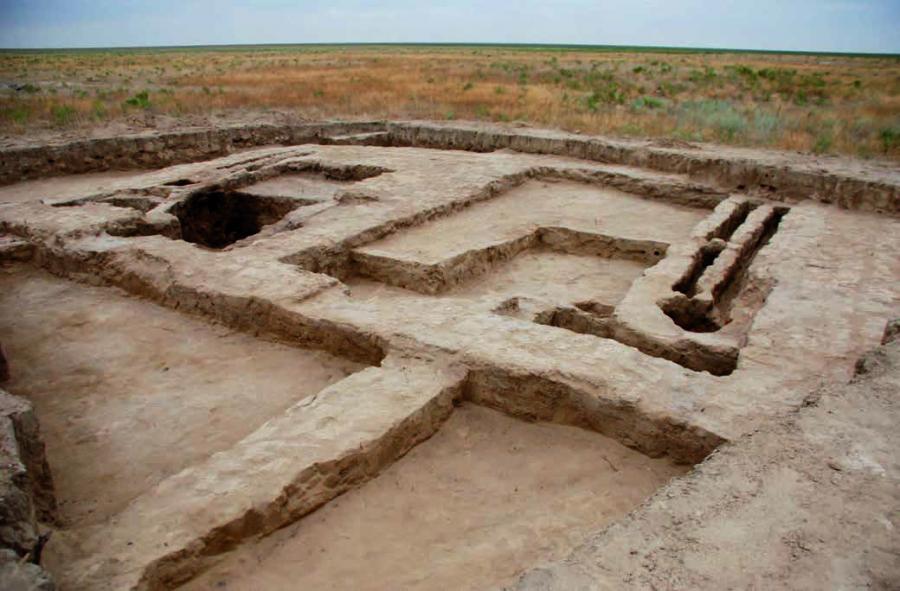
Two residential estates were found at the monument, and they are based on a one-room house, almost the entire area of which is occupied by a sufa with a two-channel cans inside. All excavated premises have no foundation, but are located in a layer resembling a plough. The fundamental method of laying is a characteristic feature in the traditions of Golden Horde construction. V.L. Egorov considers this construction method to be "a characteristic feature of Mongolian architecture, dating back to the nomadic way of life...". [Egorov, 1970].
One of the most interesting artifacts found on the hillfort is fragments of carved terracotta. A total of 159 fragments have been discovered, 68 of which are still ornamented. Analysis of the carving technique and the tools used shows that the work was performed by at least two masters of different skill levels. Among them was an experienced clay carver, as evidenced by the solid, confident carving lines on a large number of fragments found. It could also be a carver with experience of working with ganchas from neighbouring areas of the hillfort under study. At the same time, the found fragments have an ornament, the pattern of which is not cut out confidently, as evidenced by the traces of uneven pressing of the tool on the mud clay in a single line. It is also possible that a master ceramist was also involved in the production of the carved terracotta: on several terracotta fragments there is an ornament, often found on the ceramics - a few parallel, adjacent lines. According to the technique and style of carving and analogies with clay carving from the monuments of Central Asia, fragments of carved terracotta from the hillfort of Zhalpaktal can be dated to the second half of the of Zhalpaktal can be dated to the second half of the XIII century.
In 2013, three coins were found on the surface of the hillfort: silver dung, Dzhalaad-Din Mahmud, Dzhanibek/Zhanibek khan, Gulistan minting, by the type of 752 AH (1351-1352); copper coin, Zhanibek khan, Saray al-Jedid minting, 1340s, the reverse depicts a double-headed eagle; copper pool of Uzbek khan, Saray minting, 1330s. A mosque with the size of 12×13 m was found on the hillfort. Its walls are built in two bricks. It has two stoves. The central part of the southern wall is composed of vertically placed bricks, which, when cleared, were found to be 0.9 m wide mihrab. The mosque has been preserved to a height of 1 m. The entrance to the mosque is made in the northeast corner. Inside the mosque had a cover. On the east side of the mosque there is a minaret of 2.84 x 4.3 m attached to it. The width of the minaret walls is 1.2 m. It has two entrances - from the mosque and from the street. The most interesting is the excavation, which revealed a large manor house consisting of several rooms. The earliest of them are three residential dugouts, which also have sufas and canyons in their interior. The dugouts are a fairly common type of dwellings of the Golden Horde. According to several authors, they were inhabited by lower class residents. The area of the dugouts could be up to 20 m2. Their depth reached 2-2.5 m. The entrance was a dromos or ramp.
The uniqueness of this hillfort is the following. Firstly, a monument of settled culture was found in the region, which until recently was considered a territory of nomadic cattle breeding. Secondly, the only rural-type mosque in Golden Horde was found. Third, a monument was found consisting of several construction periods, the earliest of which was represented by semi-subterranean dwellings.
The special sacral meaning of the hillfort of Zhalpaktal is connected with a large number of burial necropolises around it, one of which dates back to the XIX - beginning of the XX centuries. This is explained by the fact that among the population living here the area is revered as a special, sacred, ancestral.