Information
- Location
- Түркістан облысы, Kazygurt District
- Period
- 1450 – 1850
- Category
- Historical and cultural monuments of republican significance
- Type
- Mausoleum
- Kind
- Buildings of monumental art
- Authors
- Ёлгин Юрий Андреевич
Sources
- Қазақстанның киелі орындарының географиясы: Табиғат, археология, этнография және діни сәулет өнері нысандарының тізілімі / Жалпы редакциясын басқарған ҚР ҰҒА академигі Байтанаев Б.Ә. – Алматы: Ә.Х. Марғұлан атындағы Археология институты, 2017. – 1-шығарылым. – 904 б.
Description
Brief reports about Ismail ata are contradictory even in the group of sources having close origin. It is difficult to build a single hagiographic canvas of Ismail ata's biography on them. In the legends and tales of the historical and cultural area around Sairam and Shymkent, and in the "Treatise on the Saints Madinat al-Bayd and Ispidzhab" (end of the XVII - beginning of the XVIII century) Ismail ata is called the son of Dervish ata, a Sufi saint of the XII century, a native of Sairam (Zh.M. Tulibayev). In earlier sources he was named son of Ibrahim ata (Ibrahim-sufi), son of Abd al-Jalilil-Baba, younger brother of Iskhak-baba (A.A. Divayev, A.K. Muminov, Devin DeWeese). Ismail ata died in the beginning of the XIV century. According to the "Treatise on the saints ..." he is buried as if in Sairam, and his tombstone is located "in the east side" from the mausoleum of Abdel-Aziz-Bab (Zh.M. Tulibayev). According to earlier sources, Ismail ata "is buried in the city, which is now called Terbat (i.e. Turbat. - Aut.) halfway between Sairam and Tashkent" [quoted from DeWeese, 2000]. This version seems to be more reliable, because it was in Turbat that the cult of his veneration was formed and a monumental mausoleum was built. Both groups of sources are united in the fact that the Sufi line of Ismail ata's life description connects his spiritual continuity with Khoja Ahmed Yasawi through Muhammad Danishmand and he is a prominent Sufi from the Hanafi family. Later on, this Sufi basis was overlaid with relict folk ideas about the forces of nature and remnants of the cult of fertility, which turned the Sufi into a patron saint of cattle breeders and shepherds. The mausoleum is located in the northern part of the complex. According to legend, it was built in the XIV century by order of Timur. The assumption of Timur's origin of the mausoleum is not groundless. Turbat was located on a mountain road that coincided in the Middle Ages with the caravan route from Shash to Ispidzhab. Tashkent was a gathering point of troops and a stopover point for Timur in 1361, 1363-1367, 1397 (visiting Yasy-Turkestan). Turbat could have attracted Timur's attention.
Ismail ata mausoleum in its main part (the volume of the building, the portal and the base of the covering) finds analogies in the memorial architecture of Tashkent in the XV-XIX centuries, which is due to the territorial proximity of Turbat and Tashkent and the general line of development of architecture.
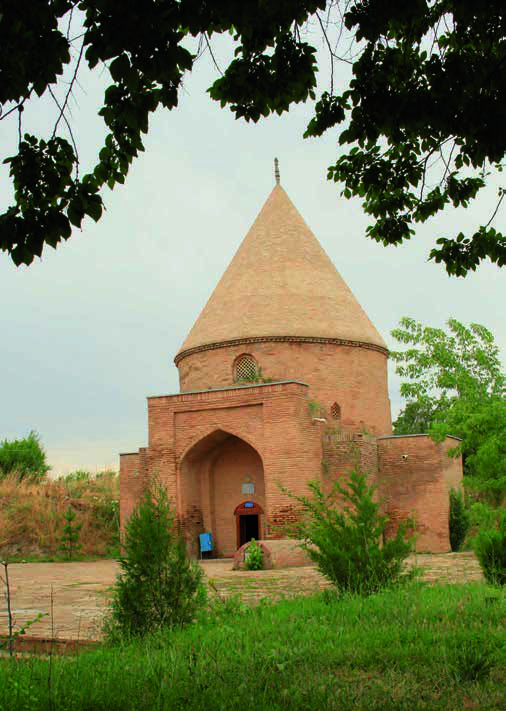
It is the semantic and compositional core of the whole complex. It is constructed of square brick on lime-ganche mortar. Portal-dome single-chamber mausoleum. Due to the side rooms with tombstone saganаs adjoining the main rectangular hall, it received a cruciform composition of the plan. Has a double dome - internal, spherical, octagonal, and external, - the faceted tent. The external dome leans on a drum cut in the bottom part, and a cylindrical drum - in the top part. The tent is ostensibly erected on the basis of oral evidences of local residents. However on the design drawings between internal and external domes wooden bulkheads and ribs of rigidity of the form testifying to spherical outlines have been shown.
The decoration of the facades is minimized - figured masonry in the form of a simple combination of bricks (angle, vertically, in the form of horizontal belts). In the portal's pinnacle wall in the 1980s one could see the remains of epigraphy on the wooden jumper of the doorway with the date of repairs (1878-1879). The interior was plastered and kept traces of epigraphy and geometric ornaments until the late 1980s.
Architectural monument of republican importance. Since 1982 it has been protected by the state. The object of pilgrimage and religious tourism.