Information
- Location
- Түркістан облысы, Kazygurt District
- Period
- 1350 – 1900
- Type
- Сomplex
- Kind
- Ensembles and complexes
- Authors
- Ёлгин Юрий Андреевич
Sources
- Қазақстанның киелі орындарының географиясы: Табиғат, археология, этнография және діни сәулет өнері нысандарының тізілімі / Жалпы редакциясын басқарған ҚР ҰҒА академигі Байтанаев Б.Ә. – Алматы: Ә.Х. Марғұлан атындағы Археология институты, 2017. – 1-шығарылым. – 904 б.
Description
Around it there is a functioning cemetery. Archaic burials on it suggest its ancient origin. It is possible that Turbat (old names Hoziyan/Khuzien/Guziyan, Sanjab, Yagma), the name of which means ashes, the grave [of saint] (Arab, Persian), even before the burial there of Ismail ata possessed sacral content associated with pre-Islamic cults. Natural objects near Turbat, which is located in a picturesque place near the northern slopes of the Karzhantau ridge, were perceived as sacred and worthy of worship.
The sacred history of the complex is based on local legends and few information about Ismail ata in the "Treatise on Saints Madinat al-Bayda and Ispijab" (the end of the XVII - beginning of the XVIII century). Another source is the Alid genealogies of Kazakh Khojas leading from Muhammad ibn Ali al-Khanafia, the third son of Imam and righteous caliph Ali, which are described in different editions of "Nasab-name" and other works.
The cult of Ismail ata gave rise to the formation of the sacral and architectural complex of the same name. It has a pronounced syncretic character. Sufi traditions, practices and rituals are imposed on the pre-Muslim beliefs with their deification of natural forces and objects.
The pre-Islamic origins of the Ismail ata complex are reflected in local folklore, which is partly reflected in later written sources. According to a stable legend, Ismail ata, as in the official Alid genealogy, comes from the genus of Khanafia. He lived together with the Kazakhs in the area of Khoziyan (Guziyan) on the western side of the big mountain Kosmola. During the attack of enemies (one version - Kypchaks, the other - Kalmaks) his father Ibrahim ata, mother and elder brother were killed, and 20-year-old Ismail was taken prisoner, where he spent 20 years. He guarded and passed the cattle. Legends show the Sufi component, because Ismail ata had spent a lot of time in caves, dedicating himself to God and performing zikr. The sheep allegedly listened to him and imitated him. The cattle, which he passed, were surprisingly healthy and well nourished. As a result, Ismail ata acts as a patron saint of cattle breeders and a feast of local Kazakhs from the Kangly family. Synthesis of Sufism with local beliefs dating back to the ancient cults of fertility, was reflected in the structure and composition of the complex, which bears the name of Ismail ata.
The beginning of folklore and ethnographic study of the complex was laid by A.A. Divayev [1901]. After almost a century of oblivion, this line of research was continued in publications on folk Islam in Southern Kazakhstan and in connection with the study of written sources and the Alid genealogy of Kazakh Khojas (R.M. Mustafina, M. Mirkhalzhdarov, Zh.M. Tulibaeva, A.K. Muminov, Devin DeeWeese, etc.). In 1981-1983 he was examined in the course of certification of architectural monuments by the expedition of the Kazprojectrestoration Institute of the Ministry of Culture of the Kazakh SSR. The complex is included in the Code of Historical and Cultural Monuments of Kazakhstan (B.T. Tuyakbayeva, A.N. Proskurin). At the same time, the first repair and restoration activities were carried out. In the first half of the 1990s was examined by archaeologists of the Institute of "Kazprojectrestoration" (A.O. Itenov, E.Kh. Khorosh). By the beginning of the 2000s the restoration works were mainly completed and the territory of the complex was landscaped.
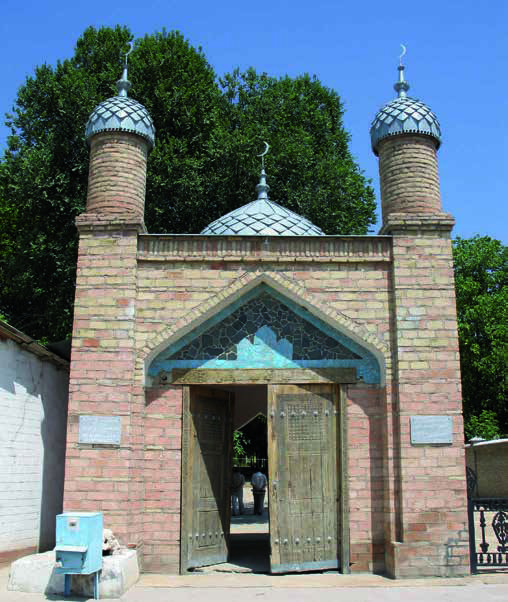
The complex includes: Ismail ata mausoleum, Koshkar ata mausoleum, chillyakhana, taaratkhana, Zhabrail ata mausoleum, mosque, entrance gate (darvazakhana), farm buildings.
Mausoleums of Ismail ata, Koshkar ata, chillakhana and taaratkhana form a courtyard, which is adjoined by the northern wall of the mosque. From the east to the Ismail ata mausoleum adjoin the remains of an extended structure, presumably former madrassa. This main courtyard flows into the second, formed by the mosque and the mausoleum of Zhabrail ata. The whole complex was built of burnt brick on lime and ganche mortar, without foundations and external plasters. The complex was formed on the basis of the free planning method, in which a great role was played by the relief of the terrain, a picturesque landscape. Unexpected angles of the buildings as a whole enrich the perception of the complex.
In the complex a prominent place is occupied by the building, which is called "chillyakhana" (XV-XIX centuries). The construction was probably covered by a double spherical-conical dome (internal on the octagon, external - on the 16-faceted drum). Chillyakhana - are secluded, most often underground structures. Their construction was similar to graves. This corresponded to the Yasawi ritual of chilla - "to kill the flesh for a while and let the soul rise to God". Architecturally, the chillyakhana in Turbat stands in the same row as the mausoleums, no different from them. Functionally, it also has little resemblance to a place of solitude for fasting. It is possible that the building was originally intended for other purposes. Taaratkhana (second half of the XIX century) has no independent meaning. The room was formed due to the continuous repair wall, which united the yard facades of the mausoleum of Koshkar ata and chillyakhana.It is a portal-dome structure with arched openings on four sides (chortak, four-arch kiosk). The street facade is decorated in the form of a flat lancet arch, which has a wide opening with a double-leaf door. The carved ornament of the doorway has a date: 1886-1887.
Architectural monument of republican importance. Since 1982 it has been protected by the state. The object of pilgrimage and religious tourism.