Information
- Location
- Маңғыстау облысы, Tupkaragan District
- Period
- 400 BCE – 101 BCE
- Type
- Ritual complex
- Kind
- Archaeological sites
- Authors
- Астафьев Андрей Евгеньевич, Ақан Онғар
Sources
- Қазақстанның киелі орындарының географиясы: Табиғат, археология, этнография және діни сәулет өнері нысандарының тізілімі / Жалпы редакциясын басқарған ҚР ҰҒА академигі Байтанаев Б.Ә. – Алматы: Ә.Х. Марғұлан атындағы Археология институты, 2017. – 1-шығарылым. – 904 б.
Description
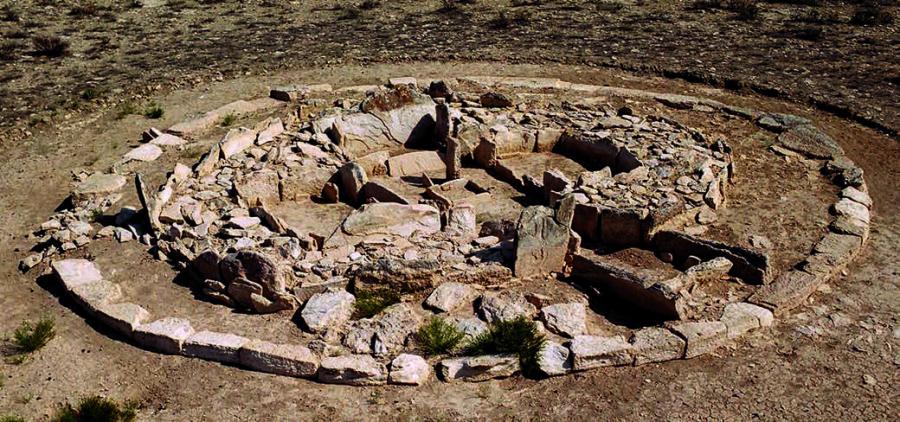
It is located 2-3 km northeast of the Tubezhik well (Tupkaragan district, Mangystau region). It is located at the eastern end of the rocky ridge, which rises above the surrounding landscape by 3 m.
It consists of two sanctuaries of medium size (initial diameter 9.6-10 m, height 1-2.5 m), round in shape. These places were considered sacred for a certain kind of social groups. Here, in a certain season of the year, sacrifices were made to the heroic ancestor, ancestors of families or clans, the Sun was revered. The cult of heroized ancestors is often associated with the cult of dying and resurrecting nature, implementing the idea of eternal renewal, revival, cyclicality of time.
Sanctuary Tubezhik-1. The inner room has the form of a cross, consists of three side compartments and a central "hall". The powerful stone base of the interior is strengthened by a ground-stone cushion with a retaining facing wall. The entrance to the premises is located from the south in the form of a 2.7 m long Dromos corridor. The walls of the corridor are formed by large vertically buried slabs, protruding above the floor level by 40-50 cm. The corridor from the south is bounded by a transverse vertical plate. The space between the slab and the masonry is wrapped in soil and small stone. In the center of the room an altar was found, in the filling of which at the floor level two ribs of a ram (?) of poor preservation and fragments of the upper part of a small stucco vessel were found. The fact that the remains of destroyed graves are in the premises, as well as the presence of low partitions in the openings between the central "hall" and the side compartments, may have a secondary sign.
The Tubezhik-2 sanctuary has also remained virtually at the foundation level. It consists of an inner room marked by a powerful stone foundation, which, in turn, is reinforced by a ground-stone cushion with a retaining facing wall. The size of the interior space is 3.9×4 m. In the southern sector, the wall of the room has a gap of 0.7 m wide, which forms an entrance to a short dead-end corridor of the dromostic type. The long axis of the corridor is oriented north-south with a slight deviation to the east. The dromose-type entrance to the interior is likely to have been a vertical well shaft from a wide retaining wall area. The bottom of the well shaft was combined with an entrance corridor, possibly with an arch-type overlap.
Two fragments of a stone anthropomorphic statue were found in the southern sector of the excavation near the masonry of the facing wall. In the south-southeast sector, 2.8 m from the facing wall of the structure, a stucco vessel was found at the level of the mainland horizon, mounted upside down. Presumably, a stone sculpture with a sacrificial altar and a stone bowl on it was installed in the round hall of the Tubezhik-2 construction. Judging by the remains found, the statue was broken into three parts in ancient times and thrown out through the manhole. Later, its ruins were filled with stone blocks of collapsed walls and sand. It is for this reason that this amazing creation of human hands in good condition has reached us.
Inside the building, it seems, several stages of improvement are fixed. Multistage involves the use of the building for a long period of time and, most likely, by different ethnic groups. The construction of the entire building should still be linked to the beginning of the IV century BC (based on the type of weapon depicted on the statue). The date of the last use of the building, on the basis of the arrowheads of the inlet burial site, should be determined by the average Sarmatian time. A vessel with four ears, found outside the building, is comparable to late Sarmatian time.
Monument of archeology of local importance. Sacred cult object of the early nomadic epoch, which has preserved evidence of a developed religious and mythological system, the existing ideas about the structure of the universe and the place of man in it. The established ideology and system of values were reflected in the ancient sanctuary and rites held there. It is an object of tourism.