Information
- Location
- Ақтөбе облысы, Mugalzhar District
- Period
- 35000 BCE – 10000 BCE
- Category
- Historical and cultural monuments of local significance
- Type
- Petroglyph
- Kind
- Archaeological sites
- Authors
- Мамиров Талгат Базарбаевич
Sources
- Қазақстанның киелі орындарының географиясы: Табиғат, археология, этнография және діни сәулет өнері нысандарының тізілімі / Жалпы редакциясын басқарған ҚР ҰҒА академигі Байтанаев Б.Ә. – Алматы: Ә.Х. Марғұлан атындағы Археология институты, 2017. – 1-шығарылым. – 904 б.
Description
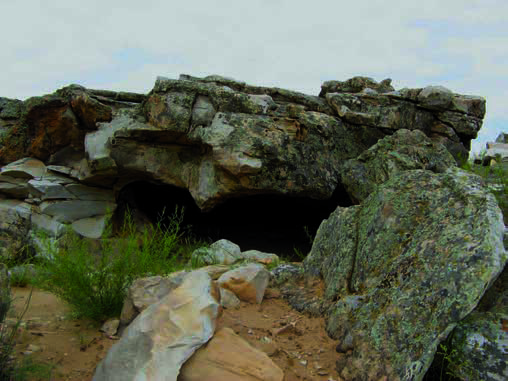
Monument of rock art. Petroglyphs of the Stone Age are located in the rocky exits of Mugalzhar near the field camp Toleubulak, 13 km north-east of Bulakty village (Mugalzhar district, Aktobe region).
The sacred meaning of petroglyphs in the grotto Toleubulak is that it is the oldest sanctuary in Kazakhstan with rock images. As a result of aeolian activity, small grottoes were formed on the rocky remains of siliceous sandstone, which ancient people used as natural sacred places for drawing.
The main idea of the grotto's petroglyphs is connected with the cult of fertility, which originated in the Paleolithic period and has been preserved for a long time. Difficult living conditions, lack of a constant source of food, low birth rate and longevity, high mortality among human populations in the Stone Age led to an increase in the importance of the cult associated with the continuation of the genus. Petroglyphs in the grotto belong to abstract images and symbolize the unity of male and female origins. In a natural shelter, having placed on planes solar symbols, leaving in bowl-shaped hollows of sacrifice, ancient people could send a cult of fertility and a life-giving moisture.
The monument consists of several objects, the central of which was originally named Emba-1 Grotto. It is located in the western part of the remains, about 20 m2 in size, and the entrance to the grotto is located on the southern side.
On the rock surface of the inclined floor there are archaic images of carved technique, less often with grinding, forming three groups. The first, upper group is represented by carved lines of parallel and sub-parallel type, as well as depressions in the form of small holes. The second, middle group consists of oval unclosed figures with two lines passing through the figure - phallic signs. The third, lower group is represented by cup-shaped recesses (up to a depth of 6 cm and a diameter of 25 cm). All three groups, including holes, carved lines and signs, are synchronous.
400 m north of Emba-1 Grotto is the small Emba-2 Grotto. There are also no animal and anthropomorphic images and linear-geometric figures and bowl-shaped depressions prevail here. Petroglyphs of the Emba-2 grotto are compositionally the same as those of the Emba-1 grotto.
On the northern slope of this rocky ridge, 100 m west of the Emba-2 grotto, on a separate block there are several figures (a camel, a horse, anthropomorphic images), applied by punching and belonging to a later time.
Similar images in the form of cup-shaped depressions and carved lines were seen by researchers in the materials of the Stone Grave Grotto in the North Azov region, which date from the Mesolithic to the early Iron Age, and the second - Eneolithic.
The monument itself dates no later than the Neolithic Era, but it is also possible to date it back to the Late Paleolithic period, judging by the numerous finds of Late Paleolithic stone objects dotting the surroundings of the Toleubulak Grotto (Emba-1).
At present, the Toleubulak Grotto is an archeological monument of regional importance and an object of domestic tourism.