Information
- Location
- Karaganda Region, Ulytau District
- Period
- 800 BCE – 1300
- Type
- Petroglyph
- Kind
- Archaeological sites
- Authors
- Байтілеу Дархан Айтжанұлы
Sources
- Қазақстанның киелі орындарының географиясы: Табиғат, археология, этнография және діни сәулет өнері нысандарының тізілімі / Жалпы редакциясын басқарған ҚР ҰҒА академигі Байтанаев Б.Ә. – Алматы: Ә.Х. Марғұлан атындағы Археология институты, 2017. – 1-шығарылым. – 904 б.
Description
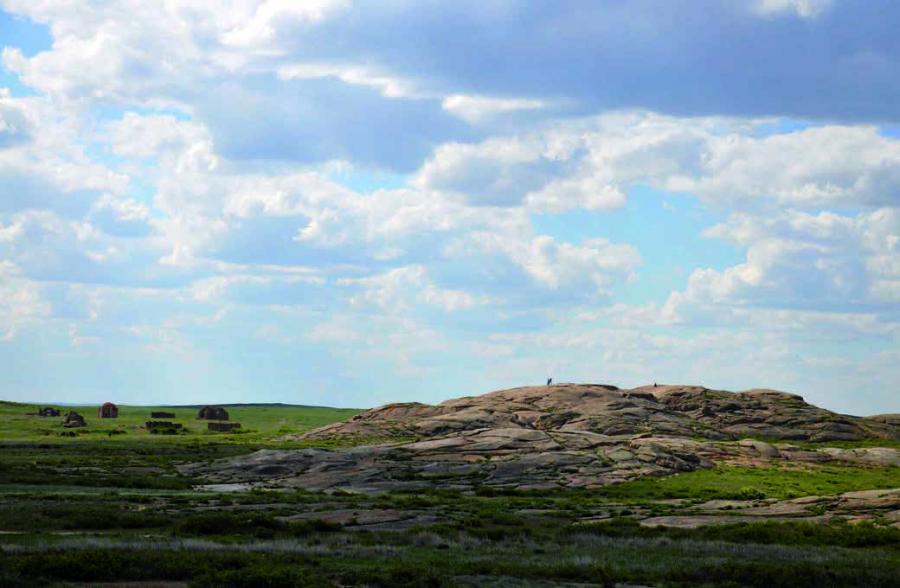
The rock art monument is located 90 km east of Zhezkazgan and 20 km northwest of Terekti station (Ulytau district, Karagandy region). Rock paintings are the main component of the archaeological complex Terekti Aulie. In addition to rock paintings, the Neolithic site, the remains of the settlement in the form of residential pits and gravestones of the Bronze Age, the early Iron Age, and the fencing of the ancient Turkic era have been discovered here. Close to the rocky exits of Terekti Aulie there are cult and memorial complexes of ethnographic time with original architectural appearance. These are mausoleums and mazars of the Naiman clans - baganaly and baltaly, built of mud brick.
The earliest mention of Terekti Aulie probably dates back to the medieval times. We can assume that the first mention of Terekti Aulie petroglyphs is found in several Arab researchers of the IX-XI centuries.
The images of the human foot found in the area of the Ulytau mountains are told from al-Idrisi, al-Biruni and Ishak ibn al-Husayn, who probably borrowed the text from al-Jahaini. In the description of the drawings, the named Arab researchers have described the locations of rock paintings, which resemble the location of the petroglyphs of Terekti Aulie.
Opening and beginning of scientific study of Terekti Aulie is necessary to connect with works of the Central-Kazakhstan archeological expedition in the given region in 1946. Brief information about Terekti Aulie petroglyphs is available in works of A.Kh. Margulan. In 1996 the complex researches on the monument under the direction of Zh. Kurmankulov were started. Petroglyph research was continued by Z. Samashev with some breaks in the following years and completed in 2013.
Rock images are located on two main and several intermediate planes of differently-sized folded relief elements, which represent separate massifs, preserved from destruction, forming a small ridge, fringed by a flat steppe. The nozzles on which the drawings are drawn are flat-headed remains that stretch along the west-east axis. The main mass of rock images is localized on the southern and southwestern slopes of the rocky areas.
Petroglyphs of Terekti Aulie characterize a continuous line of development in the visual activities of the population of the region for three chronological periods from the Bronze Age to the ancient Turkic time inclusive.
The vast majority of petroglyphs belong to the Bronze Age. It is quite possible that in the Bronze Age, due to the special natural and landscape conditions, microclimate and images of animals and symbolic signs carved by ancient artists on the surfaces of granite slabs, which were revered in society, this area became a kind of temple - an open-air sanctuary.
In the repertoire of Terekti Aulie petroglyphs the image of the horse dominates, making up almost 90% of all zoomorphic images. The image of the horse is found both alone and as part of multi-figure compositions, organized on a circular basis. Often in the middle of such compositions there are circles with holes, which suggests their connection with mythopoetic views and solar-space (or sacrificial) orientation of the subjects depicted here.
Pictures of horses on Terekti Aulie are characterized by a special stability of stylistic features, which allow to compare them closely with the figures (and protomes) of these animals on the tops of knives and daggers, as well as stone wands, included by researchers in the circle of monuments of the "Seiminsko-Turbinsky phenomenon". Images of horse hooves, recorded in the first group, may be associated with partial magic or mythological path of the sacrificial animal. Single anthropomorphic images of Terekti Aulie petroglyphs are significantly supplemented by symbols in the form of a human foot, which in some mythologies is endowed with an increased degree of sacral-magical significance. Bactrian and bull figures are also included in the composition of multifigure circular compositions. The symbols of horse chariot and the figures of tarantulas deer belonging to the transition period from the Bronze Age to the Early Saka period are depicted separately.
Features of the coarse-grained grey granite predetermined the development of the bronze age artists of the combined technique of drawing - the knockout of the animal figure according to the planned sketch and further careful polishing of the image. Occasionally, ancient masters polished the entire surface of the plane on which the application of drawings and the creation of subject compositions was supposed to take place. In the early Iron Age and in the ancient Turkic time, the artists did not practically use the technique of grinding.
Petroglyphs of Terekti Aulie are the object of tourism.