Information
- Location
- Zhambyl Region, Talas District
- Period
- 901 – 1400
- Category
- Historical and cultural monuments of republican significance
- Type
- Mausoleum
- Kind
- Monuments of urban planning and architecture
- Authors
- Чулакова Найля Пангереевна
Sources
- Қазақстанның киелі орындарының географиясы: Табиғат, археология, этнография және діни сәулет өнері нысандарының тізілімі / Жалпы редакциясын басқарған ҚР ҰҒА академигі Байтанаев Б.Ә. – Алматы: Ә.Х. Марғұлан атындағы Археология институты, 2017. – 1-шығарылым. – 904 б.
Description
The monument is located on the southeastern outskirts of Taraz, bordering the spur of the Western Tien Shan, on the rocky hill of Tekturmas on the right bank of the Talas River. The etymology of the toponymy, meaning "hidden place", "restless place" is not accidental - it refers to mystical phenomena and legends associated with the special energy of the area, formed by specific elements of the landscape - mountains, rivers, caves, which in ancient religious systems were endowed with sacred meaning. As a rule, cult complexes were generated in such places, connected with the deification of the ancestors' spirit.
The formation of the necropolis of Taraz, one of the oldest cities in Kazakhstan, began as early as the VI century, when the city became the capital of the state of Turgesh, and later of Karluks and Karakhanids. In the 40s of the last century, G.I. Pacevich discovered the largest cemetery of Zoroastrian followers in Central Asia (VI-IX centuries) on the slopes of the hills, as evidenced by the burials in the ossuaries, located in isolated niches, galleries and khums carved in the thick rocks. There are also tombs of the first Christians - Nestorians, possibly Buddhists and early Muslim burials. The necropolis was visited by locals and travelers along the caravan road, one of the branches of the Great Silk Road, which passed near the cult place, as evidenced by the fragments of the stone arched bridge of the XIII century, located at the foot.
In the XIV century on the edge of the mountain range, abruptly breaking off to the river, was erected kumbez (dome). According to legend, it was built over the grave of Sultan Mahmud Khan (Tekturmas-ata), who made a significant contribution to the spread of Islam in the region and was considered a saint by the local population. Photographs from the 1880s convey the extraordinary refinement of the architectural and artistic design of the dome central mausoleum - a kiosk standing on a high platform of limestone, which is a rare technique. Vertical segmentation on the cut corners, lancet arches along the axes of facades, identical to Gothic techniques in Western European architecture of the same period, gave the building expression and aspiration upwards. Later, a dense dome volume was added to the south side. The complex was completed by a later portal-dome construction. By the beginning of the XX century the monument was an ensemble of three adjoining structures, attracting numerous researchers of the region in different years: The region was visited by V.A. Kallaur, A. Divayev, G.I. Pacevich, L.I. Rempel, A.N. Bernstam, T.N. Senigova and others.
Having stood for several centuries, the monument was destroyed twice in less than 100 years. For the first time the mausoleum was damaged during the capture of Aulie-Ata by the tsarist troops in 1864, during the Kokandians' shelling of the river crossing near the hill, where Zachuisky detachment under the command of M. Chernyaev stood. His notes contain information "about the grave of a saint named Tek-Turmas, from which these heights were named" [quoted: Russian Turkestan, 1872]. In 1935, the mausoleum was dismantled into bricks for construction purposes. At the same time, local residents built a small building near the tomb of the saint, continuing to perform the rite of worship - ziyarat.
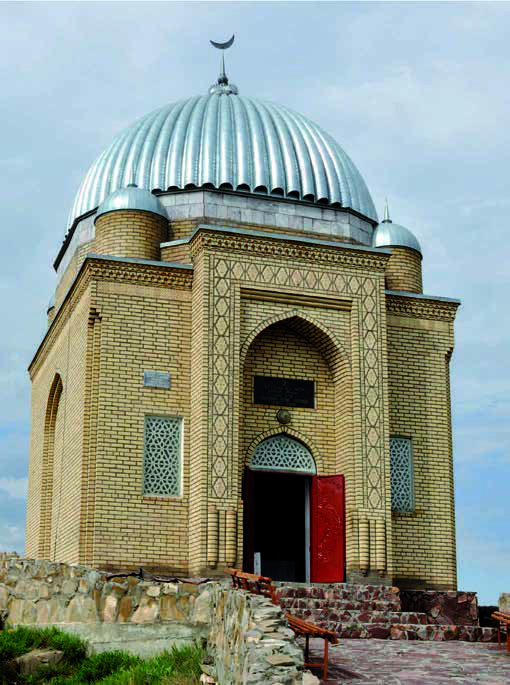
In 2001, by the 2,000th anniversary of Taraz, a tomb was erected on the site of the destroyed mazaar on the project of A. Itenov as part of an individual interpretation of the previous construction, while yielding significantly to it in the expressiveness of the facade plastics. The cubic volume (dimensions in the plan 8×8 m), mounted on a stone base, is crowned by a central corrugated dome with four small towers adjoining the octagonal drum. The entrance to the mausoleum is decorated in the form of a lancet portal with a rectangular frame, decorated with figured tiles and rectangular window apertures, taken away, as well as the internal vault of the entrance arch, by the panjar grid. The side facades enliven the blind lancet niches. The building is surrounded by stalactite cornice.
The road paved with limestone to the monument, laid on the ridge of the hill itself, passes through a kind of "propylaea" - the arches of the mazar of Mambet Batyr, companion and general of Abylai Khan, a participant in the wars with dzungars. His son - the famous Baizak Batyr - is one of the leaders of uprisings against the Kokandians, his name associated with the construction of irrigation canals in the vicinity of Taraz.
It is an architectural monument of republican importance. The object of international pilgrimage and religious tourism.