Information
- Location
- West Kazakhstan Region, Zhangaqala District
- Period
- 1836 – 1838
- Type
- Historical landscape
- Kind
- Buildings of monumental art
- Authors
- Сдыков Мұрат Наурызғалиұлы
Sources
- Қазақстанның киелі орындарының географиясы: Табиғат, археология, этнография және діни сәулет өнері нысандарының тізілімі / Жалпы редакциясын басқарған ҚР ҰҒА академигі Байтанаев Б.Ә. – Алматы: Ә.Х. Марғұлан атындағы Археология институты, 2017. – 1-шығарылым. – 904 б.
Description
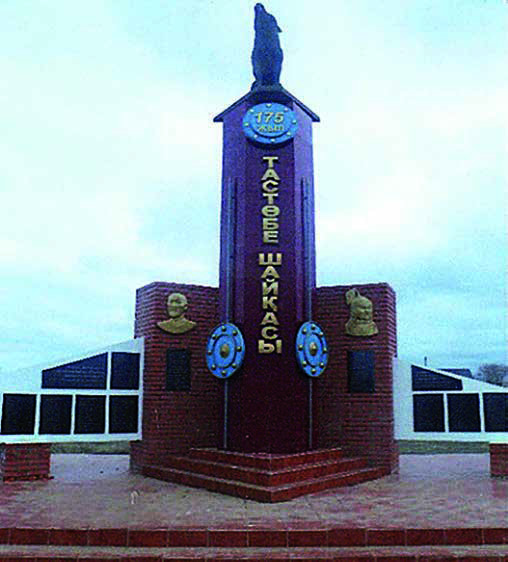
The monument was erected on November 18, 2013 in Zhangala district of the West Kazakhstan region in connection with the history of the national liberation uprising led by Isatai Taimanov and Makhambet Utemisov.
In 1836-1838, one of the largest anti-colonial and anti-feudal popular uprisings took place in the Bokey Khanate. The driving forces were ordinary cattlemen. A number of elders also stood under the banner of the rebels. The people's uprising was led by Isatai Taimanuly (1791-1838) and Mahambet Utemisuly (1804-1846). Both leaders came from the Berisch family, the Zhaik branch.
Isatai Taimanuly was born in 1791. In 1808, during the famine on the left bank of the Urals in search of a better share the Isatai family was forced to migrate to the Inner Horde. At the age of 21, he was appointed petty officer of the Zhaik clan and enjoyed great respect and authority among his fellow tribesmen. The closest associate of I. Taimanuly was the poet Mahambet Utemisuly. He spoke Tatar and Russian. For some time he lived in Orenburg. Mahambet Utemisuly was familiar with the famous Russian writer and ethnographer V.I. Dahl, who served in these years as an official on special assignments under the Orenburg governor-general. Close relations were also maintained by the poet Makhambet with the traveling scientist G.S. Karelin, who served at different times in the Inner Horde and Orenburg. His pen is the subject of flaming lines directed against the representative of the tsarist administration Sultan Baimagambet and his entourage.
One of the famous events was the fierce battle that took place on November 15, 1837 between the rebels and the punitive groups in Tastobe. The presence of selected horses and a good knowledge of the terrain ensured the success of the rebels in the first half of the battle. However, after the largest crowd of people had been fired from several guns, the rebels were forced to retreat. Dozens of people died in the pursuit of the retreat, and significant numbers of cattle were slaughtered from the rebels. After the defeat at Tastobe, the rebels dispersed in small groups through the Inner Horde. Their forces were significantly weakened and their morale was somewhat broken. Punishers have concentrated all forces on capture of the leader of revolt: for his head it has been promised 500 rubles silver, and for capture - 1000.
The decisive battle between the rebels and the punishers took place on July 12, 1838 near the rivers Kiyl and Akbulak. In the course of the battle, the leader of the rebels, Isatai Taimanuly, was killed. The rebel groups were forced to retreat and disperse in the steppe. Punitive action was taken against the insurgents. Some 80 people were killed by the rebels in the battle. After the death of Isatai Taimanuly, the movement has gone down. The rest of the detachments operated near the Lower Uralsk line - along the river Uil.
Mahambet Utemisuly was forced to hide for some time. Later he started to agitate among the Kazakhs against the Khan Zhangir and the Tsarist administration. In 1846, in one of the clashes with the people of Sultan Ruler Baymukhammed Aishuakuly, he was traitorously murdered.
The uprising led by Isatai Taimanuly and Mahambet Utemisuly was of great historical importance. It had a folk, national-liberation character. The construction of the monument is timed to the 175th anniversary of the Battle of Tastobe. The obelisk depicts the images of Mahambet and Isatai, two daggers, as well as wolves, symbolizing bravery and courage. The monument bears the names of all those who took part in this battle.