Information
- Location
- East Kazakhstan Region, Zaysan District
- Period
- 800 BCE – 601 BCE
- Category
- Historical and cultural monuments of republican significance
- Type
- Necropolis
- Kind
- Archaeological sites
Sources
- Қазақстанның киелі орындарының географиясы: Табиғат, археология, этнография және діни сәулет өнері нысандарының тізілімі / Жалпы редакциясын басқарған ҚР ҰҒА академигі Байтанаев Б.Ә. – Алматы: Ә.Х. Марғұлан атындағы Археология институты, 2017. – 1-шығарылым. – 904 б.
Description
Early Saka barrows of Shilikty (Chilikty) are located in a valley surrounded by Tarbagatay, Sauyr, Manyrak ridges; 100 km south of Lake Zaisan (Zaisan district, East Kazakhstan region). Spacious picturesque valley stretches for 80 km in length and 30 km in width. The area is characterized by favorable conditions for the nomad: warm and light snowy winter, cool summer.
At the beginning of the last century, the monuments of the Shilikty Valley were examined by the hydraulic engineer from Semipalatinsk G.N. Bokiy. The systematic study of barrows began in the middle - second half of the XX century. The East Kazakhstan expedition of the Leningrad Branch of the Institute of History, Archaeology and Ethnography of the Academy of Sciences of the USSR under the leadership of S.S. Chernikov carried out archeological reconnaissance and then excavations of the barrow No. 7 with the participation of employees of the Central Museum of Kazakhstan and the Institute of History, Archaeology and Ethnography of the Academy of Sciences of the Kazakh SSR in 1949. In 1960 the barrows No. 3, 4, 5 were investigated; in the early 1970s - No. 35, 2a, 10. In total - 13 barrows. Archeological researches of monuments of Shilikty have been renewed in 2003 by archeological expedition of KazNU named after Al-Farabi under the direction of A.T.Toleubaev by excavations of separate burial mounds of Shilikty-1, 2, 3.
To date, more than 200 barrows from the early nomadic era have been discovered in the valley, including those belonging to the "royal" and elitist ones - 100 m in diameter and 8-10 m high. According to A.T. Toleubayev's calculations, there are about 50 of them. About 120 barrows of the early nomads' time are concentrated in the center of the valley, on the area of about 1 km in width and about 6 km in length. In the micro-district, including the valley and foothills, monuments of different periods of nomadic culture were found: settlements and burial grounds, rock images and stone sculptures from the Bronze Age to the late Middle Ages.
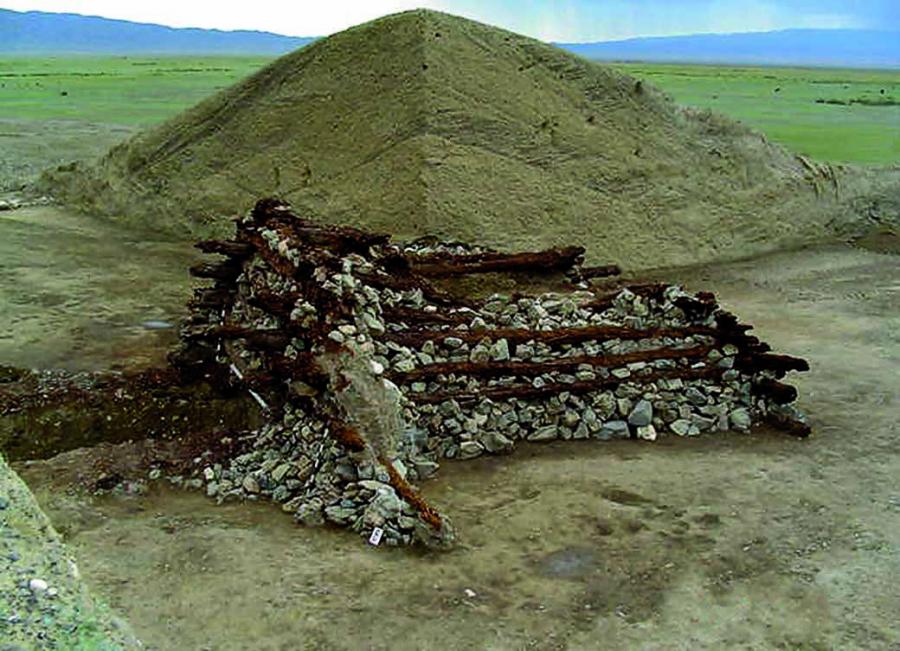
Kurgan No. 5, which materials gained the most popularity, was studied in 1960. (diameter 66 m, height - 6 m). In addition to the design features revealed in the burial, despite the fact that it was looted in ancient times, amazing ancient nomadic samples of gold articles made in the traditions of the Scythian-Siberian "animal style" - 535 gold objects were found. Among them are plaques in the form of deer with bent legs, decorated the quiver, contour figures of eagles with their heads turned backwards, cat predators curled up in a ring, figures of wild boars and fish carved from foil, decorated with inserts of turquoise and grain, plaques in the form of a bird with outstretched wings, etc. With the remains of quiver 13 bronze early Saka arrowheads were revealed. The barrow itself was a rectangular construction of larch logs with gaps between them filled with stone. The structure was 4.80×4.60 m in size and 1.20 m high and was buried in the ground by 1 m. On the east side was the dromos, the whole structure was covered with layers of stone; dense clay, fine pebbles. On the base of the barrow was fenced with a ring of three rows of large stone.
Barrow No. 1 of Shilikty-2 (Baigetobe) is distinguished by its size - diameter 77×71 m, height over 6 m. As a result of the excavations it was revealed that the basis of the funeral structure was a sarcophagus in the form of a truncated pyramid. Traditionally, for the monuments of Shilikty it is built of logs with stone on a platform of broken clay and turf. On the eastern side, which is typical for early Saka barrows, there was a dromos covered with wood. Another narrow passageway was found on the southeast side. Dromos on the east side was also found in barrow No. 36 of group Shilikty-1. A well-treated stone stele 2.8 m high was found in the Baigetobe barrow. In the barrow, which had been looted since ancient times, 15 fragments of painted strips depicting fallow deer in red, brown, yellow and greenish colours were found. In the burial, 4,303 pieces of gold were discovered - the elements of the decor of a person buried here. Among them there are 153 cast gold plaques with heraldic composition in the form of two heads of mountain goats with a bird in the middle; 36 plaques in the form of a predatory bird; 39 plaques in the form of a wolf (bear); gold cast plaques in the form of argali in the position "on tiptoe" with inlaid eyes, ears, nostrils, hooves; 20 deer profile plaques with bent legs; one five-pointed star button; 23 bell-like decorations; 63 tubular arrow rifled decorations; 223 miniature tubular beads; 743 circular beads, etc.
The number of barrows in the Shilikty-1 group is 64. The investigated barrow No. 36 (height 4.53 m, diameter 113×115 m) is located between the villages of Shilikty and Tasbastau. To the east of the barrow, a dromos was stretched. The barrow was surrounded by a fence made of stones placed on a rib and a moat 3.5-4 m wide. The ground structure of the barrow is multi-layered: pebble, sandy soil, earthen ground, turf structure. At a depth of more than 3 m a stele was found in the composition of the turf structure. Its height is 1.20 m. At the base of the structure was a horseshoe-shaped earthen shaft, built of loamy, densely compacted soil. Open to the east, it surrounded the grave pit and the dromos. Inside the earthen berm there is a stone fence made up of medium sized stones laid flat. Large stones were used in the construction and decoration of the tomb pit and dromos. Archaeologists have also identified the remains of a log roll over the grave pit. The dromos has dimensions corresponding to the barrow's dimensions: length 15 m, width 5.20 m.
The dating of the barrow No. 5, studied by S.S. Chernikov, falls within one framework - the VIII-VII centuries BC.
Barrow No. 1 Shilikty-2 (Baigetobe) is dated to the 7th century B.C. by A.Z. Beisenov and K.V. Chugunov (first half of the VII century B.C.). On the basis of the art history analysis of the images of tauteke (wild goat) in the early Scythian monuments of the eastern part of the Eurasian belt of steppes the chronology of the image development was designed by Y. Polidovich. From this position, Baigetobe chronologically correlates with the Arzhan-2 barrow within the middle - second half of the VII century B.C. / middle of the VII century B.C.
Analyzing the objects of ancient nomadic art from the barrows of Shilikty, experts pay attention to their heterogeneity, which is explained by the specific for the early Saka time mixed character of artistic culture. The analysis of such a mixture of different stylistic and iconographic methods contributes to the further reconstruction of schemes of cultural contacts in the period of formation of Saka culture. Openings of archeologists of last years in territory of Saryarka and East Kazakhstan have allowed to put a question on close ethnocultural communications existing in the early Saka period between regions of Aral Sea region, Zhetysu, Central and East Kazakhstan, Southern Urals and Sayan-Altai. This assumption is based on fundamentally similar elements of the funeral rite and art objects, showing common stylistic solutions and iconographic schemes of images, reflecting the commonality of outlook and aesthetic views. So, it is possible to assume that the horseshoe-shaped shaft at the base of the burial mound No. 36 of the Shilikty - I burial ground to some extent duplicates or expresses an idea similar to the "moustache" of the Tasmola barrows.
The results of the analysis of the composition of Shilikty products showed that the items are made of high-grade gold. Plaques in the form of fish, ibex and griffin from burial mound No. 7 of the Shilikty burial ground showed the content (% mass): Au - 93.2-95.1; plaque in the form of argali from burial mound 1 of the Shilikty-2 burial ground (% mass): Au - 94.5. The value of the Shilikty barrows, of course, is not gold as such. The huge informative capacity of materials allows to approach to the decision of questions of existence of historical and cultural community of early nomads of steppe and mountainous valley of Eurasia, including process of addition. The analysis of Shilikty's materials allowed M.K.Kadyrbaev in 1966 to express an assumption that the time of the early Saka culture formation is the middle of the VIII century BC, and the Begazy-Dandybay stage is the pre-Saka period.
The concentration of funerary and memorial structures, especially large ones, which require huge expenses of material and human resources, organization and coordination of works, marks the valley as a sacred place for contemporaries. Experts have singled out a number of features on which monuments can be attributed to the category of elitist, Shilikty burial mounds in principle correspond to the following: the monumentality and complexity of gravestone structures, the complexity of the intra-burial structure, the accompanying sacrificial burial of people and animals, a significant subject complex, including prestigious things, gold products.
It was during this period that the tradition of sacralization of the ruler of nomadic society in Central Asia was born. Here were buried those who achieved their position thanks to military valor, courage and military luck. Acting as a guarantor of harmony in life, well-being of the living, the leader, as a person sacred, continued to maintain its importance after death. Obviously, graves of ancestors, leaders and especially soldiers were sacred objects, cult. Here the cycle of funeral and memorial rites was performed. The place of the graves of the ancestors in the nomadic culture is evidenced by the answer of the Scythian king, Idanfirs Darius, given in the work of Herodotus: "...I will explain to you why I am not in a hurry to fight with you: we do not have any cities or cultivated land. We are not afraid of their devastation and desolation, so we did not fight immediately. If you want to fight with us at all costs, we have the graves of our ancestors. Find them, try to destroy them, then you will know whether we will fight with you because of these graves or not!..". The Shilikty barrows, which share common features with the early Saka complexes of Besshatyr (Zhetysu), may have served as "Herroses" for a certain group of people.