Information
- Location
- Түркістан облысы, Sayram District
- Period
- 1701 – 1900
- Category
- Historical and cultural monuments of republican significance
- Type
- Сomplex
- Kind
- Buildings of monumental art
Sources
- Қазақстанның киелі орындарының географиясы: Табиғат, археология, этнография және діни сәулет өнері нысандарының тізілімі / Жалпы редакциясын басқарған ҚР ҰҒА академигі Байтанаев Б.Ә. – Алматы: Ә.Х. Марғұлан атындағы Археология институты, 2017. – 1-шығарылым. – 904 б.
Description
In the "Treatise on the Saints Madinat al-Bayda and Ispijab" (end of the XVII - beginning of the XVIII centuries) the location of the mosque is marked as "east of the tomb of Sheikh Attar Uali". This is the southeastern part of the historical center of Sairam.
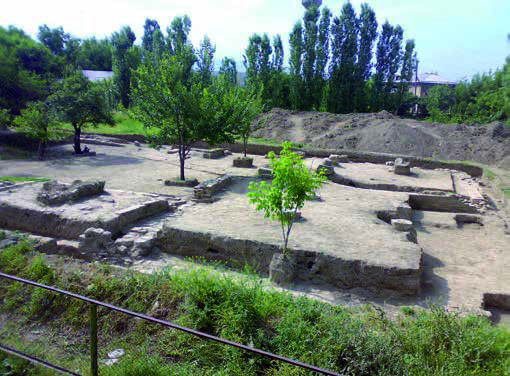
The minaret and archeological remains of the Khyzyr-Paigambar mosque are located 200 m from the intersection of the main highways of the city, east of the southern gate (Bazardarwaza), in a fenced area planted with trees. The minaret denotes an agiotoponic name that occupies an important place in the legendary and sacral history of Sairam (Ispijab). It is the only preserved object on the surface of the earth that was part of a small historical, cultural and religious complex, united in a mosque named after the pre-Islamic prophet Khyzyr-Paigambar. Together with the un-preserved Idris-Paigambar Mosque, it heads a number of monuments and sacral places of Sairam connected with the Biblical and Koranic tradition. Involvement in the cult of Khyzyr gave the late in architecture ordinary minaret an exceptional sacral dignity that has survived to this day.
The cult of Khyzyr (al-Khidr, Khizr, Khyzr, Khydyr, Kadr, etc.) is formed on the basis of the general Muslim book tradition, traditions of different peoples and local folklore. In Muslim agiology it is an extremely important and significant character. In the Koran, he is present as a nameless companion of Musa (Moses) - "a slave of Our slaves" [Koran, 18, 64-65]. Legend has given him the name of Hadir. It is among the pre-Islamic and pre-flooded prophets. The descendant of Sam, son of Nuh (Noah), lived in the time of Ibrahim (Abraham). He was a teacher and a wise companion of the prophets Musa and Muhammad. Described as a good-looking old man in a green robe and turban. His cult is of pre-Muslim origin. In legends, he is a righteous man, to whom eternal life is bestowed. It is perceived as a symbol of eternal and constant renewal of nature. In Islamic tradition, he is one of the "eternal" - Ilias (Elijah), Idris (Enoch) and Issa (Jesus). Often associated with Ilias and Idris. The image of Khyzyr is spread all over the Muslim world, everywhere has its peculiarities. He absorbed the features of different mythological characters of the Muslim East. Legends of Khyzyr are found where Sufism is common. In this regard, Sairam, where traces of Sufi practices and rituals are still found, was the breeding ground for the creation of the local cult of Khyzyr, which was fixed in the construction of a mosque with a minaret.
According to legend, Khyzyr-Paigambar has been hiding in the underground construction of this mosque (chillakhana) for 60 years in his solitude in fasting and prayer. In this connection, he is considered the patron saint of the hermit Sufis. Sairam legends and tales, reflected in the anonymous history of Sairam ("Risalya", "Sairamshahri", "Treatise on Sairam"), have local differences from the generally accepted mythological canvas. Common is that in this case legends about Khyzyr are intertwined with legends about Iskandar Zulkarnain (Alexander the Great), where Khyzyr is a vizier of Iskandar, a friend of Iskandar, a wise man, indicating the way in the "country of darkness" [Kaskabasov, 1990]. These relations emphasize the special role of Khyzyr in the legendary and sacral history of Sairam. Having conquered Sairam, Iskandar accepted Khyzyr as one of the most worthy, appointed him as the ruler of the city and ostensibly put all his army at his disposal. There is a legendary version that Khyzyr was born and lived in Sairam (Devin DeeWeese). Later legends and genealogies also mention that many saints of Sairam met with Khyzyr, talked to him, sought his advice.
He studied in the complex with the mosque Khyzyr-Paigambar, first described by A.K. Gaines (1866), then the renewed building was examined by M.E. Masson (1925). At the same time, the minaret of the mosque was not reflected, because at that time the buildings of the XVIII-XIX centuries were not considered to be outstanding monuments of architecture. In 1963, by order of the Chimkent Regional Museum, an architectural measurement of the preserved part of the minaret trunk was made (T. Podnebesnaya). In 1981-1983 it was examined in the course of certification of architectural monuments by the expedition of the Kazprojectrestoration Institute of the Ministry of Culture of the Kazakh SSR. The minaret is included in the Code of Historical and Cultural Monuments of Kazakhstan. In the protective zone of Khyzyr minaret episodic archeological works were carried out: 1970s (N.P. Podushkin), 1989 (A.O. Itenov), in 2004 and 2007 (B.A. Baitanayev).
There are no reliable data on the original building of the Khyzyr-Paigambar Mosque. Archaeological research in 2004 and 2007 revealed that the mosque in the late stages of its existence (XVIII-XIX centuries) was a multifunctional cult building such as the khanaka mosques, which included, in addition to the prayer hall in the center (winter mosque), an open courtyard, iwan, hujras, underground construction of the chilliakhana, two-stage dakhma-type tombstones, etc. The minaret, which was located 3 meters from the southeast corner of the mosque, was the high-rise dominant feature of the complex. In 1948 it was partially destroyed by an earthquake (the lantern was lost). The separate cylindrical minaret (diameter at the base is 2.96 m, height is about 10 m) is made of burnt brick on clay mortar. The lantern is a rotunda formed by eight high semicircular windows-arches, covered by a spherical dome. It is separated from the trunk by a belt of dandana. A spiral staircase of high brick steps leads up inside. The rectangular entrance with a wooden cofferdam is arranged from the east side.
The mosque and minaret of Khyzyr-Paigambar is an architectural monument of republican importance. Since 1982 it has been protected by the state. The object of pilgrimage and religious tourism.