Information
- Location
- Маңғыстау облысы, Mangystau District
- Period
- 901 – 1200
- Type
- City
- Kind
- Archaeological sites
- Authors
- Воякин Дмитрий Алексеевич
Sources
- Қазақстанның киелі орындарының географиясы: Табиғат, археология, этнография және діни сәулет өнері нысандарының тізілімі / Жалпы редакциясын басқарған ҚР ҰҒА академигі Байтанаев Б.Ә. – Алматы: Ә.Х. Марғұлан атындағы Археология институты, 2017. – 1-шығарылым. – 904 б.
Description
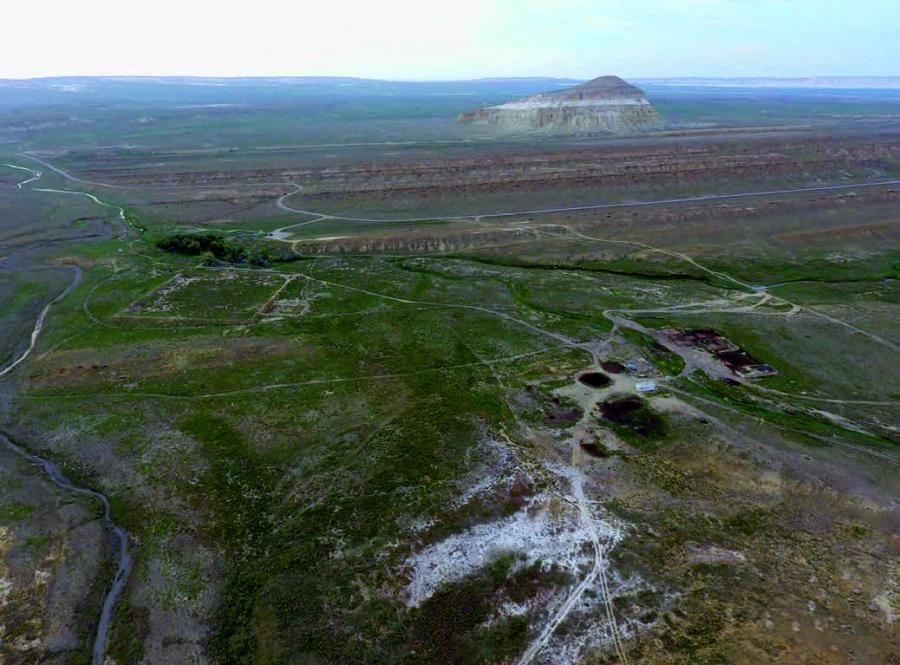
The monument is located 18 km northeast of the district center of Shetpe village (Mangystau district, Mangystau region). The city was founded in the picturesque area of Akmysh, near the legendary mountain Sherkala. The hillfort dates back to the end of the X-XVII century.
The town was founded on the northern branch of the Silk Road as a trade center - caravanserai. Kyzylkala did not exist for long. Despite the fact that the intensive life here fades away in the first half of the XIII century, there is evidence of the presence of cultural layers of the XVII century in the hillfort.
Important in the formation of the concept of Kyzylkala as a sacred object of the history of Kazakhstan is its possible conformity (which is reasonably proved by scientists) to the legendary medieval town of Mankashlag - a town belonging to the Kypchaks and Oguzes, which in the XI century was besieged by the troops of the Seljuk ruler Alp Arslan. Yaqut al-Khamavi, a Muslim scientist and writer of the XIII century, writes: "Mankashlag is an impregnable fortress at the end of Khorezm, it is (situated) between Khorezm, Saksin and the country of Russians, near the sea into which Jeyhun falls, and this is the sea of Tabaristan". It is also noteworthy that it is in this area that part of the Khazars goes after the defeat of the capital of Khazaria - Itil by the troops of Svyatoslav in the X century.
The medieval hillfort of Kyzylkala is a sacral symbol of symbiosis of land and sea trade routes. Active Asian-European trade relations are not actually reflected in medieval chronicles up to the XVI century, and only such objects as Kyzylkala serve as a vivid confirmation of this. Findings of Baltic amber, Chinese nephrite, Indian and Egyptian glass, Badakhshan lazurite, Mediterranean corals, discovered during archaeological research of the hillfort of Kyzylkala, testify to the intensity of trade relations and the breadth of the geographical range of connections of this region of Kazakhstan.
The area of the hillfort is 50 hectares. The main territory of the hillfort stretches from north to south for 700 m with a width of 400 m. The hillfort consists of the remains of a fortress fortification, surrounded by numerous estates. The fortification can be clearly read along the high rampart (height up to 4 m) with the elements of massive shell-type masonry 1.9-2 m wide. In the middle part of the north-western wall there is a main gate. Structurally, they are formed by two towers at the ends of the walls with axial displacement, which determines the diagonal passage. Corner towers and two intermediate towers with a total of 13 towers can be read on the outer side of the walls of the fortress on the protruding elements of stone masonry. The towers protrude on the average by 0.6 m at the surface of the ramparts with a width of up to 5 m.
The rabad of the hillfort is well traced in places of mass distribution of lifting material - shards of clay pottery, fragments of plinths, fragments of animal bones and other finds, as well as in the foundations of buildings. Foundations (fully or fragmentarily) are determined by masonry at the level of the day surface or clusters of rubble stone. According to the plan drawn up in 2004, the foundations of more than 200 residential and household buildings were found, without taking into account the remnants of raw buildings that are not readable on the surface.
Kyzylkala hillfort is a monument of history and culture of the Republic of Kazakhstan of local importance, in addition, the object as one of the components of the serial transnational Silk Roads nomination is included in the preliminary list of the UNESCO World Cultural Heritage.