Information
- Location
- Түркістан облысы, Turkistan city
- Period
- 1301 – 1400
- Category
- Historical and cultural monuments of international significance
- Type
- Mausoleum
- Kind
- Buildings of monumental art
- Authors
- Смагулов Ерболат Акижанович
Sources
- Қазақстанның киелі орындарының географиясы: Табиғат, археология, этнография және діни сәулет өнері нысандарының тізілімі / Жалпы редакциясын басқарған ҚР ҰҒА академигі Байтанаев Б.Ә. – Алматы: Ә.Х. Марғұлан атындағы Археология институты, 2017. – 1-шығарылым. – 904 б.
Description
The city of Turkestan is notable for the fact that it houses the mausoleum/khanaka of Sufi Sheikh Khoja Ahmed Yasawi, who is widely known in the Turkic-Muslim world. Thanks to his talents and selfless way of life, Khoja Ahmed acquired many followers and as a result of missionary preaching he converted many Turkic tribes to Islam.
His father, Ibrahim ibn Mahmud ibn Iftikhar, was born in the town of Sayram in 1103. The mother of Ahmed Yasawi, Karashash-ana, was a strong and wise woman. The graves of Ahmed's father and mother are in the town of Sayram and are places of worship for believers. His first spiritual mentor and educator was the famous Sheikh Arslan Baba, who allegedly received the Amanat symbol of Islam (according to the mythology of Amanat is enclosed in the bone of persimmon) from the hands of the Prophet Muhammad. After 500 years, the grey legend says, Arslanbaba met an eleven-year-old boy as he drove along the steppe, who turned to him and said: "Aksakal, give me my Amanat. This boy was Ahmed Yasawi. Following his mentor Arslan-baba, he greedily began to take over his everyday and spiritual wisdom.
At that time, Ahmed Yasawi's native land was only establishing an Islamic religion, so after the death of his mentor, Khoja Ahmed moved to Bukhara, which Muslims around the world called the dome of Islam in the East. Here he found a worthy teacher in the person of the famous Sheikh Khoja Yusuf Hamadani. For several years, he was an exemplary disciple and learned well that unity with God can only be achieved through repentance, patience, sincerity and asceticism. Having reached a certain maturity, he became a full member of the Sufi order, occupying a stage of a dervish. He led the life of a beggarly stray ascetic, emphasizing the special meaning that gave Sufism to the teaching of voluntary poverty and to contentment with the little.
As time passed, Ahmed Yasawi became a mature Sufi, having passed all the stages of initiation, and received from the hands of the Sheikh "irshad" - a document for the right of independent preaching. But he was not only a religious figure, but also a great poet and philosopher. Khoja Ahmed's poems were very popular among the people.
After the death of Sheikh Yusuf Hamadani, he became the leader of the Bukhara Sufi order. Ahmed Yasawi approached his mission strictly, avoiding excesses, dressed in simple clothes and prayed even more. He demanded the same behavior from others and harshly condemned those sheikhs who profited from the parishioners and murids. In his "Risolai" he wrote: "He is the true sheikh, who, having received a gift, gives it to the worthy and poor. If he uses it for himself, it will be like falling, devoured by dogs".
According to historians, after the Koran, the works of Ahmed Yasawi were the most popular among Muslims, and what he said often reached the addressee. In his spiritual sermons, poems and treatises he called on people to be kind, taught to despise covetousness and greed, gave various worldly advice, discussed the immensity of wealth, called on people to be tolerant of people of other faiths and nationalities, and spoke in defense of justice.
After several years at the head of the Bukhara Sufi community, he soon parted with this honorary dignity, announcing that he must leave and take a vow of loneliness. Thus, he came to the provincial town of Yasy on the outskirts of the Islamic world by the highest will. A vision appeared to him, and the Highest Spirit said that he needed to leave the hustle and bustle of the world to serve God selflessly. According to another legend, Ahmed Yasawi did so as a sign of mourning for the Prophet Muhammad, who died at the age of 63, whom the poet considered his teacher and, having reached the same age, settled in an underground cell near the mosque and spent the rest of his life there. In the dungeon he developed his own system of communication with the Higher Spirit of Nature. In his prayers he withdrew from the outside of the rites and confessed the zikir, but did so quietly.
In his spiritual poems Ahmed Yasawi called on "Divanihikmat": "Leave His words, find Himself". We should not praise God, but accept His soul, penetrating into the very essence of spirituality. He wrote all the works, including poems, in the Turkic language. His poems were called "divine hikmats" by the people. Khoja Ahmed Yasawi is considered to be the second saint after Muhammad, and the city of Turkestan is considered to be the "Little Mecca".
He died here in 1166-1167, in the city of Yasy/Turkestan, where he spent the last years of his life, and a small, but exquisitely decorated mausoleum was erected over his burial. Naturally, the place of the Master's rest later became a place of mass pilgrimage and worship of Muslims. Thanks to the offerings of many pilgrims and locals, the tomb became rich and build-up. Soon here, in the cemetery of the town of Yasy, a cult center of the Sufi order of the Yasawites was formed. It was repeatedly looted, in particular during the attacks on Turkestan by Tokhtamysh, one of the khans of the Golden Horde. With a sword of retribution in 1395, Emir Timur crushed the power of the Golden Horde and in honor of this victory decided to build a new grandiose memorial complex on the site of the old mausoleum, which had come to the dilapidated state by that time.
The construction began immediately and was carried out at a fast pace. According to legend, Timur personally determined the main parameters of the project of the future mausoleum. But in February, 1405, preparing for a long time the planned grandiose campaign to China, Timur has died. With his death the construction was interrupted.
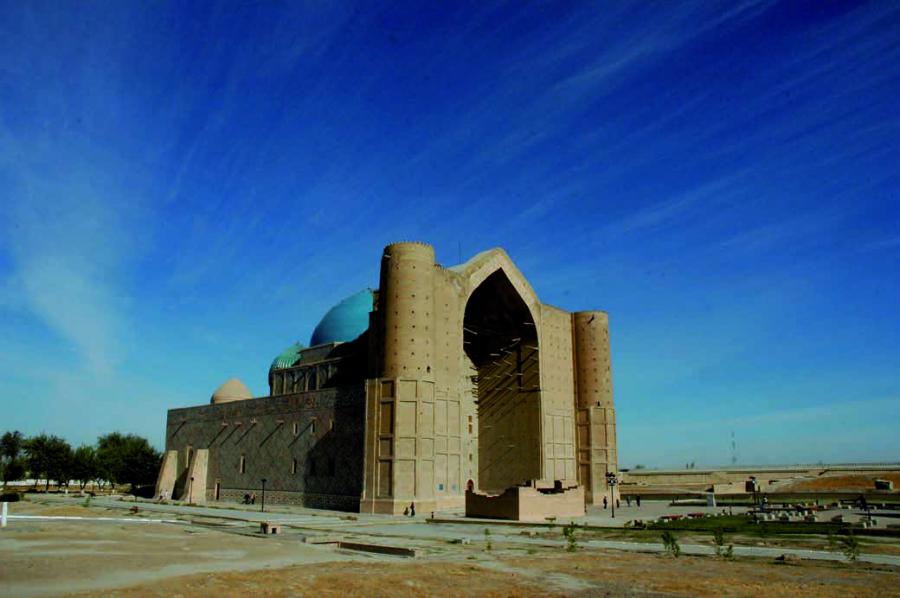
The Mausoleum of Khoja Ahmed Yasawi is a huge longitudinal-axis portal-dome construction. The building has a huge portal and a number of domes. Around its central hall there are more than 35 rooms of different purposes united. The main composition of the premises is represented by a jamaatkhana - a hall for meetings; a burial vault - a burial place of Ahmed Yasawi; a mosque; a large and small aksarais - rooms for meetings, debates; a kitabhana - a room for census of papers, storage of books and documents; an askhana - a room where ritual cuisine was prepared; a kudukhana - a room with a well; hujras - rooms for khanaka ministers and pilgrims. Compositionally, all the rooms are grouped into rectangles of about 60×50 m in size and 15 m in height. The domes and arches of the portal rise to 38 m. The thickness of the outer walls is 1.8-2 m, the thickness of the walls of the Kazanlyk is 3 m.
The burial vault, or gurkhana, has a double dome and a colorful entrance portal from the northwest, called the Muhammad-Hanafi portal. From the Kazanlyk, eight two-storey corridors lead to all the other rooms except the tomb. These corridors divide the building into eight blocks. In each block there are rooms, different in purpose.
The scale of the mausoleum was equal to that of the Bibi-Khanym mosque in Samarkand, the Ak-Saray palace and the Dorussiadat tomb in Shakhrisyabz. The Khoja Ahmed Yasawi Mausoleum memorial complex uses all the most progressive techniques that have developed in the architectural practice of the East at that time.
The walls of the Kazanlyk, gurkhana and mosque were covered with a 1.5-metre high majolica panel of blue hexagonal tiles and decorated with inserts of mosaic sockets-medallions. The panels were decorated with a mosaic border. The floor had a belt of carved sandstone with floral ornaments.
At present, the original mosaic panel is preserved in the niche of the gurkhana. Three-quarter majolica columns have also been preserved here. The walls of the Kazanlyk, gurkhana and mosque above the mosaic panel were decorated with ornamental paintings, which were whitewashed with limestone during repair work in 1884-1886. In the center of the Kazanlyk stands a bronze boiler (cauldron) with a capacity of 80 buckets, weighing two tons and a diameter of 2.45 meters at the top. The bronze boiler was cast in the village of Karnak, 25 km north of the town of Yasy, by the master Abd al-Aziz, son of Sarvareddin from Tavriz, in 797 AH. The cauldron contained sweetened water, which the ministers distributed to the believers at the end of Friday prayers. The ministers claimed that this water had healing properties.
In recent years, the flow of pilgrims from all over the Turkic world to the walls of the Khoja Ahmed Mausoleum has been increasing. The city of Turkestan becomes really "the second Mecca" for Muslims of Kazakhstan and tourists from all parts of the Islamic world. Those who visit Turkestan and touch the tomb of St. Ahmed Yasawi will experience a surge of miraculous energy.