Information
- Location
- Almaty District, Sarkan District
- Period
- 1001 – 1299
- Category
- Historical and cultural monuments of international significance
- Type
- City
- Kind
- Archaeological sites
Sources
- Қазақстанның киелі орындарының географиясы: Табиғат, археология, этнография және діни сәулет өнері нысандарының тізілімі / Жалпы редакциясын басқарған ҚР ҰҒА академигі Байтанаев Б.Ә. – Алматы: Ә.Х. Марғұлан атындағы Археология институты, 2017. – 1-шығарылым. – 904 б.
Description
The monument is known in Arabic sources already in XI - beginning of XIII centuries as the capital of Karluk jabga, independent possession of Karluk Turks in the Karakhanid kaganate. The remains of this city were discovered by archaeologists on the eastern outskirts of the village. Antonovka (Koylyk) on the bank of a small river Aschibulak (Sarkand district, Almaty region). The area occupied by the settlement is 1×1.2 km. The city is included in the UNESCO World Cultural Heritage List.
The city wall was well preserved on the northeast and southwest sides. The topography of the settlement includes entrances to the northeast and west walls and buildings along the Aschibulak River, and the central part, where rich estates and a cathedral mosque were located, is clearly visible. Towers are traced. The height of the wall reaches 6-8 m, the remains of the moat can be traced from the outside. Buildings of the settlement are manor houses. Between the estates the territory is occupied by beds of canals and reservoirs, the central street is traced. The settlement dates back to the end of the VIIIth - beginning of the XIVth centuries and is based on archaeological and numismatic materials.
To understand the multi-confessional life of the city inhabited by different ethnic groups: Turks, Sogdians, Iranians, where the merchants' diasporas from different countries of Central Asia coexisted, it became possible due to the large-scale excavations and analysis of written sources, among which Guillaume de Rubrooke's records - the ambassador of the French king Louis IX to the Kahan of Mongols Munke - stand out. On his way he visited the city of Kailak (Kayalyk). Archaeologists found the temples, which were visited by Guillaume de Rubrook.
Guillaume wrote about one of them: "Temples were placed from east to west, and in the north side of the room was arranged, acting like a clergy, and sometimes, if the house is rectangular, this room is in the middle of the house. From the north side they make a hollow in the place of the cleros, where they place a chest as long and wide as a table, and behind this chest to the south they put the main idol, which I saw in the Karakorum, as large as St. Christopher's drawing ...
On this chest, which resembles a table, they put up lamps and victims... Just as idolaters like us have big bells.
The above characteristic of the temple, undoubtedly, testifies to its Buddhist character. The sacrificial table is especially accurately described. Confirms this view Description of the holiday: "When I entered the aforementioned idolatry, I found there priests of Idol. It is on the first day that they open their temples, and the priests are dressed up. They raise incense, lift up the lamps, and offer the sacrifices of the people, which consist of bread and fruits. Indeed, on the 1st and 15th of the lunar month the Buddhist clergy burn incense, sacrifice biscuits, fruits and water, and light up the lamps during the whole day.
More specifically, the fact that this temple was Buddhist is evidenced by the description of the clergy vestments and worship: "...All priests shave their heads and beards, they keep chastity and must live a hundred or two hundred times in one community. On the days when they enter the temple, they set up two benches and sit in the direction of the clergy, but against it on the ground, holding books in their hands... Wherever they go, they always have some rope with a hundred or two hundred nuclei in their hands, as we wear the beads, and they repeat the words: "Om mani beccam", that is, "Lord, you are weighs", as one of them translated it to me, and he waits as many times for gratitude from God as he remembers, saying it, of God".
Another of the temples that Guillaume de Rubrooke visited was described as follows: "They had three idolaters in the above-described city of Kailak. In the first, I found a man with an ink cross on his hand, from which I believed he was a Christian. So I asked, "Is he a Christian? For everything I asked him, he answered like a Christian. So I asked him, "Why don't you have a cross and a picture of Jesus Christ here? He answered, "It is not our custom. From here I believed that they were Christians, but they neglected it because of lack of education. Yet I saw there behind the trunk, which serves them instead of the altar, on which they put the lamps and sacrifices, some image, which had wings like St. Michael and other images like bishops, holding their fingers as if for blessing. The cross on the arm, the images of saints and ritualism indicate that this temple belonged to people who professed religion, called manichaeism. Manichaeism was widespread among the Turks, including the Karluks.
Next to Kayalyk, 3 km to the east, there was a village through which Rubruk drove after stopping in Kayalyk. This settlement was probably located on the site of Lepsy settlement, 6 km from Antonovka settlement. Unfortunately, it is destroyed, archaeological works are difficult there and the remains of a Christian church have not been found yet.
Islam was widespread in Kayalyk and other areas of Zhetysu. It penetrated into the Dzungarya region later than south Kazakhstan and southwest Zhetysu into the Talas and Shu valleys. Islam officially became the state religion in the Karakhanid Kaganate in the first half of the Х century. According to the legend, recorded by the historian, Islam was received by Satuk Karakhan, who saw in a dream a man who came down from the sky and said to him in Turkic: "Accept Islam for your salvation in this and in the future world". The adoption of Islam contributed to the rapid spread of Muslim culture in the Karakhanid state and the emergence of mosques, Muslim necropolises and mausoleums in the cities.
It is known that among the active preachers of Islam were pupils and followers of Khoja Ahmed Yasawi, who moved from Turkestan to the cities of Southern Kazakhstan and Zhetysu. Among them written sources name the city of Kayalik (Kayalyk), where the clan of such khojas lived. It was in this city that one of the manuscripts devoted to the genealogy of Turkestan Khoja was compiled in 1281. Data of written sources were confirmed by excavations and research of the remains of the cathedral mosque, mausoleums and khanaka.
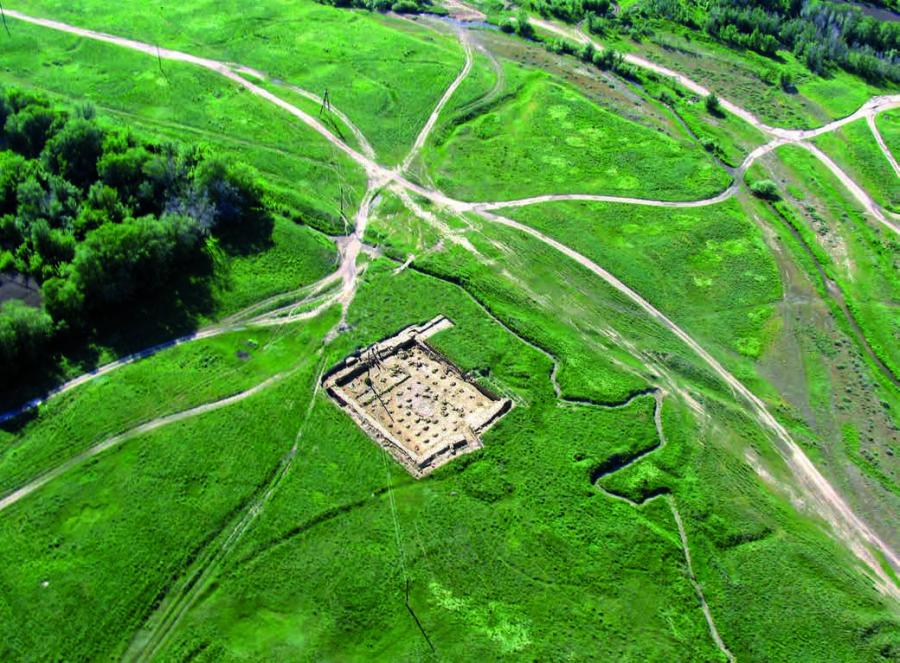
The mosque was built almost in the center of the city and before the excavations was a quadrangular elevation. Excavations have shown that it was a building of 34×28 m in size, the walls of which are up to 2 m thick were built of rectangular raw bricks and preserved to a height of 1.5-1.6 m. Inside the walls were smeared, and between the smearing were laid canals connected to the hearths, which circulated smoke and hot air. So in the cold season the mosque was heated.
The entrance to the mosque is located in the eastern wall, opposite, in the middle of the western wall, of burnt brick was built in the form of a niche mihrab, indicating the direction to the holy city of Mecca. This is the most sacred part of the mosque, in the direction of which prayers turn. Kayalyk mosque is one of the architectural buildings such as "forest columns" or "pillars". It means that inside the mosque there were no additional load-bearing walls, and the wooden-reed roof was supported by numerous wooden columns. The columns have not survived, but there are still stone bases on which they stood. There are 54 such bases in total. The size of the mosque, which was built and existed in the late XII - early XIII centuries, indicates that it was a cathedral, that is, the main one in the city and, apparently, in the whole state of Karluk jabgu.
According to the research, there was a complex of mausoleums built in the XII - first half of the XIII century next to the mosque. The mausoleums were destroyed, apparently, deliberately, and then time completed their final transformation into ruins. The following sections of the site have been preserved walls, the base of the corner column made of burnt square brick and brick floors, under which four burials were found: two men's, women's and children's burials. The burials of once dead people were carried out according to the Muslim rite. According to the canons of Islam, in the grave with the buried things are not put in, but there are deviations from the rules. Thus, on the skeleton of the woman were found gold hollow pendants inside the balloons and two gold rings.
At the site of the mausoleum, burnt bricks were found during excavations, some of which were selected and used later. It was possible to establish from the fragments of carved slabs and bricks that the facades-portals of the mausoleums were lined with carved bricks, making up the belts, filled with geometric and vegetative ornaments, and the inscriptions in the Arabic alphabet were included in the plant motifs.
The most interesting results were obtained during the excavations of residential areas of the city, in particular, the rich estate of Kayalyk. It was heated by a system of underground channels through which hot smoke and heat from a special furnace circulated. The front rooms of the estate were decorated with carved ornaments. Chinese ceramics, Iranian chandeliers (ceramics covered with golden-brown paint) and glass, and Central Asian bronze, found in the estate, suggest that the rich owner lived here, who has the opportunity to buy expensive foreign goods.
Thus, a large city of the IX-XIV centuries was discovered and studied in the Ili Valley. - Kayalyk, the former important political, economic and cultural center of Karluks on the Great Silk Road. This is evidenced by the findings of silver and copper coins minted in the local mint during the period when the city was one of the capitals of the Jagataid ulus of the Mongolian Empire, which occupied vast areas of Eurasia.
The city was also a spiritual, sacral center, where Buddhism, Christianity, Manichaeism and Islam coexisted peacefully in the XIII century. This is evidenced by the notes of Guillaume de Rubrooke and excavations of Buddhist and Manichaean temples and the cathedral mosque. The spread of Islam in Kayalyk is evidenced by the toponyms, in particular Arabsai, as well as legends of the Arab, a Muslim preacher.