Information
- Location
- Түркістан облысы, Tulkibas District
- Period
- 5000 – 3001
- Type
- Camp
- Kind
- Archaeological sites
- Authors
- Мамиров Талгат Базарбаевич
Sources
- Қазақстанның киелі орындарының географиясы: Табиғат, археология, этнография және діни сәулет өнері нысандарының тізілімі / Жалпы редакциясын басқарған ҚР ҰҒА академигі Байтанаев Б.Ә. – Алматы: Ә.Х. Марғұлан атындағы Археология институты, 2017. – 1-шығарылым. – 904 б.
Description
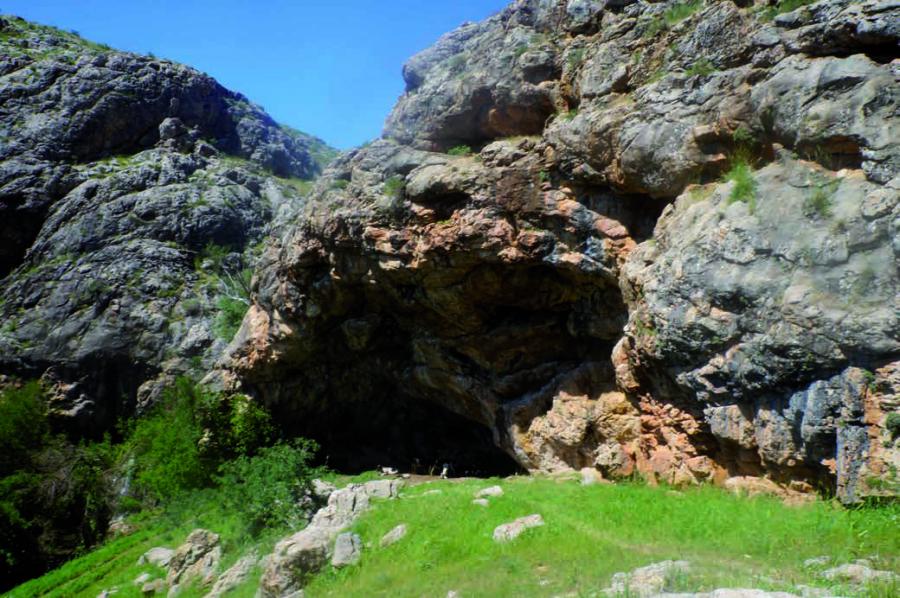
The monument is located on the southern slopes of the Karatau Ridge, on the left bank of the river of the same name, 10 km north-east of the village Zhanakogam (Tulkubas district, SKR).
The Karaungur cave site is one of the oldest in Kazakhstan, dating back to the Stone Age, where people have lived since the Neolithic Age (V-IV thousand BC). The site was opened and first examined by Kh.A. Alpysbayev in 1959 and 1973. Additionally, the cave was studied by a detachment of the Kazakh-Russian archeological expedition in 1992. The cave was formed as a result of tectonic and karst processes in limestone rocks. The formed cavity has the following dimensions: maximum height of about 15 m, width of about 43 m and depth of about 39 m.
The cave is very convenient for habitation, it is easily accessible, the river flows next to it, it is well lit, has a wide and flat floor with a canopy. The results of archeological work indicate that the cave was inhabited in the Neolithic period and that there were traces of visits in the subsequent Eneolithic, Bronze and Early Iron Age periods. However, due to the episodic nature and small amount of work at such a large stratified site, there is a possibility of discovering the remains of the Paleolithic Age.
The excavations at the site revealed stone and bone artifacts, animal bone and teeth ornaments, shell articles, ceramic fragments and dentistry. The stone inventory is represented by micronuclei with microplates, large two-site nuclei. The guns are dominated by retouching plates on the side edges, inserts, scrapers, geometric microliths, points, incisors, arrowheads of the Kelterinar type, etc. Products made of bone are represented by perforators, needles, tips, "spatulas", as well as items of jewelry in the form of pendants and beads. Of interest is a stone fragment with a well polished surface, ornamented with notches on the side edges, on one side - with six, on the other - with seven notches every 2-5 mm (to the point of fracture).
The bone remains of such ungulates as argali, wild boar, roe deer, maral, mouflon, etc. indicate that hunting was the basis of economic activity of the inhabitants of the Karaungur cave. The teeth found during excavations belong to four or five subjects, three women aged no more than 20-30 years, and one or two other women aged more than 55-60 years. Conditions for their detection without other anthropological parts include the use of teeth in magic rituals and wearing in the form of amulets. For example, one of the teeth found in a cave, along with the remnants of the red substance, has a hole for hanging.
The materials of the cave site of Karaungur testify to the existence of a peculiar Neolithic culture in the south of Kazakhstan, which has similarity in the technique of primary splitting, secondary processing and in the tool set with the Kelteminar culture (Southern Priaralie) on the one hand, as well as in some forms of two-site nuclei and tools - with the materials of Gissar (South-Western Tajikistan) and Central Ferghana cultures.
At present, the Karaungur cave site is a monument of history and culture of local importance. The object of pilgrimage and religious tourism.