Information
- Location
- Zhambyl Region, Taraz city
- Period
- 1001 – 1100
- Category
- Historical and cultural monuments of republican significance
- Type
- Mausoleum
- Kind
- Buildings of monumental art
- Protected zone
- ✓
Sources
- Қазақстанның киелі орындарының географиясы: Табиғат, археология, этнография және діни сәулет өнері нысандарының тізілімі / Жалпы редакциясын басқарған ҚР ҰҒА академигі Байтанаев Б.Ә. – Алматы: Ә.Х. Марғұлан атындағы Археология институты, 2017. – 1-шығарылым. – 904 б.
Description
XI century architectural monument. Located in the city of Taraz, at the intersection of Tole Bi and Baizak Batyr Streets.
The mausoleum is built over the grave of one of the members of the Karakhanid dynasty - Shah-Mahmoud Bugr Karakhan. There are stories and legends written about him by V.A. Kallaur: "Abdu-r-Rahim-Bab. His son Sha-Khasan, by the pronunciation Kylydj-Karakhan. His son Abdul-Halyk-khan. His grave is in Otrar (south of Turkestan), and the grave of Aulie-ata is on the Talas River. Aulie-ata had a second son named Kasym-khan-Baba, his grandfather Kyran-sheikh, his son-in-law Mahmud-khan-sheikh, and his daughter Bibi-Aisha, whose grave is in two tashas from the mountains Aulie-Ata. On the bank of the Talas River, the so-called Bek-Turmas-ata is buried. His sacred name is Sultan-Mahmud-khan. Aulie-ata - may God's mercy be upon him - invited him to the position of bek, but he did not want to be bek and therefore he was given the nickname "Bek-Turmas" (i.e. he will not be bek)" [quoted from: Kallaur, 1897]. The monument has not survived to this day in its original form, in 1906 it was rebuilt by Tashkent ishan Said Beckhanov and, despite the preservation of the structural principle, lost its authentic architectural and decorative design.
In the cultural and historical space of Kazakhstan the mausoleum of Karahan occupies a special place due to its chronological localization in the process of formation of Islamic culture, being one of its symbols in the region. It is possible to speak about qualitative breakthrough and rapid blossoming of urban culture and establishment of Islam-oriented urban civilization in the region. The penetration of Islamic culture into the territory of Kazakhstan in 960 is connected with the Karakhanid dynasty. The Islamization action in 960 within Zhetysu among the Karakhanid Kaganate Turks-Karluks symbolized a new stage in the evolution of the religious identity of the population of South East Kazakhstan. The Karakhan Mausoleum is an archaeological, architectural and historical source of these events in the history of Kazakhstan, as well as the sacred space of Islamic culture in the region. V.V. Bartold was one of the first to draw attention to the legends of Satuk Bogra-khan and put forward versions of the Islamization of the Karakhanid state. The information on historical preconditions of Islamization is of scientific value. This is a new stage of religious evolution, the establishment of late "revelation religions", civilizational impulses of the new religion - young Islam, information about the impact of these processes on the development of trade routes, economic arteries, the Muslim education system as an important component of world culture, the Islamization of the Turks, the role of Sufi orders, etc.
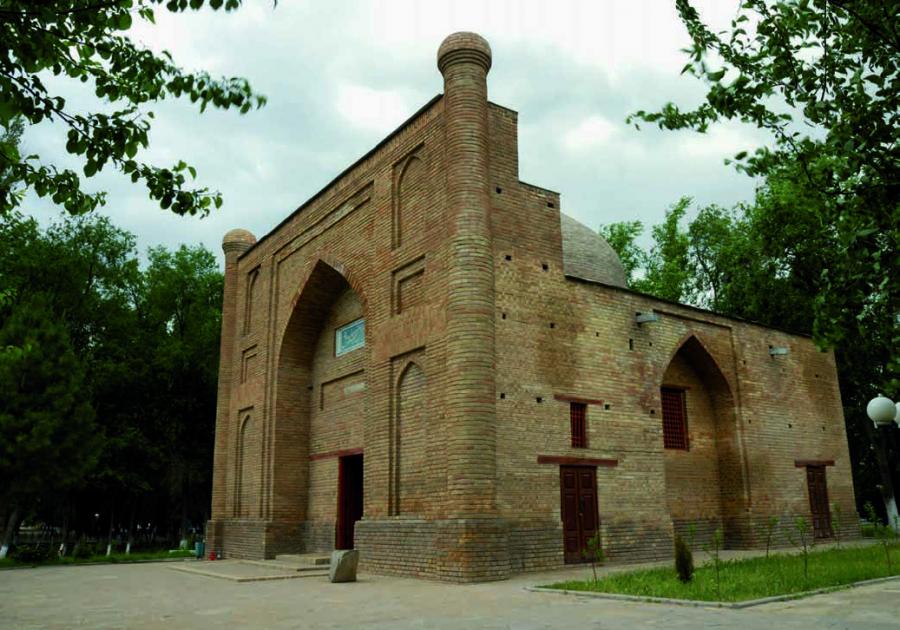
For the first time the mausoleum was studied in detail by B.Denika and described by him in the book "Architectural Ornament of Central Asia". It is a square in terms of portal-dome structure. It consists of a central hall and three small corner rooms (hujras), the fourth corner of the mausoleum is occupied by a staircase leading to the roof of the building.
The front facade of the mausoleum faces south and is framed by minarets on the edges. The entrance is in the depth of the arch, on both sides of which there are three niches: rectangular, square and lancet shapes. Above the entrance to the mausoleum there is an inscription in Arabic: "There is no god except Allah, and Mohammed is his prophet". Outside the mausoleum walls are made of modern bricks, and inside the dome and arched niches, finishing the window apertures, are made of bricks of Karakhanid time. The facade of the mausoleum, judging by the figured bricks found in the excavations (more than 30 varieties), was richly decorated.
In 2002, the mausoleum was restored for the 2,000th anniversary of Taraz.
The monument has been under state protection since 1982 and is included in the list of historical and cultural monuments of national importance.