Information
- Location
- Маңғыстау облысы, Tupkaragan District
- Period
- 300 BCE – 1 BCE
- Type
- Temple
- Kind
- Archaeological sites
- Authors
- Астафьев Андрей Евгеньевич, Ақан Онғар
Sources
- Қазақстанның киелі орындарының географиясы: Табиғат, археология, этнография және діни сәулет өнері нысандарының тізілімі / Жалпы редакциясын басқарған ҚР ҰҒА академигі Байтанаев Б.Ә. – Алматы: Ә.Х. Марғұлан атындағы Археология институты, 2017. – 1-шығарылым. – 904 б.
Description
The monument is located 30 km to the north-east, to the east of Fort-Shevchenko and is located on the eastern edge of the ridge elevation 2 km to the south-west of Karatam cemetery (Tupkaragan district, Mangystau region).
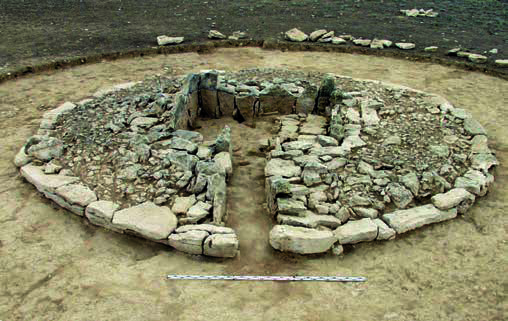
In terms of interior space has an irregular rectangular shape. The walls of the premises are erected from a combination of horizontal and vertical masonry. Horizontal masonry is made only by the southern wall of the room, in the central part of which there is an opening of the entrance corridor. The rest of the walls on the inner contour are lined with massive uneven slabs up to 20 cm thick. Their lower ends are buried in the mainland up to 20 cm. The highest height of the inner cladding is 1-1.1 m. The total thickness of the walls of the room reaches 1.4-1.6 m. In terms of the external contour of the horizontal masonry wall has a pentagonal shape, repeating the shape of the interior. From the outside, this masonry is reinforced with angled slabs. A passageway of the conditionally corridor type connects the funeral chamber with the external wall of the building. Its total length is 3.75 m, width 0.7 m. The walls of the corridor are formed by the technique of combining vertically buried slabs and horizontal masonry. The highest preserved height of the walls is 0.9 m.
At the level of the ancient horizon there are three stucco vessels, bronze arrowheads, etc. A potter's vessel and about 60 fragments of a large stucco vessel were found in the entire entrance corridor. A slab with a tamga-shaped sign, a stone anthropomorphic sculpture and a stone stele with drawings were found in the masonry of the retaining wall of the building. All these findings indicate the cult nature of the building and its later reuse for burial of people.
Although Meretsai-2 was built according to the Tubezhik architectural principles, it belongs to the type of corridor tombs or round mausoleums with a rectangular inner chamber. There is no moment of processing and careful adjustment of structural elements.
The shape of the circle and square used in the construction of the sanctuary has a symbolic meaning associated with mythological understanding of the world vision. The circle has been perceived in different religious and mythological concepts since ancient times as a symbol of the top, sky and sun, in contrast to the square - the symbol of the bottom, the earth. The combination of both symbols in one structure should probably be regarded as an embodiment of the idea of unity of the universe. The construction of the sanctuary and the nature of the findings demonstrate the cult purpose of Meretsai-2. Thus, anthropomorphic sculpture is usually associated with the cult of ancestors and soldiers.
It is a monument of archeology of republican importance. Object of tourism.