Information
- Location
- Almaty District, Eskeldi District
- Period
- 3300 BCE – 1400
- Type
- Petroglyph
- Kind
- Archaeological sites
Sources
- Қазақстанның киелі орындарының географиясы: Табиғат, археология, этнография және діни сәулет өнері нысандарының тізілімі / Жалпы редакциясын басқарған ҚР ҰҒА академигі Байтанаев Б.Ә. – Алматы: Ә.Х. Марғұлан атындағы Археология институты, 2017. – 1-шығарылым. – 904 б.
Description
Monument of rock art of the Bronze Age, Early Iron Age, Middle Ages. It is located 30 km south of Taldykorgan on the southern slopes of the Eshkiolmes Ridge of the western spur of the Zhetysu Alatau, falling into the valley of the Koksu River (Eskeldy district, Almaty region).
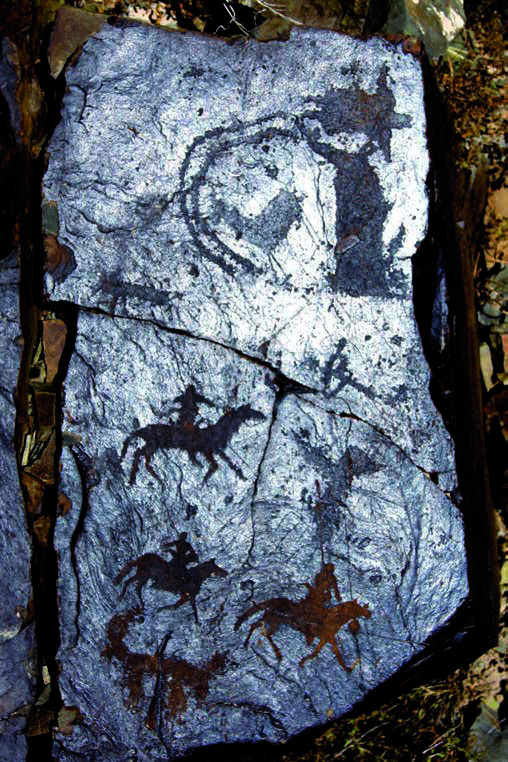
The sacral significance of the petroglyphs of the Eshkiolmes Ridge lies in the fact that the rock drawings show the full range of religious and mythological views of the ancient peoples of the region from the Bronze Age to the Middle Ages. A number of cult plots are comparable with descriptions and mythological texts of the most ancient literary monuments: " Rigveda ", " Avesta ". The petroglyphs of Eshkiolmes are the most vividly traced origin of the traditions of the Scythian-Siberian animal style and express the main artistic traditions of rock art of the North-Eastern Zhetysu. It is necessary to note the originality of methods of drawing on the rocks and the undoubted artistic expression of the art of local ancient artists. Miniature images, sometimes not exceeding 1-2 cm, carved on the rocks by graffiti-carving technique, are distinguished by special elegance. Due to these features, rock art is represented here much richer and more diverse than in other monuments of the same type, and by the number of drawings the sanctuary of Yeshkiolmes exceeds the world-famous Tamgaly complex (Tanbalytas).
The oldest plots of rock paintings by Eshkiolmes date back to the Bronze Age. Among them there are both single images of animals and large multi-figure compositions with scenes of hunting, sacrifice, confrontation, adoration and sacred marriage. Battle scenes and compositions with chariots look especially bright, and there are more than a hundred of them in the petroglyphs of the Eschiolmes Ridge. They have quite a certain mythological context. Among the widespread religious ideas in the Bronze Age petroglyphs there are cults of "sun-headed" deities, fire, warriors, fertility and related cult of the progenitor mother, sacred animals, etc. The main connecting thread of all elements of the worldview of the ancient epoch was the cult of fertility, closely connected with the images of gods - the higher forces that ensure the reproduction of the world and the welfare of people. The leading rite of all epochs was the act of sacrifice. It is associated with the most striking drawings of the Bronze Age, for example, the image of three archers, shooting a giant. This plot is regularly repeated in different gorges of Eshkiolmes and directly illustrates the famous Vedic myth about the creation of the world and people from the body of a giant Purusha. This group of rock paintings dates back to the second half of the II millennium BC.
During this period, the traditions of the Scythian-Siberian animal style in rock art were born. Some of the subjects are notable for their conventionality, as they look like they were copied from metalware. Outstanding religious and mythological subjects of the early Iron Age are scenes of hunting and tormenting of herbivorous animals by predators. With the help of graffiti, the masters were able to make the scenes of predation of sacrificial animals more dynamic and expressive. Rock drawings of the Eshkiolmes Ridge reflect all stages of development of animal style in the art of Saka-Usun tribes of Zhetysu I thousand B.C.
The main part of the medieval drawings of the VI-XII centuries is made up of battle, household plots and hunting scenes. One of the leading zoomorphic images of ancient Turkic rock art was the image of a wolf. As a "progenitor" he occupies a special place in the ideology of the Turks and is associated with the cult of a warrior-hero, expressed in the images of horsemen of the standard-bearers. The image of the standard-bearer warrior in the fine arts of medieval nomads of Eurasia is a canonized plot. Painted on the rocks, it is a peculiar historical document of Turkic military-political formations.
The Eshkiolmes Ridge stretches in the latitude direction for a distance of about 30 km. More than 15,000 petroglyphs are concentrated in 24 gorges in the western and central parts of the ridge. Structurally, the rocky images are not evenly arranged, their densest concentration is observed in the gorges 10, 14 and 18 - these are peculiar sacral centers of Eshkiolmes. Here the most vivid ancient drawings are found, structurally organized as "temples" in the open air, which allows to assert their religious and cult purpose. Rock paintings are an integral part of archaeological complexes (settlements and burial grounds are located both in the upper gorges and on the right bank of the Koksu River) of antiquity and the Middle Ages, reflecting the artistic traditions and worldview of the local population.
Rock images in the mountains of Eshkiolmes were first discovered by geologist L.I. Skrynnik in the late 1970s. In 1982-1990, the monument was studied by the staff of the archaeological expedition of the Abai KazPI (headed by A.N. Maryashev). Currently, the location is being studied by various expeditions of the Institute of Archaeology named after A. Kh. Margulan. It is the object of tourism.