Information
- Location
- East Kazakhstan Region, Tarbagatay District
- Period
- 700 BCE – 1100
- Type
- Necropolis
- Kind
- Archaeological sites
- Authors
- Оралбай Ерден Қуанышбекұлы
Sources
- Қазақстанның киелі орындарының географиясы: Табиғат, археология, этнография және діни сәулет өнері нысандарының тізілімі / Жалпы редакциясын басқарған ҚР ҰҒА академигі Байтанаев Б.Ә. – Алматы: Ә.Х. Марғұлан атындағы Археология институты, 2017. – 1-шығарылым. – 904 б.
Description
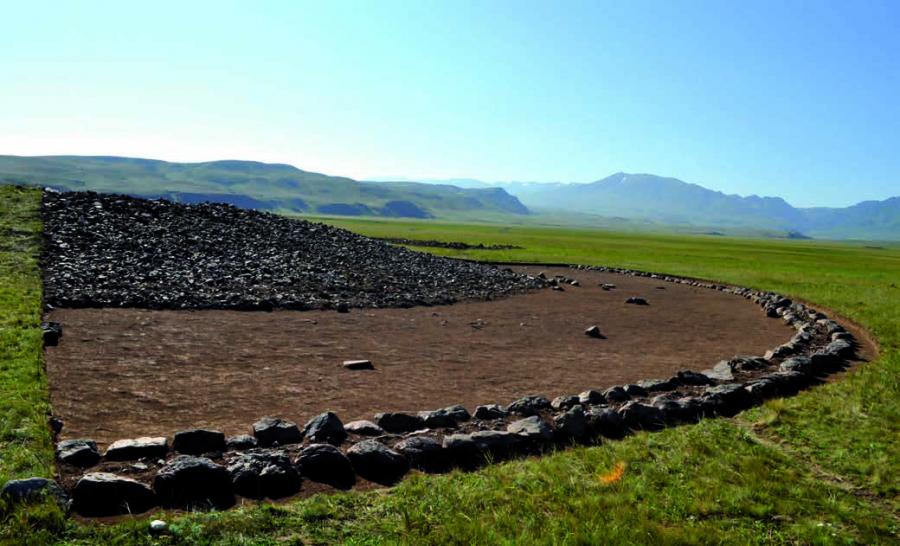
Eleke Sazy, a complex of early nomadic and ancient Turkic barrows. The monument is located 80 km south of the village of Aksuat, on the plain of Eleke Sazy (Tarbagatai district, East Kazakhstan region).
Eleke Sazy is a unique place where the burial and memorial monuments of nomads were erected for several millennia: from the early Sak time to the ancient Turks. To date, a total of seven burial grounds with more than 300 burial mounds have been identified on the Eleke Sazy plateau. The largest of them has a diameter of 120 m and a height of 5 m. In terms of their features, the monuments are close to the synchronous memorial structures of Kazakhstan, the Altai sub-region and South Siberia. The main part of the barrows dates back to the 1st millennium B.C. The characteristic features of the above-ground structures are related to the Saki cultural horizon.
One of the barrows, No. 7, unfortunately, as well as the overwhelming majority of elite monuments, was looted. The monument is surrounded by a double fence and is surrounded by a wide moat 2.5-3.5 m wide. The diameter is 31×33 m and the height is 2.2 m. Shell and dromos are located on the eastern side. The funerary structure is a ground structure in the form of a rectangular structure of stones, oriented on a long axis along the line of West-East. In the construction of the monument one can see analogies with the early Saki barrows of Besshatyr and Shilikty. Of particular interest among the findings are the gold ribbed perforated nozzles from the arrowheads, plaques in the form of a profile image of fallow deer, two-bladed bushheads of arrows. The penetrating rocks have so far raised the question of their purpose; the images of deer are similar to the artworks from the famous early Saki barrows of Shilikty and Zhalauly. On the basis of the accompanying object complex the monument can be dated to the VII century BC. Eleke Sazy's barrows are among the unique Saka monuments - majestic cult objects "strip of mountains" (K.A. Akishev), burials of leaders, where rituals of remembrance of powerful ancestors - protectors were held.
The image of deer is one of the most popular in the art of the early nomadic era, it was considered a sacred animal by the Saka-Scythian peoples. In the early Saka monuments of Eastern Kazakhstan there are known examples of rock and plastic art with its image. There is a theory that the term "Saka" comes from the name of the male deer. Nowadays the image of a deer has undoubtedly become a symbol of the Scythian-Saka peoples in the Eurasian space. Eleke Sazy Reindeers are depicted as dumps, which may indicate the symbolism of peaceful life; in the barrows of Shilikty deer in the same region - with pronounced branchy horns; on petroglyphs of Tarbagatai deer with a beak-shaped muzzle, which may be one of the variants of zoo- and ornithological pictures of the image as a symbol of the unity of heaven and earth.
As a result of field and theoretical researches the new materials on art, art culture, military business which characterize the level of material and spiritual culture of ancient nomads of Tarbagatai are received. It is especially important for the solution of the most important question of Scythian-Saka archeology - the place and time of origin and formation of the early nomadic cultural complex. Preliminary conclusions about the ethnicity of the population that left these monuments have also been drawn. The similarity of products from Eleke Sazy with finds from the early Saka monuments of the Shilikty Valley gives full right to assume that this area has played the role of a political and cult center of the region since at least the beginning of the first millennium BC. The phenomenon of Tarbagatai lies in the nature-landscape features typical for both Altai and Zhetysu, which are the specific cultural centers of the Scythian-Siberian continuum. The uniqueness of the ancient heritage of this ridge against the background of the Eurasian continent cultures of the early nomadic epoch allows us to see its place in the system of cultures of the Scythian-Saka world and to reconstruct some ideas, which determined the appearance of ancient monuments.
In Eleke Sazy there is also a unique monument of the ancient Turkic cultural complex - one of the few burials of kagans, the rulers of the Eurasian space. Kagan complexes store the most important information on the political history, cultural and economic life of the Turkic Kaganates. Comprehensive study of all its components is fundamental in the development of problems of continuity in the formation and development of statehood in the territory of Kazakhstan.
As an object of pilgrimage and tourism, in order to promote the historical and cultural heritage of the state of the archaeological monuments can create a museum in the open air. It is also important as an important source on the history of statehood in the territory of Kazakhstan.