Information
- Location
- Kostanay Region, Arkalyk city
- Period
- 1001 – 1200
- Category
- Historical and cultural monuments of republican significance
- Type
- Ritual complex
- Kind
- Archaeological sites
- Authors
- Хасенова Бахыт Молдашевна
Sources
- Қазақстанның киелі орындарының географиясы: Табиғат, археология, этнография және діни сәулет өнері нысандарының тізілімі / Жалпы редакциясын басқарған ҚР ҰҒА академигі Байтанаев Б.Ә. – Алматы: Ә.Х. Марғұлан атындағы Археология институты, 2017. – 1-шығарылым. – 904 б.
Description
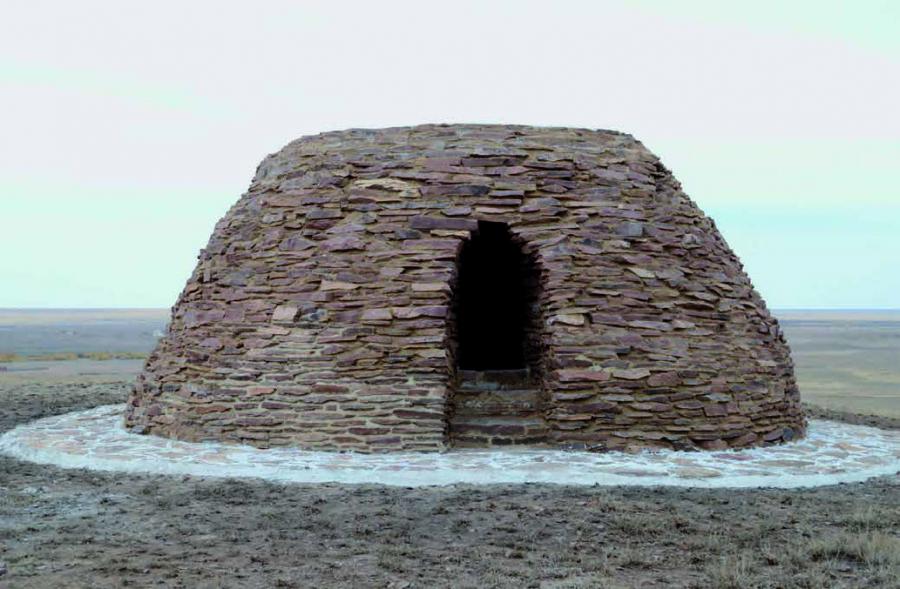
Two ancient ritual constructions of natural stone in the form of a yurt, located near the village of Yekidin ( Sarytorgay) (Arkalyk, Kostanay region). The name of the village Yekidin comes from these monuments.
Yekidin literally means "two vaults" in Kazakh. They are made according to the principle of a false vault, when the laying of stones, gradually narrowing in diameter, forms a hemisphere outside. The entrance is orientated to the east. The upper part of the vaults is crowned with a cleverly made hole.
According to the local legend, in the XVII-XVIII centuries, during the war in the area of Yekidin there was a bloody battle between two warring families. Weyrleaders of the warring clans in this area founded two capital stakes, located next to each other. These cult constructions of the Middle Ages are among the poorly studied at the moment. In Saryarka there are several more such structures, the most famous of which are Dombauyl on the left bank of the Kengir River and the mausoleum of Kozy Korpesh - Bayan Sulu on the right bank of the Ayagoz River. They have different dates within the early and developed Middle Ages. Such a variety of dates is explained by the cult nature of these structures, and therefore, the absence of any artifacts that traditionally allow to determine the chronology. At this level of research it is necessary to agree with the opinion of academician A. Kh. Margulan, a connoisseur of ancient steppe architecture, that they belong to the pre-Islamic period. Once such a structure formed a single sacral space together with stone sculptures made in the Kipchak tradition. This is evidenced by the peculiarities of iconography: two of the characters depicted in stone near the mausoleum of Kozy Korpesh - Bayan Sulu - hold vessels in both hands. Proceeding from it is possible to narrow down preliminary dating of such cult constructions of the specific form and to connect with history of the ethno-political association known, judging by written sources, as Desht-i Kypchak (XI-XII centuries).
The tradition of erecting architectural structures made of limestone dates back to the Bronze Age. It is known that this material was first used in the construction of mausoleums of Begazy-Dandybay culture. At the same time, the ancient builders tested the reception of a false vault, which became widespread in the future. These two components were preserved until the ethnographic time, they were used in the construction of burial structures.
On the one hand, vault-type structures characterize a certain stage in the history of the population of Central Eurasia, while at the same time demonstrating the existence of a stable tradition in the steppe architecture. It is necessary to note in particular the form of these structures in the form of a hemisphere, which is one of the most sacralized in the steppe culture. This is the form of the space where the life (yurt) is concentrated in the traditional culture, as well as its opposite - the place intended for reverence of the ashes and memory of ancestors (mausoleums of the Bronze Age, ethnographic time, barrows of the early Iron Age).
Тhese structures were erected in specially selected places, they are always well seen on the ground, are located at a short distance from the river. They formed a special sacral system of coordinates, understandable to the inhabitants of the Great Steppe, unfortunately, not preserved undisturbed to this day.