Information
- Location
- Karaganda Region, Ulytau District
- Period
- 1863 – 1866
- Category
- Historical and cultural monuments of republican significance
- Type
- Mausoleum
- Kind
- Buildings of monumental art
- Authors
- Ахатов Ғазиз Аманжолұлы
Sources
- Қазақстанның киелі орындарының географиясы: Табиғат, археология, этнография және діни сәулет өнері нысандарының тізілімі / Жалпы редакциясын басқарған ҚР ҰҒА академигі Байтанаев Б.Ә. – Алматы: Ә.Х. Марғұлан атындағы Археология институты, 2017. – 1-шығарылым. – 904 б.
Description
It is located on the right bank of the Kara-Kengir River, 25 km west of the Alasha Khan Mausoleum (Ulytau District, Karagandy Region).
The mausoleum was built over the grave of Duzen Sandybayev (Duzen Sandybayuly), a rich man of the Bagynali family (Nayman). Duzen's brother Erden was an elder sultan of the Atbasar district. About occurrence of this monumental construction there are some versions among the population. According to one of them, the mausoleum has been constructed at a life of Duzen. Under other version, the mausoleum is constructed after death under the order and for money of Duzen's son - Zhanuly. According to the third version, the mausoleum was built by the order of Duzen's brother Erden Sandybayuly.
For the first time the description of the monument is given by S. Sharipov, where the time and money spent on the construction of the mausoleum are indicated. The mausoleum was built by the national master Seraly Elamanuly in 1863-1866. The master was tasked to build a structure similar to the mausoleum of Alasha Khan. For construction of a monumental construction Seraly Elamanuly was sent by relatives of Duzen Sandybayev to Turkestan for mastering knowledge and experience of construction of similar constructions from a brick. According to sources, 362 horses and 1500 rams were spent on the construction of the mausoleum, of which 50 horses and 1500 rams were used as food by workers for three years. In 1946 the monument was examined by an expedition headed by architect M.B. Levinson. The monument was measured and photographed. A detailed description of the Duzen mausoleum is found in the works of prominent architects M.M. Mendikulov, G.G. Gerasimov, T.K. Basenov.
In 1973, the Mausoleum of Duzen was examined by the expedition of the Ministry of Culture of the Kazakh SSR.
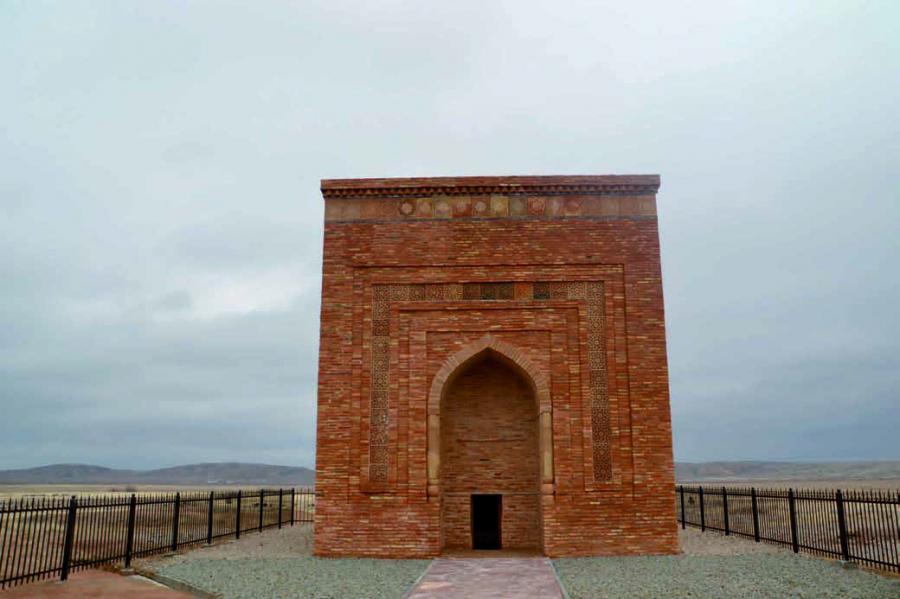
The mausoleum is a portal-dome structure consisting of a cube of the building, a dome on a 10-sided drum and a massive portal. The plan represents a rectangle with the dimensions of 8.5 x 10.2 m, and the inner outline represents a square. The mausoleum is built of square bricks on clay-saman mortar. The main facade of the mausoleum is represented by pylons, which form a deep niche of the entrance opening. The side parts of the pylons are decorated with figured masonry made in the form of a "herringbone". The side and rear facades of the mausoleum are decorated with shaped masonry in the form of rhombuses. The arch of the entrance niche has a "U"-shaped belt filled with square carved terracotta tiles with geometric octagonal ornamentation. In the interior of the mausoleum there are eight lancet niches. The floor of the mausoleum is paved with square bricks.
The peculiarity of Duzen mausoleum is the presence of a bypass gallery. The staircase entrance leading to the gallery is arranged from inside the room in the south-western pylon. The size of the gallery is 1.8×1.6 m. It is covered by a false vault and encircles the entire room around the perimeter, and has expansions when corners of buildings are turned. The gallery leads to the roof of the building. In the upper part of the portal of the mausoleum there are two rooms and a staircase with access to the top of the portal, to the ground.
The monument is located close to the road, serves as a reference point in the steppe, we honor the local population. Next to the mausoleum there is a necropolis. Duzen Mausoleum - one of the largest monumental buildings of the XIX century, is valuable as a copy of the magnificent monument of architecture of Alasha Khan's mausoleum.
The monument of architecture of republican importance is under the protection of the state.