Information
- Location
- Karaganda Region, Ulytau District
- Period
- 1401 – 1500
- Category
- Historical and cultural monuments of republican significance
- Type
- Mausoleum
- Kind
- Buildings of monumental art
- Authors
- Искаков Айдар Шарханұлы
Sources
- Қазақстанның киелі орындарының географиясы: Табиғат, археология, этнография және діни сәулет өнері нысандарының тізілімі / Жалпы редакциясын басқарған ҚР ҰҒА академигі Байтанаев Б.Ә. – Алматы: Ә.Х. Марғұлан атындағы Археология институты, 2017. – 1-шығарылым. – 904 б.
Description
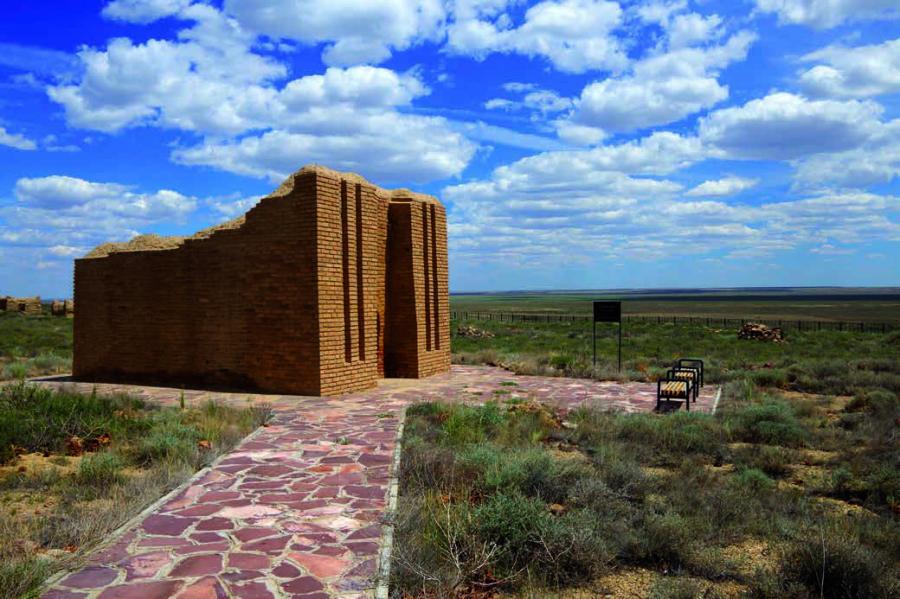
One of the unique monuments of the Zhoshy ulus period. Located in Karagandy region, 10 km above the confluence of the rivers Kara-Kengir and Sarysu, in the tract Karazhar. The mausoleum is built on the steep bank of the river, on its highest terrace and is clearly visible from afar. Like many monuments of memorial architecture, it served as a landmark and, possibly, a spacemark. On the western steep side of the hill, on the left bank of the channel, where the Bolgan Ana Mausoleum is located, on the middle terrace, there are remains of large stone structures. In terms of size, these ruins occupy a significant area. These are most likely the ruins of some fortified castle of an influential khan or sultan. According to one of the legends, Bolgan Ana is the daughter-in-law of Alasha Khan, and according to another - in the early XV century, a ruler named Bolgan lived here. According to academician V.V. Bartold, Bolgan-ana (Bolgan Begi) is the daughter of Zhoshy Khan. Information about the mausoleum is available in the description of Hafiz Tynysh of the campaign of 1582 by Khan of Bukhara Abdallah, where he and his army stopped near the mausoleum of Bolgan-ana. In the middle of the XVIII century P.I. Rychkov, describing the monuments along the river Sarysu, marks the mausoleum of Bolgan-ana as a beautiful high-rise building. Sh.ShH. Ualikhanov describes in his work "About Kirghiz-Kaisak graves (tombs) and antiquities in general": "...In the remote steppe, near Ulytau, on the Kangirs, there are many graves that amaze with their structure: Kamyr-khan, Alacha-khan, Dombaul, Bulgan-Ana and others, all of them are made of bricks, covered with different colors of enamel from the outside. Bulgan-Ana, located at the mouth of the Kara-Kengir, on Kara-Jar, white color, it is a small building with a dome, the same structure and all the others".
There is no exact information on the time of construction of the monument. According to its design peculiarities the monument belongs to the Golden Horde period. In 1946-1947 the mausoleum was examined by A. Kh. Margulan, who notes that it is similar to the architectural monuments of the Karakhanid period. According to the type of architectural construction, the Bolgan Ana Mausoleum belongs to the portal-dome structures. The main facade is oriented to the south-west. It has a powerful portal with a lancet arch in it. The plane of the main facade wall is divided into a series of vertical strips with the help of small niches 45 cm wide and 12-13 cm deep, framing the portal arch with a rectangular frame in the form of the letter " U".
Similar to the Ayakkamyr mausoleum, the niches were designed for tiles. At a height of 2.42 m on the outer corners of the peshtak there were left small ledges for the installation of round three-quarter columns. These columns were laid out of special glazed ground bricks, their diameter is 35-37 cm. The masonry was removed very carefully, with thin, even seams. The height of the surviving part of the structure is equal on the peshtak part of 3.70 m, and on the parallelepiped of the main volume - 2.90 m.
The outer surfaces of all the walls, except the front, are smooth, without any architectural and decorative design, which corresponded to the established tradition in the construction of mausoleums in today's Central Kazakhstan.
Bolgan Ana Mausoleum is an architectural monument of republican importance. It is the object of pilgrimage and religious tourism.