Information
- Location
- Almaty District, Kerbulak District
- Period
- 600 BCE – 401 BCE
- Category
- Historical and cultural monuments of republican significance
- Type
- Necropolis
- Kind
- Archaeological sites
Sources
- Қазақстанның киелі орындарының географиясы: Табиғат, археология, этнография және діни сәулет өнері нысандарының тізілімі / Жалпы редакциясын басқарған ҚР ҰҒА академигі Байтанаев Б.Ә. – Алматы: Ә.Х. Марғұлан атындағы Археология институты, 2017. – 1-шығарылым. – 904 б.
Description
One of the ethno-cultural and sacral centers of the Saka tribes of the Northeast Zhetysu of the Iron Age. The monument is located on the right bank of the Ile River, 65 km east of the village of Shengeldy, on the territory of the "Altyn Emel" nature reserve, at the foot of the Zhelshalgyr mountains, at the entrance to the Shalbyr gorge (Kerbulak district, Almaty region).
In the socio-cultural space of Kazakhstan the Besshatyr barrows are the most representative and give the most vivid impression about the Saka culture and architecture on the territory of Kazakhstan. The first mention of the Saka necropolis is found in the work of historian V. Gorodetsky, where it is said that V. Parfentyev visited the barrows on the right bank of the river Ile in 1924. The Semirechensk and Iliysk archeological expeditions led by K.A. Akishev were engaged in research of barrows, in 1957 and 1959-1961. Excavations were carried out on 18 barrows.
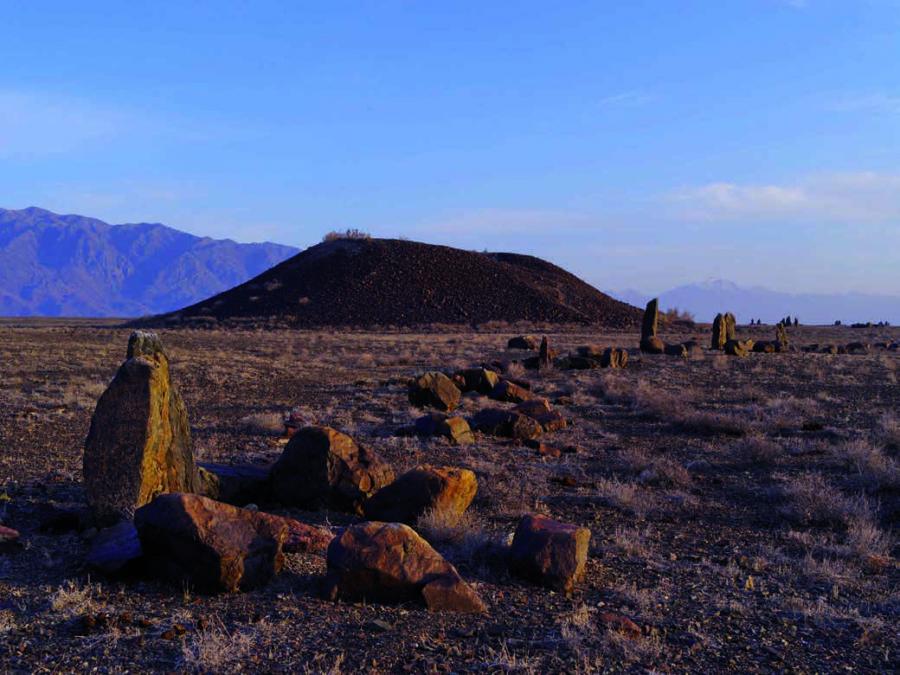
The Besshatyr burial ground occupies an area of 2 km2, its length from north to south is 2 km, from west to east - 1 km; it consists of 31 burial mounds, 21 of them with stone cover and 10 - with an embankment of crushed stone and earth. The Besshatyr barrows are distinguished by the complexity of their architectural design. Most of them look like truncated cones with stone cover. Among the structural elements we can name the stone shaft surrounding the barrow (on the Big Besshatyr barrow - diameter 104 m and height 15-17 m, it had a width of 2 m, height of 50-60 cm). Around the burial mounds there are fences - ring structures made up of large stone columns (menhirs), buried at the end, and large boulders. A total of 94 fences were fixed near the Big Barrow. It is noteworthy that they were located on a spiral, the beginning of which was on the eastern side of the barrow. At 250 m to the north-east of the barrow, seven similar fences were found, forming a separate chain of 40 m long. Their ritual character is probably confirmed by fragments of ceramic vessels found nearby. The number of fences is ambiguous. Thus, the second barrow has 12 fences built of large boulders and menhirs; around barrow No. 3 - 40 fences.
The stone cover of the burial mounds was quite thick (on the Big barrow with a thickness of 1-3 m; on the Second barrow, the layer of earth and crushed stone reached a thickness of 13 m). Barrow No. 3 is distinguished by 17 alternating layers of stone and crushed stone. Under the stone layer, a structure made of processed logs of Tien Shan spruce was installed at the level of the ancient day surface. It consisted of three parts - a corridor, a pre-door building and a burial chamber. The logs were held in place by vertically open columns. The logs bear evidence of processing in the form of traces of chisel and knife work. At the ends of the logs there are lugs. The ceiling of the chambers was flat, built of 7-8 rows of logs and reed mats tied with chiy ropes. Under the burial mounds No. 3 and No. 6, catacombs from the main guide path and lateral branches were found. The total length of the main path together with the lateral branches at burial mound No. 6 was 55 m. Logs for construction were prepared in 200-250 m from the place of burial on the opposite bank of the river Ile, in the spurs of the Ile Alatau. Regrettably, the barrows were looted, probably in ancient times.
Monumental structures with menhirs in a certain, specially selected area allow to assume sacralization of the buried here persons, a complex cycle of memorial and other ritual activities. Catacombs could also be used for funerals and sacrifices. Besshatyr is one of the elite funeral and memorial complexes in the steppe part of Eurasia, such as Arzhan, Kenes, Begazy-Dandybay, the main elements of their funeral rite are similar. Experts explain this by the common heritage of the cultural substratum, or by the spread of the Arzhan cultural tradition. Monumental log "tombs" of Besshatyr have no analogues in ancient wooden architecture, distinguishing themselves among the elite monuments of Shilikty, Issyk, Berel. Probably, the structures made of logs in the form of a truncated pyramid over the burial place have their roots in the monuments of the Bronze Age (Begazy-Dandybay).
In general, it seems that Besshatyr is a necropolis of the nomadic elite of the 1st millennium B.C., an ethno-cultural and sacral center of the early Saka time of the North-Eastern Zhetysu. The unique monument has preserved its cultural landscape, being an organic part of the river valley surrounded by low mountains. The complexity and monumentality of the burial structures, the differentiation in size testify to the high level of political organization, social stratification, the level of construction, developed religious and mythological ideas and ideology. To date, a series of radiocarbon dates of the monument have been obtained, which is especially important given the looting of the barrows. The first dates were obtained for the 1st and 3rd barrows. The calibrated interval was 820-490 B.C. for the 1st barrow and 340 B.C. to the 5th century A.D. for the 3rd barrow. The date obtained from the 6th Besshatyr barrow is included in the chronological section of the end of IX - first half of VI century BC (820 and 750 BC). In 2013, data were obtained for the 3rd Besshatyr barrow - about 550 BC. These dates allow us to talk about the construction of the necropolis of Besshatyr in the valley of the Ile River in the early Saka time.
For centuries, the Besshatyr memorial and ritual complex existed and functioned as a sacral space that embodied the mental symbols of Saka culture in the monuments and ritual practices reproduced in this place. The design of each barrow was thought out in advance. The multi-layered embankments served to create a microclimate inside the barrow, preserve the structures and preserve the shape of the barrow itself - the scred monument of ancestors.
The Saka steppe culture and civilization is one of the basic elements of the mental and material culture of the Kazakh people. The artifacts found on the territory of the Besshatyr barrow are rich in information about the ancient ideas of Saks about the world, space, society and yourself. Executed in full accordance with its sacred status and purpose, the Besshatyr burial ground provides historians, religious scholars, archaeologists and other scientists with information about the ethnometric and ethno-social systems of the Saks.
The rich heritage of the Saka culture, materialized in the Besshatyr memorial and ritual complex, gradually becomes a historical and cultural brand of the Republic of Kazakhstan in the international scientific space.