Information
- Location
- Karaganda Region, Karkaraly District
- Period
- 1786 – 0
- Type
- Mausoleum
- Kind
- Buildings of monumental art
Sources
- Қазақстанның киелі орындарының географиясы: Табиғат, археология, этнография және діни сәулет өнері нысандарының тізілімі / Жалпы редакциясын басқарған ҚР ҰҒА академигі Байтанаев Б.Ә. – Алматы: Ә.Х. Марғұлан атындағы Археология институты, 2017. – 1-шығарылым. – 904 б.
Description
It is located 38 km east of Temirshi village (Karkaraly district, Karagandy region).
Berdykozha (1708-1786) from a sort of shanyshkyly of Elder Zhuz was one of outstanding representatives of a class of Batyrs of the XVIII century. According to sources, it has been awarded by the national respect and glory thanks to the feats during the Kazakh-Dzungarian wars.
The life time of Berdykozha Batyr coincides with the heyday of the Institute of Batyrism in Kazakh society. The data of the Kazakh historical folklore testifies that Berdykozha Batyr differed not only by personal heroism, but also was one of the key commanders. As one of the senior Kazakh Zhuz's commanders, he took part in the major battles of the XVIII century. Information about Berdykozh Batyr is given in the work of Captain I. Andreyev "Description of the Middle Horde of Kyrgyz-Kaisaks". According to this source, in 1783 Berdykozha arrived at the Semipalatinsk fortress and was accepted by the local administration rather kindly. According to Berdykozha Batyr, Russian officials learned that he and his clans occupied the territory of the Seventies for more than 18 years and settled in the lands adjacent to the Kyrgyz and only this year settled down near the mountains of Chingistau. The time of his special exaltation coincides with the period of rule of Khan Abylai. According to sources, such Batyrs as Karakerey Kabanbay, Kanzhygaly Bogenbay, Kazdauysty Kazybek, Shakshak Zhanibek, Kokzhal Barak, Shanyshkyly Berdykozha, and Syrym Malaysary were nominated from the Kazakh people during this period of time.
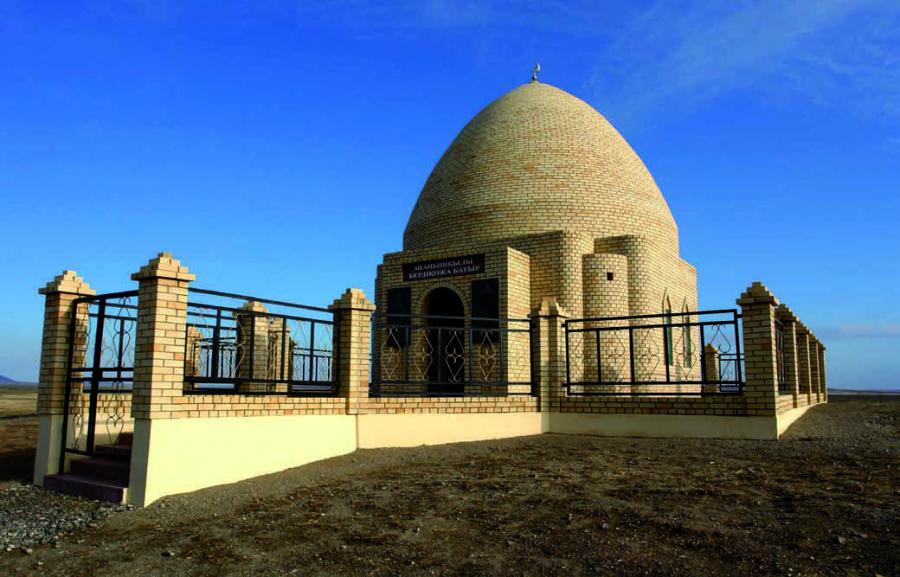
Berdykozha Batyr Mausoleum is located on the top of a high hill, which is part of a small hill on the right bank terrace of the Dagandaly River, near the mountains of Kokshetau and Duan. When choosing the burial place of Berdykozha Batyr, obviously, the factor of the surrounding landscape, the availability of roads and water sources were taken into account. This also indicates the special social status of the Batyr. Besides, Berdykozha Batyr himself bequeathed to bury him in a place where busy roads pass and where travelers could read a prayer at his grave. The elevation on which the mausoleum is erected dominates the surrounding plain. This ensured good visibility of the site at a considerable distance from the steppe landscape. Such a favorable location of the monument was also noted by travelers, for whom the construction was a significant landmark for centuries.
The mausoleum is square in shape and measures 6.50×6.25 m. The walls of 0.5-0.55 m wide are composed of two rows of horizontally laid rectangular raw bricks of 40×25×10 cm in size, between which a binding solution of river clay with pebble admixture is fixed. In the lower part of the walls, large boulders are fixed, mounted in the walls for their additional strengthening. The entrance of the mausoleum is oriented to the south-west. A small vestibule was built in front of the entrance. The floor of the mausoleum is covered with lime plaster. In the central part of the building there is a tombstone in the form of a trapezoidal mud brick.
The area where the mausoleum is located, judging by the abundance of monuments in the range of 3,500 years, has been attracting people since ancient times and was sacred. Here, in the upper reaches of the river Dagandaly, near the mountains of Karakoitas and Akkoitas, there is a unique cult-memorial complex with burials of the ancient elite and significant stele-mangirs. Monuments of the Bronze Age are represented by classical square or rounded fences made of slabs placed on the edge, inside which the upper edges of stone boxes are fixed on the surface. The Late Bronze Age is represented by grandiose barrow structures made of huge stone slabs that make up square and rounded fences inside the embankment. Monuments are accompanied by stone steles. Monuments of the early Iron Age are represented by rounded barrows of stone, and the Turkic era - by square stone fences accompanied by stone steles. Close to archeological objects there are cult and memorial monuments of the XVIII-XIX centuries, similar to the mausoleum of Berdykozha Batyr. They have a helmet shape, vestibules in the entrance part, limestone walls, etc. The nearby mausoleums of Sartymbai Batyr, Zhapalak Batyr, Bi Tlegen, etc. allow to apply the name "Batyrs' Valley" to the micro-region. The mausoleum was built in 2016 over the ruined structure of the burial site. The mausoleum of Berdykozha Batyr meansIn the lists of historical and cultural monuments of local importance, it is the object of pilgrimage and tourism.The mausoleum was built in 2016 over the ruined structure of the burial structure. The mausoleum of Berdykozha Batyr is included in the lists of historical and cultural monuments of local importance, it is a pilgrimage and tourism destination.