Information
- Location
- Маңғыстау облысы, Karakiya District
- Period
- 1601 – 1950
- Category
- Historical and cultural monuments of republican significance
- Type
- Сomplex
- Kind
- Archaeological sites
- Authors
- Ажигали Серик Ескендирулы
Sources
- Қазақстанның киелі орындарының географиясы: Табиғат, археология, этнография және діни сәулет өнері нысандарының тізілімі / Жалпы редакциясын басқарған ҚР ҰҒА академигі Байтанаев Б.Ә. – Алматы: Ә.Х. Марғұлан атындағы Археология институты, 2017. – 1-шығарылым. – 904 б.
Description
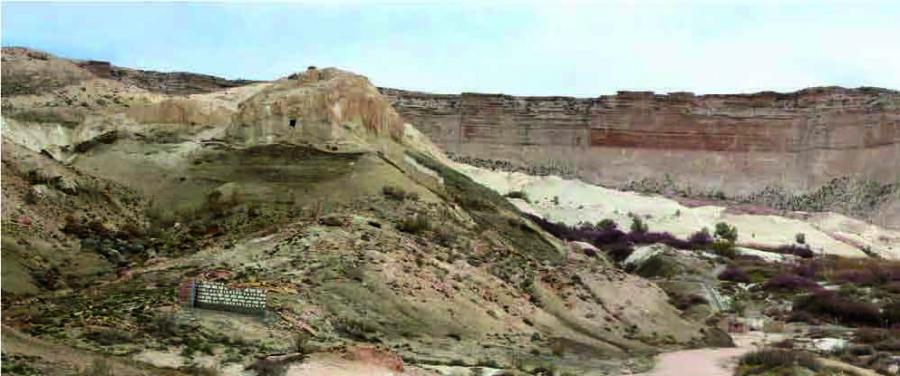
It is situated in 61 km to the east - northeast from the village Senek (mosque) (Karakiyan district, Mangystau region). The monument is located in the picturesque and inaccessible area of Ustyurt's western mantle in the recent past, in the area of Oglandy and consists of a rocky mosque (ritual center of the complex), located around it cemetery and another necropolis on the top, on the plateau, at a distance of more than 1 km to the east-south-east from the cave complex. From the upper necropolis of Oglandy, where a large cultural and tourist complex has been built, a winding path leads to the mosque below.
The cult and memorial tourist complex Beket ata in Western Ustyurt is particularly popular among the population of the Caspian region and Kazakhstan as a whole, among domestic and foreign tourists. It is connected with many factors and first of all with the personality of Beket ata - one of the most famous religious and spiritual enlighteners in Western Kazakhstan, and also with unique features of the landscape and nature. According to a cycle of national legends and literary sources of the XIX century, Beket Myrzagululy from the subdivision munal of the genus Adai was engaged in selfless activity, taught the literacy of children in the late XVIII - early XIX centuries.
The dates of his life are not exactly known. Thus, the naturalist E. Eversmann, who participated in the expedition of Colonel F.F. Berg to Ustyurt, in January 1826 wrote: "...This strange hermit died 12 years before his death" [Eversmann, 1963, p. 145]: that is, about 1814. Subsequently, Lieutenant Alexeyev, who conducted a topographical survey of Ustyurt and, accordingly, a survey of local Kazakhs in 1851-1852, indicated in his report that Beket "died about 40 years ago" [Alexeyev-2, 1963, p. 282-283]. In recent publications, the date of Beket's death is 1813 or so. Obviously, the second statement is more correct, namely: attributing the date of Beket's death to the first half of the 1810s. According to popular legends, according to which Beket ata lived to the age of the Prophet (63 years), the date of his birth is "derived" - 1750. However, this date (or, more precisely, its life span) is also questionable due to its obvious tendentious "traditionalism", since in the agiology of the Turkic peoples of the region the life span of the "saints" was often determined by the age of Muhammad. Similarly, it is believed that Ahmed Yasawi, having lived to the age of the Prophet, "entered the dungeon for 63 years", where, according to some reports, he spent the rest of his life. Thus, the indication of the years of Beket's life as 1750-1813 should be regarded as very conditional, although perhaps close to the truth.
Other biographies of Beket Myrzagululy are mainly based on folk historical legends, surveys of informants. He apparently spent the first half of his life (up to 40 years old) as an ordinary nomadic cattleman, at the same time showing outstanding qualities of a Batyr. He was a contemporary of Barak Satybaldyuly, a famous batyr of the Shomishti family - the tabyn. It is also believed that Beket received his religious education in Beskala (Khiva) from Pakirzhan Kazhy (K. Sydiykuly). A great popularity and respect among the people was gained by the selfless activity of Beket ata: at the end of the XVIII - beginning of the XIX centuries he taught the literacy of nomadic children, was a spiritual mentor of the Kazakh cattle breeders Mankystau, Ustyurt, Embi valley. During this period he also proved himself as an original architect and builder. It is known for certain that under his leadership three mosques were built: on Embi, in Beineu and here, on the western mitt of Ustyurt, in the area of Oglandy, where Beket Myrzagululy was later buried. E. Eversmann points to the existence of another, fourth, mosque - in the area of Bayaly, "in the vicinity of the Aral Sea". However, its existence and, accordingly, its exact location is not definitely proven. Perhaps, it is noted by the geographer S.V. Viktorov and others "Akmechet underground" ("Akmeshit", "Akshukir") in 135 km to SSE from Oglandy, or the object under a similar name in 220 km to the east from it, which is mentioned by some informants. It should be noted that in the same deep part of Ustyurt there is also a famous well Bay, Baylar ("Bayali" of Eversmann?)]. The cave in Tobykty on Buzachi Peninsula is also mentioned as one of the mosques of Beket in the literature. It is considered that these mosques were built by Beket for his sons: Baitele (Baiteli), Zhailau, Togay and others. It is also noted in the literature that they were located in places of seasonal pastures of Beket's aul.
During the XIX - early XX centuries the main of these rock-subterranean mosques (in Oglandy, Beyneu and Embi) became the centers of large cult-memorial complexes and retain their significance to this day, and the complex in West Ustyurt is now the largest object of "sacred geography" of the Aral-Caspian region. The monuments are under the protection of the state, and in recent decades they have undergone large-scale repair and restoration works and landscaping activities, etc. At the same time, it should be noted that the anthropogenic load on these objects, especially on the protected complex of Beket ata - Oglandy, has increased very significantly in the recent period and, perhaps, requires certain regulation.
The personality of Beket ata Myrzagululy is associated with a long cycle of legends and historical stories: "Oglandy and Beket-ata", Beket-ata, Barak, Baluaniyaz", Beket-ata and Bekdurdy ishan", etc. His name once became the cry of the Kazakh tribe of Adai. The multifaceted personality of Beket ata is dedicated to a number of publications, the kuy of the same name; in Mankystau and other regions of Kazakhstan there are periodically celebrated events dedicated to the anniversary dates of the life of the spiritual educator.
The cult complex Beket ata (Oglandy) due to the above mentioned factor of inaccessibility purposefully began to be studied by corresponding experts only from the end of 60th - beginning of 70th years of XX century. One of the first was architectural expedition of 1973 under the hands of prof. M.M. Mendikulov (Central Office of the Society for the Protection of Historical and Cultural Monuments of Kazakhstan - KazPTI), in 1978, 1980 expeditions of the Ministry of Culture of the Kazakh SSR, in 1982 - the expeditionary group of the Central Office of the OOPIK, etc., in 1996 - specialists NIPI monuments of material culture of the Ministry of Culture of the RK (S.S. Agitaev). In 1999-2000, 2003 on the monument were carried out repair and conservation (fortification) and restoration works. In 2010-2011, a highway from the regional center was laid to the remote monument complex.
The cult-memorial complex Beket ata (Oglandy) consists of three main parts: a rock mosque of the end of the XVIII century, located near it on the steep slopes of the necropolis of the XIX - early XX centuries and the upper cemetery of Oglandy, the base of which dates back to earlier times. The mosque is carved out in a rock, consists of five rounded in terms of cameras, in the extreme southwest there is a mihrab niche. In the northern room in the dome there is a light hole, in the niche there are horns of argali. Initially, the mosque was the home of the hermit, deeply revered by the people; after his death it was buried here (in the northern cell, in the niche). Currently, its premises have been landscaped, and a special area has been arranged in front of the mosque entrance. Approaches to the mosque are taken: the main one from above is from the plateau (where the cultural and pilgrimage center is located) and from below - from the valley. On the steep slopes around the rock sanctuary there are numerous Kazakh gravestones - saganatams, kulpytases and koitases, the construction of which in this area was very difficult. Due to the special relief difficulties, many monuments were destroyed in their time.
Located at the top of the cemetery of Oglandy by the time of the founding of the mosque there was already its name (or location, in general), apparently related to the Oghuz-Kipchak term "Oglan" - young, youth, child. In the Middle Ages, in the Golden Horde, Maverannahr and Asia Minor, the term "Oglan" was also used to refer to princes, military leaders, commanders of troops, etc. Obviously, the name of the monument is connected with the last meaning of the word: either with the burial place of a young man, the prince, or with the area of residence - camp, shelter. A. Kekilbaev does not exclude that the medieval ruler of Mangyshlak Tuikhodzha-Oglan ("Түйе Khodzha Ogylan") could be buried here somewhere. Oglandy necropolis is represented mainly by archaic monuments of XVII-XVIII centuries: cyclopean fencing made of limestone, calculations, crates of broken stone with rough steles on one or both sides. In addition, there is a group of similar structures, but in combination with highly artistic Kazakh steles of the XIX century. Many of them are accompanied by interesting epigraphic material, tamgas.