Information
- Location
- Kyzylorda Region, Aral District
- Period
- 901 – 1100
- Category
- Historical and cultural monuments of republican significance
- Type
- Tower
- Kind
- Buildings of monumental art
- Authors
- Тажекеев Әзілхан Әуезханұлы
Sources
- Қазақстанның киелі орындарының географиясы: Табиғат, археология, этнография және діни сәулет өнері нысандарының тізілімі / Жалпы редакциясын басқарған ҚР ҰҒА академигі Байтанаев Б.Ә. – Алматы: Ә.Х. Марғұлан атындағы Археология институты, 2017. – 1-шығарылым. – 904 б.
Description
It is situated in 68 km from Aiteke Bi town (Kyzylorda region).
The tower is located on the dominant point of gentle elevation. A.I. Maksheyev, an officer of the general staff, noted: "The tower is located on an elevated place, probably before the former island, four versts from the Kara-Aryk and 10 versts from the Aral Sea coast... The wife of Chanjar, Kyzylbash Khan, is buried here. There is no reliable information on the history of the tower erection, the legends that still exist connect this monument with the wife of Sanzhar, the ruler of Zhankent: an undeservedly offended young woman, having turned into a bird, settled in this construction forever.
According to the legend, once Sanzhar Khan, the ruler of Zhankent, saw a young Begim sulu and at first sight fell in love with a beautiful, intelligent girl. Having gone through all the stages of the rite, he married her. But as a jealous husband, he would not let his wife leave the house, and no man could enter her chambers. One day, when Sanzhar Khan was going hunting, he found out that he had forgotten his armor at home. Having sent one of their batyrs to the khan's palace, they stayed waiting. It took a long time, but the Batyr never returned. Angry Sanzhar had galloped home. Upon arrival at his wife's quarters, he found a batyr lying unconscious. Sanzhar began to insult his wife, accusing her of treason.
Begim, knowing that there were no men in the palace, walked around the palace, not covering her face. Neither did she notice a batyr running in looking for his ruler's armor. Begim's beauty impressed him so much that he fell without feeling. Not listening to excuses, Sanzhar cut off his wife's braids and wrist in fury. Begim left her house in tears and hid in a minaret (Begim Tower) near the Aral Sea. This minaret still exists as a memory of St. Begim Ana. Begim's father Karabura, offended and hurt by the injustice of Sanzhar khan to his daughter, prayed to the Almighty for justice. To people's surprise, the girl's hair and hand grew overnight. However, the wounded heart of his beloved daughter father could not cure.
According to legend, Zhankent was flooded by snakes, and the inhabitants left this city forever. The caravans were bypassing the snake city, the birds did not build nests, and the animals were afraid to approach... In 1867, the famous artist Vasily Vereshchagin was struck by history - "the tragedy of Zhankent", he wrote: "Kazakhs told a story about the existence of a large city here, allegedly once and said that there were buildings destroyed by snakes. Here lived the khan, he married the daughter of the king, but for infidelity he wanted to take her life. The father-in-law was a sorcerer (baksy). He put snakes on the city, which ate the khan and all his subordinates".
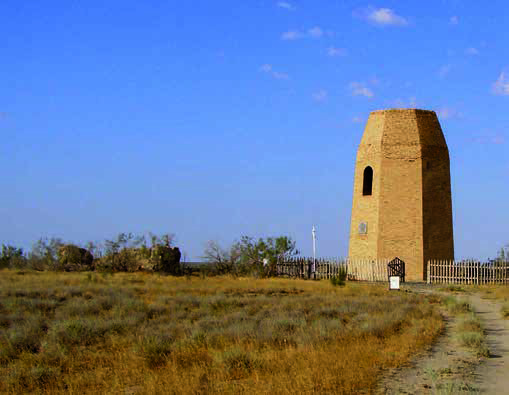
The tower of Begim ana stands on the necropolis, which consists of a large number of heavily damaged burial facilities in the form of floating raw fences, hills and hollows. Munara is the undisputed dominant feature, and in the flat terrain it is visible from many kilometers away.
The raw body of the tower is lined with burnt square brick (23×23×5/6 cm), from time to time the brick has acquired a dark brown hue (patina). The tower has the form of a slightly narrowing octahedral prism crowned with a kind of dome in the form of an octahedral truncated pyramid. The tower's pillar is monolithic up to the middle of the tower's height; above it there is a round vaulted chamber with a large anti-aircraft hole. This room is accessed by an archway located in the middle of the monument's height. The upper part of the cell is lined with baked bricks, and above the cell there is a platform fenced with an inclined parapet - a pyramidal dome. The monument has now been restored, but at the same time such elements as the shape of the archivolt of the arch, the color of the original bricks, etc., have been lost. Moreover, the image of the severe ancient tower that dominated over the surrounding space has also been lost.
The monument has an extremely important historical and cultural significance, as it belongs to a unique type of tower. Only two towers of this type are known at the mouth of the Syr Darya: Uzun-Tam and Saraman-Kosa. Other places in Central Asia and Kazakhstan do not have such towers. The monument also reflects the rich spiritual heritage of Kazakh culture, preserving the best examples of oral art and folk architecture. Pilgrims, especially women, come here.