Information
- Location
- Zhambyl Region, Bayzak District
- Period
- 1850 – 1900
- Type
- Mausoleum
- Kind
- Sacred objects
- Authors
- Сатенова Марал Ратаевна
Sources
- Қазақстанның киелі орындарының географиясы: Табиғат, археология, этнография және діни сәулет өнері нысандарының тізілімі / Жалпы редакциясын басқарған ҚР ҰҒА академигі Байтанаев Б.Ә. – Алматы: Ә.Х. Марғұлан атындағы Археология институты, 2017. – 1-шығарылым. – 904 б.
Description
The second half of the XIX century. Located on the top of the hill, on the border of Dikhan and Sarykemer rural districts, on the right bank of the Talas River, 4-5 km north-east of the village of Sarykemer (Zhambyl region).
Baizak Mambetuly (1789-1864), better known in history as Baizak datka, - bi, batyr, ruler of the family Shymyr of the tribe Dulat. He is a descendant of the legendary batyr Mambet Kundasuly, according to legend, a close ally of Abylai Khan, an active participant in the Kazakh-Dzungar wars. Baizak batyr - a significant figure in the history of the national liberation movement in Zhetysu and South Kazakhstan, repeatedly led the Kazakh people against the Kokand domination. In 1821, after the next tax collection, the Kazakh clans of the Elder Zhuzes, who were in the power of the Kokand khanate - syrgeli, oshakty, ysty, shymyr and zhanys - rose up under the leadership of Sultan Tentek-tore (Rustem Asfendiyaruly). As T.K. Beisembiyev points out, about 12 thousand people gathered under the sultan. One of the leaders of the movement was Baizak batyr and his brother Baiterek. The rebels seized the fortress of Sairam, spread their influence on the cities of Shymkent, Aulie-Ata. However, being defeated in the oncoming battle, the rebels split into two parts and took refuge in the fortresses of Sairam and Shymkent. After a long siege, the defenders of the fortifications surrendered. Sultan Tentek-tore, Baizak Mambetuly and other Kazakh foremen had to agree to pay to Kokand the baj (road tax or duty) annually. Nevertheless, Kokand authorities, paying tribute to the courage of batyr Baizak Mambetuly, elevated him to the rank of dadhah (literally - pleasing to justice) and appointed him ruler of the Shymyr family. In the 40s of the XIX century, with the arrival of Khan Kenesary in the region of Zhetysu and the intention to deploy a liberation movement of Kazakhs not only against the Russian colonization, but also against the Kokand domination, he was supported by many clans of the Elder Zhuz. Among the supporters of Kenesary khan there were Toishybek, Suranshy, Sypatai and Baizak Mambetuly batyrs. In 1841 warriors of Baizak datka took part in the capture of the Kokand fortresses such as Zhanakorgan, Zhulek, Ak-Mechet, participated in the siege of the Sozak fortress. After the death of Kenesary Khan Baizak datka returned to his native land and continued the liberation struggle of the Kazakhs against the Kokand viceroys. For a long time he supported the struggle of Toishybek batyr and his son Baiseit, in 1858 together with Kyrgyz troops he fought with the Kokandians in the Shu-Talas region.
In 1860, he took part in the Battle of Uzunagach in cooperation with the Kokand army in order to support the struggle of Kazakh batyrs Suranshy, Sypatai and other elders against the strengthening of colonization of the tsarist Russia in Zhetysu. In the early 1860s, the dzhigits of Baizak datka, together with the Kyrgyz batyr Sarymsak, took part in the siege of the Kokand fortifications of Merke, Cholak-Kurgan, and Aulie-Ata, which contributed to the rapid advancement of Russian troops in the Talas region. In the summer of 1864, Baizak Mambetuly sent his worriors headed by his son Akmolda in support of the Russian military detachment approaching Aulie-Ata. Having learned about it, the Kokand authorities have grasped 75-year-old Baizak datka and have subjected to severe execution: having tied the alive to a canon's vent, have torn off his body by a shot. The news of the death of a respected elder and a batyr led to a powerful surge of national liberation movement in the region. His son Akmolda batyr led 1,000 dzhigits to the troops of Colonel M.G. Chernyaev and took an active part in the siege of Shymkent.
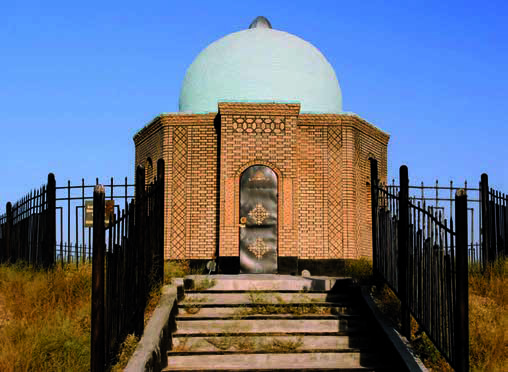
According to oral information, after the death of a batyr, relatives could only find two of his fingers. The remains of Baizak were buried on a high hill, on the site of an ancient barrow. Since then, this hill has been popularly called Baizak Soresi. Above the grave of the batyr the relatives built a raw mazar, which was completely destroyed by the beginning of the XX century. In 2000, a new mausoleum designed by architect A. Momynzhanov was erected over the burial site of Baizak datka Mambetuly. Despite the fact that the construction was built of modern building materials, the architecture of the construction corresponds to some traditions of cult and memorial architecture of the region. The small size of the building looks majestic due to its location. The mausoleum is made in the form of an irregular hexagon, stretched in the longitudinal axis. The rounded dome of the building is located on a high drum. The main dome ends with a small dome and a crescent moon. The main facade is decorated with a narrow portal with an arched entrance vestibule. Four side facades have window openings. The outer walls are lined with light Khorezm bricks, with ornamental masonry and a panel of carved bricks. In the center of the room there is a tombstone 0.9 m high, which uses raw bricks from the old burial site and a granite memorial plate. A metal fence is arranged around the mausoleum. Wide concrete steps lead from the foot of the barrow to the mausoleum. In 1998, at the entrance to the village of Sarykemer, a monument to Baizak Mambetuly (architect Zh. Moldabaev) was erected on a hill. The monumental figure of batyr is made of pinkish-grey granite. The height of the monument is 4.2 m. The height of the pedestal, lined with red granite, - 2 m.
Вaizak datka Mambetuly played a significant role in the history of the national liberation movement in the XIX century. He devoted his life to the struggle for independence of the Kazakh people in the Shu-Talas region. Many efforts were made by Baizak datka to strengthen the welfare of the local region. He paid great attention to creating a system of irrigation channels, which were dug under the leadership of Baizak Mambetuly and his sons. Most of them were named after the children and close relatives of the batyr. He also cared about the spiritual development and education of the inhabitants of the region. With his direct participation, several mosques were built, which functioned until the establishment of Soviet power. His name is widely known and revered in Zhambyl region and beyond. At one time, the exploits of Baizak batyr were sung by Zhambyl Zhabayev.