Information
- Location
- Zhambyl Region, Merki District
- Period
- 401 – 1500
- Type
- City
- Kind
- Archaeological sites
Sources
- Қазақстанның киелі орындарының географиясы: Табиғат, археология, этнография және діни сәулет өнері нысандарының тізілімі / Жалпы редакциясын басқарған ҚР ҰҒА академигі Байтанаев Б.Ә. – Алматы: Ә.Х. Марғұлан атындағы Археология институты, 2017. – 1-шығарылым. – 904 б.
Description
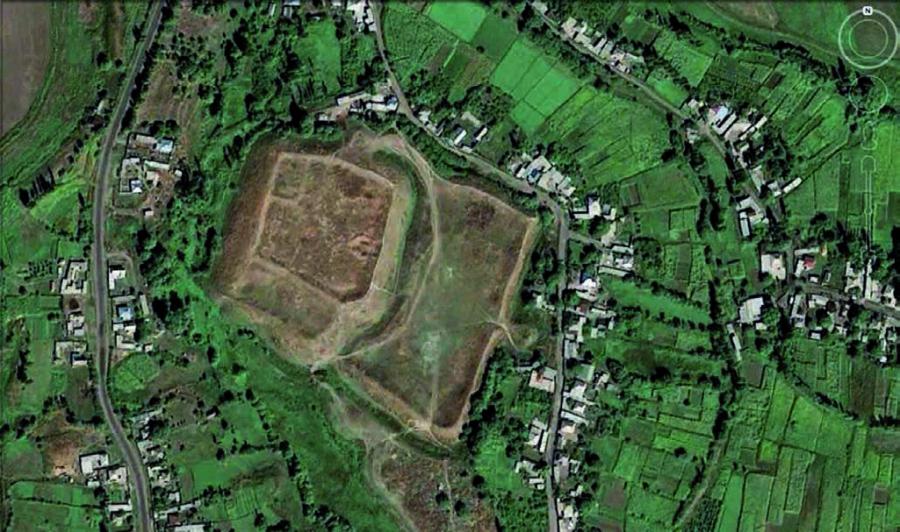
Located in the village of Chaldovar (Merke district, Zhambyl region).
The formation and development of cities in Central Asia and Kazakhstan with common laws was not a pattern, having its own clearly identifiable features. The structure of medieval cities was also not unified and depended on the objective conditions of the process of urban formation. This conclusion is especially important and characteristic for medieval Kazakhstan, where the formation of urban centers took place in the conditions of historical interaction between the settled-agricultural and nomadic population, which affected the topography and types of cities, the originality of urban culture. From the early stages of formation and development of civilization an important role in the development of society and statehood played cities. Combining administrative, social-economic, integrative functions, they were centers of science, cultural life, as well as a place of concentrated development of civilization processes in the region.
In written sources, Aspara was first mentioned in the notes of the Chinese Buddhist pilgrim Xuan-Jiang as the city of Osubolai - Aspara back in the VII century. At that time Aspara was also mentioned for the first time by Arab travelers - Ibn Hordarbek and Kudama.
The monumental ruins of Aspara are located near the village of Chaldovar on the right bank of the Aspara Gorge. The ruins of the ancient town of Aspara are found, firstly, because they still have an ancient name of Aspara, or Ashpara (they are also called Asrantobe), and secondly, they are located 25 km from the ancient town of Mirka, which corresponds to the 4 farsakhas that separated these cities, thirdly, the nature of the ruins of Aspara after its destruction by Mongols in the beginning of XIII century was restored by Timur and turned into a city-fortress, which should have provided the rear of Timur's troops, who were preparing for a campaign in China, among other fortresses. There is hardly any other monument in Kazakhstan, which could be compared with Aspara by the monumentality of its ruins. The height of the most elevated part - the citadel - reaches 20 m, on the edges of the ancient settlement there is a well-preserved rampart under which powerful fortress walls are guessed, deep moats up to 10 m wide surround it from all sides. Even now it is difficult to reach Aspara because of the marshy terrain, and only dams and ramps of entrances indicate the places through which once reached the city.
In the 70s of the XIV century Timur was preparing for a campaign to China, but on the eastern border there was a tense geopolitical situation: the soldiers of Mogulistan constantly disturbed the outskirts of the empire. Emir Timur repeatedly made attempts to subdue Mogulistan, but unsuccessfully. At the end of the XIV century in the empire there was a need to strengthen the borders by building powerful fortresses. The biographer of Timur ibn Arabshah wrote about it: "The story about the arrangement by him (Timur) from the side of Moguls and China and about what he did in these places. When he arrived in Samarkand, he sent his grandson Muhammad Sultan, son of Dzhangir, along with the emir Safe Al-Din, to the extreme point where his words and decrees reached, and this is what is beyond the River Seikhun ..., a month's journey from the country of Maverannahr. They occupied valleys and fields and built several fortresses, the most distant of which is called Aspara... an impregnable fortress, ready to be robbed and devastated...".
Before the Mongolian expansion, Aspara consisted of a citadel, a shahrestan and districts in the form of agricultural and artisanal buildings outside the city walls. Aspara was also mentioned in the message of Giyaz-ad-Din, who accompanied the Embassy of Shahrukh (son of Timur) to China in 1419. 100 years later, information about Aspara appears in the sources of the Kazakh khanate. The last news about Aspara belongs to the beginning of the XVI century: "In winter of the year nine hundred and nineteenth (1513-1514) Kasym Khan left in the direction of Aspara for the sake of mastering his own countries". In the middle of the XVI century Muhammad-Haidar tells only about ruins of cities in the Shu valley. It is known from written sources that the main population of the fortress was a military garrison. However, outside the powerful walls of Aspara there were also civilians engaged in agriculture and cattle breeding, pottery and metal smelting. Evidence of this is the numerous animal bones, iron coulters, ceramics, metal findings.
The monument was researched by the Semirechensk archeological expedition in 1938-1940 under the direction of A.N. Bernstam, in 1964-1965 - L.B. Yerzakovich, in 2012-2014 - A.A. Nurzhanov and E.Sh. Akymbek. The length of the destroyed walls in the north is 245 m, in the east - 300 m, in the south - 196 m, in the west - 150 m. The citadel is 190×160 m in size and 15 m high. The main part of the city existed in the V-XII centuries, and the north-eastern part was built in the XIV-XV centuries.
The walls of the ancient settlement of Aspara are made of raw bricks, and the mud floors are covered with mosaics of square raw bricks. The specificity of the fortress walls is of particular interest: no walls were found in the layer of XIII-XIV centuries. Perhaps, it is connected with the practice of Mongolian destruction of walls. The fortress wall appeared only at the end of the XIV century.
Archaeologists consider the cow's shoulder blade in one of the rooms to be an interesting find in the Aspara hillfort. The product arouses interest in its original shape and finish. It has a smooth yellowish surface, covered on both sides with Turkic letters in the Arabic alphabet, made in black paint. It is clear that it is composed on the occasion of the simultaneous death or death of many persons of high social status. The inscription had ritual and sacral meaning. At present, the local residents of Chaldovar village have erected a symbolic sacral monument depicting a cow's shoulder blade to commemorate this unique find at the entrance to the hillfort.
Aspara is a monument of urban culture of Kazakhstan, an object of cultural heritage of the country.