Information
- Location
- Ақтөбе облысы, Bayganin District
- Period
- 1800 – 1950
- Type
- Сomplex
- Kind
- Ensembles and complexes
- Authors
- Ажигали Серик Ескендирулы
Sources
- Қазақстанның киелі орындарының географиясы: Табиғат, археология, этнография және діни сәулет өнері нысандарының тізілімі / Жалпы редакциясын басқарған ҚР ҰҒА академигі Байтанаев Б.Ә. – Алматы: Ә.Х. Марғұлан атындағы Археология институты, 2017. – 1-шығарылым. – 904 б.
Description
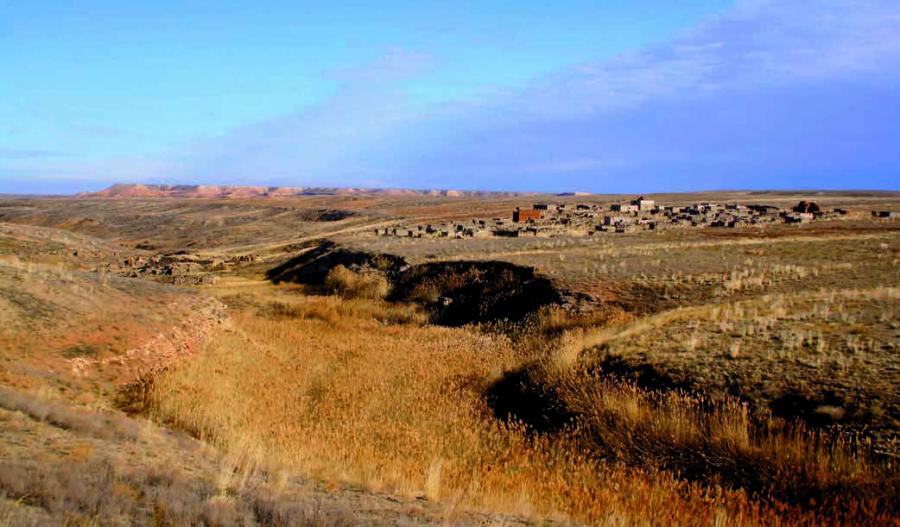
The monument is located 53 km south-west of the former village Aktumsyk, in the upper reaches of the largest of the same name ravine Aschy-Airyk of Northern Ustyurt (Donyztau) (Baygani district, Aktobe region). The object is a well-preserved old Kazakh settlement, consisting of several groups of monuments.
The emergence of the complex refers to the middle of the XIX century and associated with the transition of a significant part of the Kazakh-nomads of Ustyurt (first of all the Shomyshty – Tabyn family) to a semi-nomadic semi-settled way of life, with the establishment of Islamic religion as an ideology in the Aral-Caspian region, the need to teach Kazakh pastoralists children to read and write. The settlement, which is mainly of a cult nature, was left by the Kazakhs of the above-mentioned family of karakoilysubdivision. According to informants, “a mosque in Aschy-airyk was built by one Adai, who then transferred it to Ishan from the Tabyns who wandered here” (M. Nurmagambetov, born in 1907, Bulaktykolvillage, Baiganin district); according to some reports, the ishans of the mosque were representatives of the Tabyn subgenus Zholy, subdivision of Ekibas (T. Serikbayev, born in 1937, Algavillage, Alga district). Cult-housing complex functioned until the end of the 20s - early 30s of the XX century. In 1892, the monument was visited by the expedition of geomorphologist S.N. Nikitin, during which, apparently, was carried out photofixation of the settlement. It was a combination of stationary forms of housing and cult buildings with mobile dwellings (yurts).
The Aschy-Airyk complex, like many similar Kazakh settlements in the Northern Ustyurt region, is an object of special historical memory, the most important cultural monument of the modern population of the southern districts of the Aktobe region and adjacent territories (right up to the right bank of the Amudarya River - the Beskaladistrict, where is a significant number of Kazakh diaspora). Until the early 1990s, the object was visited by representatives of the Kazakh Shomyshty clans - Tabyn and partly Adai, but due to changes in the infrastructure and the departure / relocation of the pastoral population from the southern half of Baiganin district and due to the particular remoteness of the monuments, the pilgrimage was significantly reduced. Nevertheless, many natives of these places and their descendants periodically visit the Donyztau cult-housing complexes. In the 2000s, a commemorative obelisk was erected in memory of the activities of outstanding Ishan - spiritual enlighteners in the region of Northern Ustyurt, many of whom were repressed in Czarist times and under Soviet rule, near the complex Aksai-1, east of Aschy-Airyk. with the text: “Zholaushy! Zhazyksyz zhapa shekken ishandardyng aruaghyna arnap dugha okyngyz! Urpaktary" ("Passenger! Pray to those who suffer innocent victims! Sons").
Along with this, the cult-housing complex Aschy-Airyk (like many others in Donyztau) is an outstanding historical and cultural ensemble, a monument of architecture and construction culture of the Kazakhs. These objects represent a unique, inimitable phenomenon in the history of culture not only in Kazakhstan, but also in the entire steppe Eurasia. In addition, cult-housing complexes of Northern Ustyurt have uncommon potential for the development of tourism (including extreme) and, of course, are objects of high sacredness. The Aschy-Airyk complex has the status of a monument of architecture and urban planning of local importance.
The cult-housing complex Aschy-Airyk consists of five groups of monuments located along the banks of the ravine, gradually lowering in the north direction. On the eastern side of the ravine there is a large necropolis and a mosque, along with residential and farm buildings. On the opposite slope there are also a housing complex and two separate cemeteries to the south of it. The center of the whole ensemble is a mosque with the buildings around it, built of primary processed blocks of sandstone and mud brick. Actually, two-nave mosque, with extensions from the west and east. Characteristic of the box roof arches over the premises. Nearby stands a building with a helmet-shaped dome, folded from sawn-off blocks, which was obviously of an administrative-official nature. Of great interest are the funeral monuments, in particular, the construction of burnt bricks on the main necropolis: a two-chamber mausoleum with domes, as well as a giant saganatam with an original decor of facades and tops at the corners. Along with this, there are specific saganatams and a helmet-shaped mausoleum made of characteristic processed blocks and sandstone slabs. A large number of various kinds of fences are made of sawdust, chipped blocks, including an old wrought iron fence with two kulpytases.