Information
- Location
- Маңғыстау облысы, Beyneu District
- Period
- 400 BCE – 101 BCE
- Type
- Temple
- Kind
- Archaeological sites
- Authors
- Косинцев Павел Андреевич, Ақан Онғар
Sources
- Қазақстанның киелі орындарының географиясы: Табиғат, археология, этнография және діни сәулет өнері нысандарының тізілімі / Жалпы редакциясын басқарған ҚР ҰҒА академигі Байтанаев Б.Ә. – Алматы: Ә.Х. Марғұлан атындағы Археология институты, 2017. – 1-шығарылым. – 904 б.
Description
It is located 25 km north-west of the village of Turysh (Beineu district, Mangystau region).
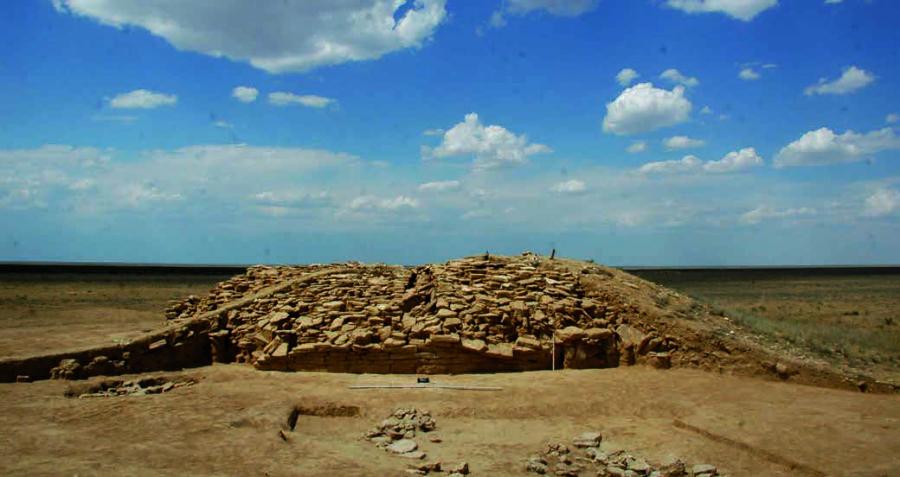
Akpan temple belongs to the group of Ustyurt sanctuaries. One of the largest cult objects. The initial diameter of the stone temple is 20.4 m, its height is no less than 7-9 m. The main cult construction consists of two circular walls. The facade of the external wall is carefully processed. The diameter of the inner space is 7.7×7.8 m. The entrance is located on the southeast side and has the form of a corridor. The length of the entrance is 5.7 m, width - 0.68-0.86 m. The entrance threshold rises above the clay floor of the temple at 1.66 m. It is decorated in the process of construction of a stone "body" of the temple design, made in 16 rows, i.e. construction was carried out simultaneously and according to a single plan. During the cleaning of the inner part of the temple on the floor there were fixed the evidences of carrying out the rituals in the form of the remains of hearths and bones of animals.
From the south, southwest and southeast sides of the temple four pits were revealed - the places of sacrifice. The pits were filled with numerous bones of sacrificial animals, as well as fragments of ceramic vessels. Opposite the entrance, near the outer wall of the temple, four specially left upside down clay vessels were found.
All bone remains of animals were found in pits, which indicates their deliberate burial. The complex of bone remains has a complex structure. It includes at least five elements: sacrificial remains, ceremonial remains, food remains, tools and animals that have died naturally. It should be noted that the first two complexes are difficult to separate. Remains of ceremonial actions include accumulations of small bones of small ruminants and saigas, as well as gazelle bones. Tarans could be used for playing, and gazelle scapular bones for playing and fortune-telling. Most ungulate bones are food remains. It is possible that these are traces of some ritual activities in which animal meat was used as food. It should be noted that with the use of animal meat for food, bones were not broken or broken into only 2-3 parts. Wild ungulate bones, saiga and kulan, which together constitute more than 80%, dominate. Mined kulans were slaughtered and eaten near the sanctuary, and saigas were mainly used to bring heads and upper ("meat") parts of legs to the sanctuary. Young sheep were generally slaughtered and adult kulans and saigas were hunted. According to ethnographic data, this is quite possible - the horse was first slaughtered as a sacrificial animal, and then the meat of the sacrificial animal was eaten. Other hoofed animals could also be treated. Analysis of the slaughter seasons of three animal species (sheep, horse and saiga) showed that people performed rituals in the Akpan sanctuary in two periods: late spring - early summer and autumn.
It can be assumed that the rituals held at the sanctuary are associated with wandering. They were performed in late spring when leaving the place of wintering and in autumn, after returning to the place of wintering.
After a while the temple was used for other purposes for the second time. The southwestern part of the outer wall of the main cult construction was rebuilt. In the inner part of the temple at different depths were found burials of five people. Near one skeleton in situ position 13 golden plaques of clothes were found.
The monument has a sacral character as an ancient cult construction. The materials received as a result of its research allow to find out a number of questions not only about character of ancient cults and rituals, but also about an economic orientation of a life of a society of ancient nomads, building business, architecture, etc. Some aspects of ancient views and related acts were preserved in nomadic culture for more than two thousand years before the ethnographic modernity. It is a monument of archeology of republican importance. Object of tourism.