Information
- Location
- Павлодар облысы, Ekibastuz District
- Period
- 0
- Authors
- Батталов Қайрат Қанатұлы
Sources
- Қазақстанның киелі орындарының географиясы: Табиғат, археология, этнография және діни сәулет өнері нысандарының тізілімі / Жалпы редакциясын басқарған ҚР ҰҒА академигі Байтанаев Б.Ә. – Алматы: Ә.Х. Марғұлан атындағы Археология институты, 2017. – 1-шығарылым. – 904 б.
Description
It is located in the interfluve of the lower reaches of the rivers Olenti and Shiderti (Ekibastuz district, Pavlodar region). Akkol-Zhaiylma is a subregion specific to the steppe of Saryarka and is distinguished by its rich nature. The lowland, flooded in spring by the rivers Olenti and Shiderti, provides juicy and dense vegetation for pets.
Information about this region is found in the manuscripts of Mashkhur-Zhusup Kopeyev. Mashkhur often wrote about Akkol-Zhayiylma in the context of the land where the saints settled down. The study of Akkol-Zhaiylma is connected with the names of ethnologists Zh. Artykbaev, A. Zhanisov, historian G.B. Nurakhmetova, the study of the Auliekol complex was carried out by archaeologist T.N. Smagulov. Materials on the region were reflected in publications and mass media.
The toponym Akkol-Zhaiylma is often found in the works of M.-Zh. Kopeyev and in the folk epic "Kozy Korpesh - Bayan Sulu", in the legend about Altai, the description of the region is available in "Materials on Kyrgyz land use". The region is represented by the historical heritage of different eras. The Kyrgyz Land Use Materials for the region provide the following topographical description: "There are several fresh lakes in the region, especially in the southern part of the region, where the Ulenty and Chidderty rivers run out, and from where the Jalauly River flows into the lake of the same name. This area, which is called "Akkul" in its southern part and then "Djailma" in the north, represents a vast lowland, flooded with water in spring, which lasts for 15-20 days. After the decline of the water in this area, there are many karasu, small lakes and tributaries, a significant part of which are drying up by the end of the summer".
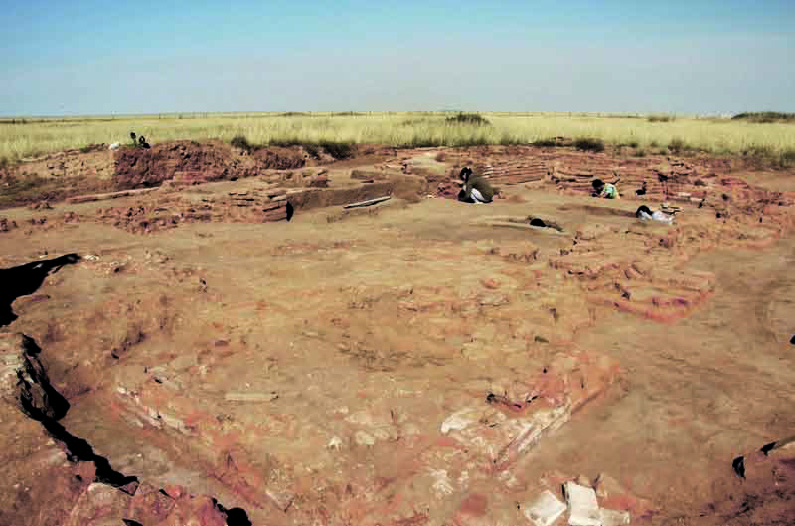
Data from modern archaeological excavations confirm the thesis that Akkol-Zhaiylma had an important cultural and historical significance. In 2004, the remains of the mausoleum were found on the shore of Lake Akkol (Auliekol), 2 km from Karazhar village, inside the old Kazakh cemetery. The object dates back to the XIV century. It is one of the largest in the region. The burials are made according to the Muslim tradition with elements of pre-Islamic rituals, typical for burials of XIV-XVI centuries. The features of Islam can be seen in the western orientation, the presence of wooden coffins, the insignificant presence of accompanying equipment, the absence of traces of sacrificial food, the cult of fire and other signs. The bazaar-horde of the medieval ruler consisted of all the necessary infrastructure: from clergy, doctors, craftsmen, servants, guards to merchants.
Zh. Artykbayev cites the information of the Arab merchant Hasan al-Rumi, which claims the existence of a small town of Akkol: "In fact, I met with astronomer Masood during the namaz. We have calculated it by means of astronomical tools and have found that it lasts 4,5 hours with small. We learned that there are places in Desht-i Kypchak where the shortest night is. For example, in the small town of Akkol the shortest night lasts three and a half hours, i.e. shorter than Bulgar night by one hour. However, there is still no significant evidence of the existence of an urban settlement in the Akkol-Zhaiylma region. Evidence of the development of commodity-money relations in this area is the Golden Horde coins, found as a result of archaeological excavations. In total, about 8000 artifacts were found on Auliekol. The furnaces found prove the development of craftsmanship. The chygiris attached to the wheel for taking water in the river give grounds to suppose the development of irrigated agriculture. Images of fish on bricks and ceramic weights for nets testify to the development of fishery. Thus, the archaeological complex of Auliekol proves the importance of the region as a summer hordes of rulers of the Horde period (XIV-XV centuries). The emergence of a whole complex of cult infrastructure is closely connected with the active spread of Islamic traditions among the steppe elite.
Zh. Artykbayev believes that Akkol-Zhaiylma became the political center of the Ak Horde dynasty, and then Kok Horde. According to the scientist, the region became the center of summer stakes of Shiban's descendants. As a whole it is necessary to note admissibility of such versions. It is authentically known that in XIII century Irtysh region has entered into ulus of the elder son Zhoshy/Dzhuchi - Horde Eugene. The sanctity attached to the area in folklore may be connected with the establishment of Islamic traditions among the Genghis Khanate and the construction of Muslim mausoleums of the steppe elite. It should be noted that Kazakhs often attached sacred importance to places associated with Genghis Khanate. The Genghisids were attributed the patronage of heaven and emphasized their sacred selectivity (kielіlik). For example, legends often refer to holiness (kielіlіgі) and election (kutty) of Abylai khan. To a certain extent, it is connected with pre-Islamic beliefs in election to the eternal sky (tanir kuty kongan).
By the XVIII-XIX centuries, the traditions of veneration of the Akkol-Zhaiylma region as sacred lands were being strengthened. It was connected with the activity of outstanding personalities - preachers of Islam. In the XIX century, a famous connoisseur of the region, Mashkhur-Zhusup Kopeyev, wrote about the sanctity of the lands around Lake Akkol:
Both good and evil have left this world,
However, one of them caused us to lose our peace,
I'll tell you about a nugget,
The man who inhabited the holy lands of Akkol.
These lines were dedicated by Mashkhur-Zhusup to Isabek Ishaan Khazret, the outstanding preacher of Islam. The significance of Akkol-Zhaiylma as a sacral region is connected with the plethora of outstanding ishans and khazrets originating from the asyl suyeks - kozha. There are mausoleums of the descendants of the first Islamic missionaries in the Pavlodar Irtysh region - Isabek Ishaan Khazret, Zhandarbek Kozha, and the monument to Tuite Aulie. The importance attached by Kazakhs to the region as one of the political centers of the Kazakh khanate is confirmed by letters from Russian officers. In the beginning of the XIX century in Akkol-Zhaiylma was elected as a khan of Middle Zhuz Bokei, son of Barak sultan. Prominent sultans and clans were gathered at Akkol-Zhaiylma. The head of the Separate Siberian Corps Lieutenant General Glazenap wrote the following lines to Sultan Shanshar Sultanmameduly: "Thank you more humbly, dear Sultan, for your diligence, and I do not think it is necessary to leave you with my arrival by the 30th of May at Jayilma lake for being at the ceremony of Bukei Khan, which I assume to be present at".
The Akkol-Zhaiylma region is a holy land with rich historical and spiritual traditions in the minds of its people. Numerous sacred objects located on this land have become places of mass visit.