Information
- Location
- Kostanay Region, Rudny city
- Period
- 2000 BCE – 1001 BCE
- Type
- Сomplex
- Kind
- Archaeological sites
Sources
- Қазақстанның киелі орындарының географиясы: Табиғат, археология, этнография және діни сәулет өнері нысандарының тізілімі / Жалпы редакциясын басқарған ҚР ҰҒА академигі Байтанаев Б.Ә. – Алматы: Ә.Х. Марғұлан атындағы Археология институты, 2017. – 1-шығарылым. – 904 б.
Description
The monument is located in the town of Rudnyi (Kostanay region).
Ancient sacral object of Kostanay region. It consists of settlement, burial ground and sacrificial place. The complex dates back to the period of the final bronze, II millennium BC. Nowadays the term "antiquities of the Sargara-Alexeyev type" is widely used by specialists to describe the objects of the Andronov cultural-historical community left at the last stages of the Bronze Age. In general, the materials of the complex contain materials of several stages of the Bronze Age: Sintashty, Alakol and Sargara.
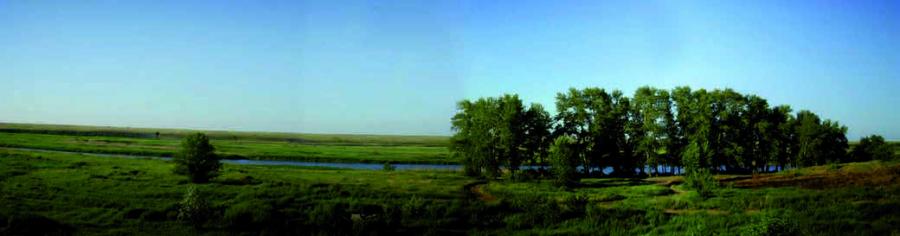
The burial ground is located in a picturesque place on the left bank of the Tobol river, 4 km away from the village founded by the settlers and called Alexeyevsky. Its length along the coast is about 1 km. The ancient settlement was found slightly downstream on the river and is located on the high sloping bank of the Tobol river. It is separated by a small ridge on the northern side. A small hill on which the sacrifices were made is the centerpiece of the complex. The Imperial Eagle is adjacent to it from the western side, and the settlement begins 45-50 m southeast of the remnants of the extreme sacrifices.
The Alekseyev burial ground was opened in 1921 by a geologist student B.V. Sokolov, who discovered two ruined tombs with fragments of ceramics, bronze tools and jewelry in the scattered sandy shores. Surveys at the burial site began in 1930 as a result of cooperation between the Kustanay Museum of Local Lore with specialists from the State Historical Museum (Moscow). So the history of studying of the monument began not simply, but as a whole the beginning of systematic studying of region was put.
O.A. Krivtsova-Grakova conducted a little reconnaissance. It was the very beginning of the 1930s. For carrying out of works the approaches were used. On the way from Kustanay to Alekseyevsky took almost the whole day. O.A. Krivtsova-Grakova came to Kustanay region for a long time - in the field seasons of 1931, 1935, 1936, 1938, 1939. The results of research of Alekseyevsky monuments became the basis for the PhD thesis of O.A. Krivtsova-Grakova. We read about it in the letter of 1944 addressed to A. Kh. Margulan of B.N. Grakov: "...My wife has a great work (her candidate dissertation) about excavations near Kustanay from 1930 to 1940 [cited from: Scientific archive "Gylym Ordasy", f. 11, op. 1, d. 543, pp. 14-15]. In the letter of O.A.Krivtsova-Grakova addressed to B.N. Grakov, we meet: "...I saw Margulanova at lunch today and informed him that I was going to Kazakhstan next year. I booked Alekseyevka and a second parking lot near Sadchikovsky village..." [quoted from: And life..., 2011, p. 239].
A. Kh. Margulan supported the activity of O. A. Krivtsova-Grakova in the Kostanay steppes. Brief information about the excavations of Alekseyevka found a place in his regular publications on the pages of the leading editions of the Academy of Sciences of Kazakhstan. For years of researches O.A. Krivtsova-Grakova at Alekseyevka were excavated and studied the northern and eastern slopes of the sacrificial hill, dug and cleared the dugouts, ashes and the above-ground structure at the settlement, continued excavations at the burial ground. A significant part of the burials was destroyed by landslides and debris that formed a steep slope, called the "Sandy Krunch" in the local population. A total of 21 burials were investigated. Anthropologist M.M. Gerasimov reconstructed the appearance of a woman.
The funeral rite of the burial ground was revealed - these are usually curved burials, performed mainly on the left side. Elements of the accompanying material complex are represented mainly by ceramic vessels in which food was placed. In addition to ceramics, women's burials often contain bronze and paste beads, ribbed prongs, rhombic and round bronze plaques, temple rings, 1.5-turn pendants, convex-concave bracelets with spiral curls. A hryvnia was found in one of the graves.
The main rite of sacrifice found on the hill was to bury in the ground ceramic vessels with food, often covered with large shards, replacing the lid. After three years of work, 59 such pots were found on the hill. During the five years of excavation, an area of 2,566 m2 was uncovered and seven dwellings were fully explored. These were half-earths of rectangular shape. The area of the dwellings varied: the smallest was 135 m2, while the largest was 250 m2. Some of them were connected by passages and formed a complex of buildings.
The study of the monument for the first time showed that the ancient inhabitants of the banks of the Tobol River in the Bronze Age mastered complex technologies of metal processing and ceramic production. An impressive osteological collection was obtained, which provided information on the composition of the herd of inhabitants of the settlement.
Alexeyev cultural complex is a textbook object in archeology of the Bronze Age of Steppe Eurasia. One of the few archeological monuments studied, which includes a full range of data on the material (settlement) and spiritual (burial ground and sacrificial place) culture of the Bronze Age tribes. This object is also valuable because it is associated with certain pages of archeological study of our country, its initial stage, the discovery of classical monuments in the Kazakh steppes.
The complex of monuments within the city of Rudnyi with proper support of the state can be turned into a tourist infrastructure object. Worthy further study and preservation of the monument opens up new prospects in its use as an object of historical and cultural heritage.
The monument is a tourist attraction, visited by archaeologists and local history experts. There are excursions for schoolchildren.