Information
- Location
- Karaganda Region, Ulytau District
- Period
- 901 – 1100
- Category
- Historical and cultural monuments of republican significance
- Type
- Mausoleum
- Kind
- Buildings of monumental art
- Authors
- Ахатов Ғазиз Аманжолұлы
Sources
- Қазақстанның киелі орындарының географиясы: Табиғат, археология, этнография және діни сәулет өнері нысандарының тізілімі / Жалпы редакциясын басқарған ҚР ҰҒА академигі Байтанаев Б.Ә. – Алматы: Ә.Х. Марғұлан атындағы Археология институты, 2017. – 1-шығарылым. – 904 б.
Description
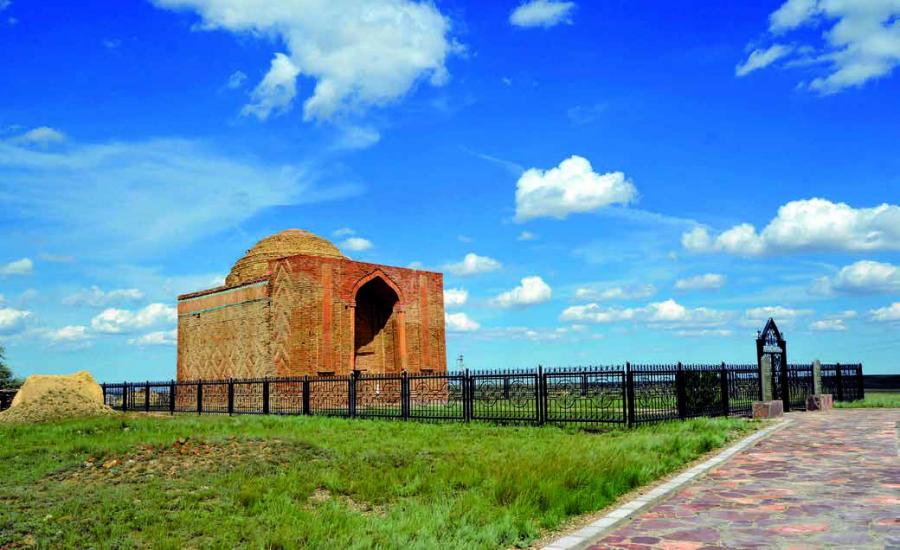
It is located 90 km north of Zhezkazgan, 2 km south of Malshybay village on the right bank of Karakengir river (Karagandy region). There are a large number of mausoleums made of burnt brick and stone, saganatams, and a number of barrows forming a peculiar necropolis. Alasha Khan's mausoleum stands out among them.
The earliest information about the monument is connected with the data of Russian travelers, topographers and military men. This monument is mentioned in the article by Sh.Sh. Ualikhanov "On Kyrgyz-Kaisak graves (tombs) and antiquities in general".
Evidence of the veneration of the mausoleum is given in the description of the monument to Y. Schmidt: "If from the mouth of the Sary-Kengir to the right bank of the river Kara-Kengir upstream, in 15 versts, among the bare steppe plain, rises a monumental structure of the times of Khan's domination: the tomb of Alacha Khan. The grave is placed inside a large and tall mosque with a narrow opening instead of a door, a small earthen hill is covered with horse skulls, colored rags and spear-shaped poles with horse tails. The building itself is shaped like a massive cube of 10 fathoms with a dome and small towers on the corners, the walls are made of red baked bricks and covered with patterns of white glazed bricks. The dome is covered with blue glaze, the dome has an inner passage around it, which is penetrated from the inside by a narrow and steep stone staircase inside the wall".
Similar information about the mausoleum of Alasha Khan is available to N.I. Krasovskiy: "The grave of Alacha Khan is located on the right side of the river Kara-Kengir, 10 versts above the mouth of the Sary-Kengir, towering on a flat hill, the slopes of which are dotted with many tombstones of newest origin. The brick building remained almost unscathed, only blue paint descended from the dome, and in a few places from the walls of the cube fell off the tiles that decorated its top. The body has a length of 6, width of 5, height of 4 fathoms; the dome above it is more than two fathoms; the thickness of the walls is about ½ arshin. The interior of the building is decorated in the corners and in the middle of the walls with niches having each 3½ fathoms in height, and the length of the chord of 3-wall niches and 4 corners of 2¾ arshin. Inside this tomb, as well as in the interior of all the monuments revered by the Kyrgyz people, there are poles, to which many shreds of clothes or bundles of hair pulled from the horse's mane are attached by nomads passing by the tombs".
Description and dating of the mausoleum is available in the 18th volume of "Full geographical description of Russia": "Behind the Kara-Kengir River there is one of the majestic monuments of Kyrgyz history - the tomb of Alacha Khan, a famous Khan of the times of the mighty Kyrgyz hordes (XV century). The monument is a massive brick cube of 10 fathoms high, with a dome and four towers at the corners. The dome is covered with blue glaze, and the walls are covered with patterns of white glazed bricks. Inside the building there is a large room in the middle of which there is a small hill above the grave, covered with horse skulls, colored rags, horse tails and wooden spears".
The mausoleum is made of baked bricks and belongs to the type of portal-dome structures. The size of the mausoleum is 9.8×12 m, the height to the top of the dome is 10.4 m. The mausoleum has a portal in front of it and a spherical dome on a 16-sided drum. Daylight penetrates through a round hole at the top of the dome into the room.
The main facade of the mausoleum is occupied by a portal with pylons and a deep arched entrance niche. The mausoleum is oriented to the south-west by the main facade. The entrance niche arch with decorative corner columns has a U-shaped belt filled with terracotta tiles with geometric ornament in the form of "braids". The walls of the mausoleum are surrounded by tapes of the basement and the frieze, between which a patterned masonry of vertically and horizontally placed bricks is applied. The frieze is faced with terracotta slabs with carved geometric ornament of large eight-pointed stars. Above and below the friezes are framed by narrow strips of turquoise irrigation bricks. Above it is arranged slightly protruding eave.
The main distinctive feature of the mausoleum of Alasha Khan is its three-dimensional composition called "octahedron in the cube" and the presence of a bypass gallery on the upper level. In the left corner of the mausoleum entrance there is a staircase with high steps - access to the gallery. The floor of the mausoleum is laid out of one row of bricks.
The study of the monument is connected with the activity of A. Kh. Margulan. He refers the time of construction of the mausoleum to the pre-Mongolian period - X-XI centuries. Relying on analogies with the Karakhanid architectural monuments of the XI century. A. Kh. Margulan notes that legends about Alasha Khan reflect the activity of a person who united ancient steppe tribes and created the first large state. He also cites Kazakh genealogy, according to which people consider Alasha Khan to be the ancestor of the ancient tribes called "Alty Alash".
The expression "Alty Alash" has a sacral and legendary meaning, and therefore Kazakhs consider it synonymous with the word "Kazakh", as well as, for example, Bashkirs, Tuvinians, Altaians and others who identify themselves as "children of Alash".
Sacred image of Alasha Khan is reflected in the words of the legend: "Alash Alash bolganda, Alashakhan Khan bolganda" ("When Alash became Alash people, when Alasha Khan became Khan"). Origin of Alasha khan A. Kh. Margulan connects with Oguzes, and the cycle of legends about him refers to the history of the tribes of the VI-XII centuries. Based on folk legends, he connects the Alasha Khan settlement in Ulytau with the personality of Alasha Khan.
Alasha Khan's mausoleum is an architectural monument of republican importance and is under protection of the state.
It is a place of pilgrimage and tourism.