Information
- Location
- Zhambyl Region, Jambyl District
- Period
- 1101 – 1200
- Category
- Historical and cultural monuments of republican significance
- Type
- Mausoleum
- Kind
- Sacred objects
Sources
- Қазақстанның киелі орындарының географиясы: Табиғат, археология, этнография және діни сәулет өнері нысандарының тізілімі / Жалпы редакциясын басқарған ҚР ҰҒА академигі Байтанаев Б.Ә. – Алматы: Ә.Х. Марғұлан атындағы Археология институты, 2017. – 1-шығарылым. – 904 б.
Description
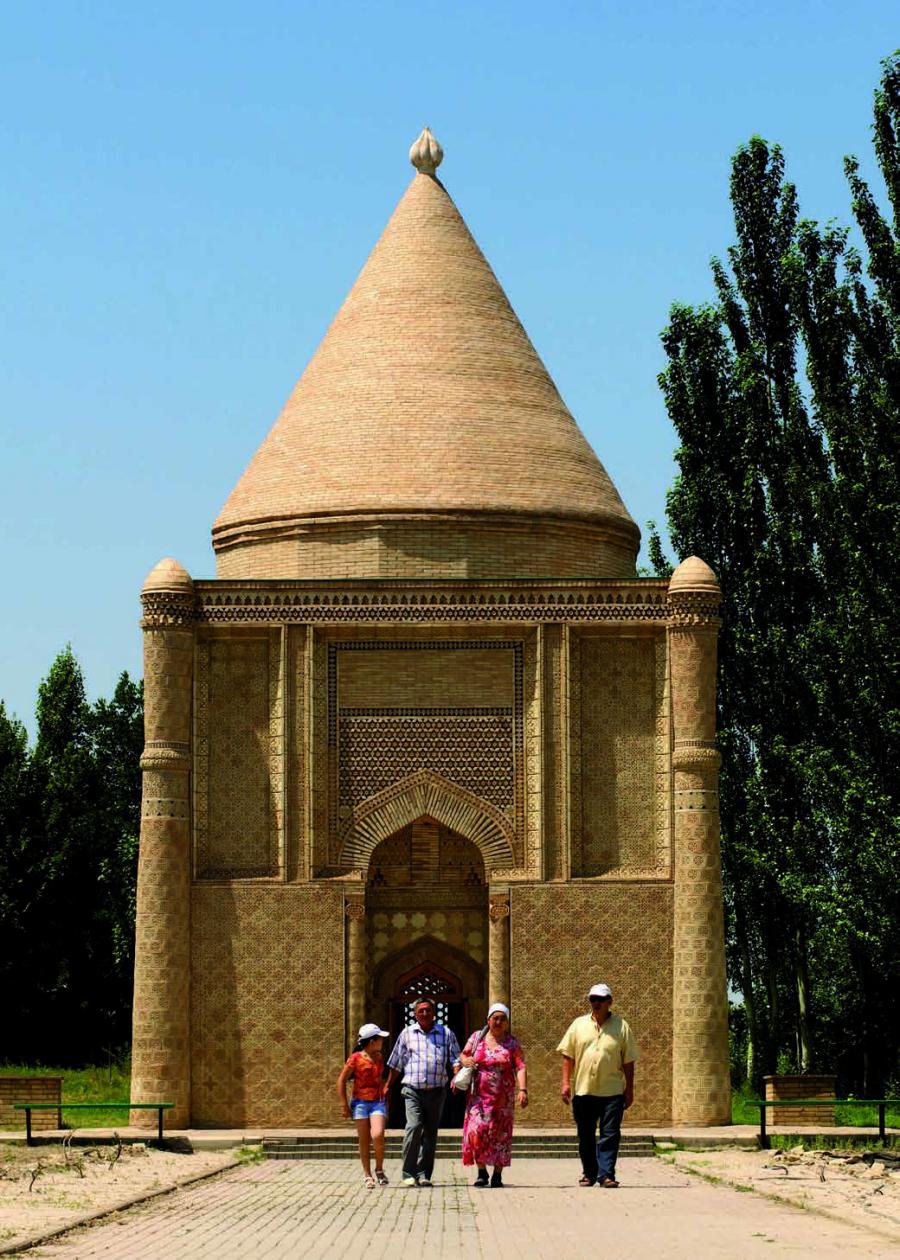
It is situated in Aisha-Bibi village (Zhambyl district, Zhambyl region).
Aisha-Bibi Mausoleum is one of the brightest and most significant monuments of Islamic culture and architecture of the Middle Ages in the territory of Kazakhstan, it continues to function as a sacred space for people of the XXI century, uniting their common cultural and historical memory. The most important element of the architectural ensemble of any city is the cult buildings. In medieval cities in Kazakhstan, which were located in the cultural space of the Islamic religion, such structures were mausoleums. By the time they appeared on this territory, this type of structures had a long history and existed in different parts of the Muslim world, embodied in a variety of architectural variations. Early Islamic religion tabooed the erection of tombstones, seeing in them the deification of man, but in the IX century this tradition was broken by the erection of a mausoleum over the ashes of caliph al-Muntasir in Samarra (Iraq). Since that time dynasty family tombs of the mausoleum have been erected to noble people, tombs over the ashes of the faithful, called "mazars" and the status of sacral spaces.
Mausoleums and mazars are considered to be cult objects, and the people buried in them are considered to be Islamic saints. In the system of buildings of the X-XVIII centuries the mausoleums constitute a significant part of the system. This is explained by the spread of Sufism on the territory of Kazakhstan with its cult of sacral attitude to buried people recognized as wise and righteous. Aisha-Bibi mausoleum, according to architect T.K. Basenov, is "a kind of museum, which concentrates the main ornamental treasures of the architecture of Kazakhstan and which contains the key to understanding the traditional forms, principles of evolution and combination of separate ornamental motifs". In 1856, the mausoleum was painted by Sh.Sh. Valikhanov.
Legends have also told us the story of its creation. According to one of the legends, the beautiful daughter of the famous poet and scientist Hakim-ata is buried there. She fell ill and died suddenly in the rainy autumn time during her trip to her bridegroom Karahan. Among the inscriptions on the corner columns of the building are the following words: "Autumn, clouds ... life is beautiful". Legends related to the monument were recorded by V.A. Kallaur: "...One of the local sarts of Magruf-Khoja...informed me that one of the Samarkand khans was married to a Christian woman, a Chinese princess, identifying her with the name of Hanym-Bibi (the monument is located in Samarkand), whose sister Aisha-Bibi visited her in Samarkand. On the way back, Aisha-Bibi died near the Asy River, where a real monument was erected. Another version is known: "Aisha-bibi was the daughter of Ismail-ata. The Aulie-Ata saint chose her as his bride and expressed his desire for Ismail-ata. The latter reluctantly agreed and sent his daughter to Aulie-ata, but said that the groom would not see the bride. And so it happened: Aisha-Bibi died on the way, in two carcasses from the city, where she was buried. V.A. Kallaur also gives a different version: "...She was the sister of Amir Timur's wife and daughter of Chinmachin's Khan. She went to see the works being built by her sister Hanym in Bukhara "Madrasa-and-Hanym" and took the gold with her on several mules, but on the way she fell ill and died. Then Amir-Timur gathered all the masters of his wife and built a mazar over the tomb of his sister-in-law" [Quoted from: Kallaur, 1897].
The base of the mausoleum is cubic. Large columns are placed at four corners. Small niches, small columns, vaults, lancet arches, terracotta tiles were used in the decoration. The patterns of the mausoleum syncretize traditional types of ornamentalization of ancient tribes living on the territory of Kazakhstan. They include geometric, zoomorphic and solar models generated in the cultural environment of Andronov and Saka tribes. The most preserved part of the mausoleum is the western facade, which rises to 6 m. The archivolt of the facade arch relies on three-quarter columns with jug-shaped capitals. At the heel of the arch the wall is buried, and the upper part of the arch is enclosed in a U-shaped frame. The decorative ornament is based on vegetal-geometric motifs. In the center of the mausoleum there is a tombstone of 3.00×140 m, composed of bricks from the destroyed walls of the building with the inclusion of facing tiles. On the inner side of the walls one can see eclectically inserted tiles from the outer cladding, including the slab.
The genesis of sacral architecture can be represented as follows. In Khorasan and Zhetysu in the XI-XII centuries, preference is given to similar architectural images of tombstones, which is the result of the proximity and close ethnocultural contacts of the Seljuk and Karakhanid states. In the funeral rites and rituals of the population the idea of tombstones existed long before Islam, the connection with the religion of Avesta is assumed. Nauses as a special type of ordinary and family mausoleums were found during excavations in the territories of Khorasan and Maverannahr, including in Merv (II-III centuries), Northern Bactria on Davlverzin-Tepa and Bandykhan (I century BC - II century AD), on Pendzhikent (VI-VIII centuries) and in the Shu valley (VI-VIII centuries).
The Aisha-Bibi mausoleum is one of the sacred symbols of materialized Kazakh culture. It belongs not only to cultural and historical monuments of anthropogenic character, but also to a special type of natural and cultural landscape. The object is one of the most visited cultural and historical monuments in the Republic of Kazakhstan. Every day hundreds of pilgrims from all over Kazakhstan and neighboring countries visit the Aisha-Bibi mausoleum in the hope of touching the sacred space.
Aisha-Bibi Mausoleum is an architectural monument of national importance.