Information
- Location
- Kyzylorda Region, Zhanakorgan District
- Period
- 1801 – 1900
- Category
- Historical and cultural monuments of republican significance
- Type
- Mausoleum
- Kind
- Buildings of monumental art
Sources
- Қазақстанның киелі орындарының географиясы: Табиғат, археология, этнография және діни сәулет өнері нысандарының тізілімі / Жалпы редакциясын басқарған ҚР ҰҒА академигі Байтанаев Б.Ә. – Алматы: Ә.Х. Марғұлан атындағы Археология институты, 2017. – 1-шығарылым. – 904 б.
Description
It is situated on the right bank of Syr Darya river on an elevated place 6 km south of Besaryk station (Zhanakorgan district, Kyzylorda region).
Oral information about Aikozha Ishaan has reached our days. He was born in 1773 in Zhanakorgan region. Aikozha Zhumadildauly comes from a kind of duan-kozha. Having reached the adulthood, he gets a religious education in madrassa of Tashkent, Bukhara. After that, he continued his spiritual education in Afghanistan for four years, along with such students as Kulboldy, Maral, Kosym, at the famous scientist Islam Shaikh, who could make the river flow backwards. Later, Kulboldy returned as an ishaan to Terenozek, Maral to Karmakshy, Kosym to Kazalinsk, and Aikozha to Zhanakorgan. While Aikozha was still studying, his teacher Islam Shaikh noticed in him, apart from memorability and insight, the presence of some mysterious power that was not noticed by ordinary people. One day, he decided to test his students and called them to his house. When the others pass to the teacher without delay, Aikozha stopped at the door, without crossing the threshold. When the teacher asked him the reason for this behavior, he said: "I cannot go over the sacred thing that lies below this threshold. I ask you to remove it". It turns out that Islam Shaikh hid the Koran in front of the entrance to test his disciples. Such clairvoyance of Aikozha was a surprise to both the teacher and the disciples.
Aikozha was engaged in literacy and religious education of people of Zhanakorgan region. He opened a madrassa school in Karasopy and served the people as an educator. However, later, offended by the words spoken by his contemporary Koken Batyr, he migrated from there to Aktas, taking with him 30-40 families. Koken Batyr, realizing his mistake, caught up with the nomadic people and asked for forgiveness. Then the light-eyed Aikozha, having forgiven him, took people away with him, saying: "It would be wrong if the nomadic people, who were going to go back to the road, would come back". Having reached Aktas, he spoke to the people who followed him: "If it pleases God, our residence is now here". Then they asked: "How will we live in an area where there are no people or water? When Aikozha heard this, he stuck his staff into the ground and started beating the key with crystal clear water from there. It is still called "Aikozha's key". Aikozha Ishaan left this world in 1857 in the area called Sarykamys, located near the village of Besaryk. His body is buried near Aktas aulie. Aikozha Ishaan had 11 children. At present, more than 400 families are burying them.
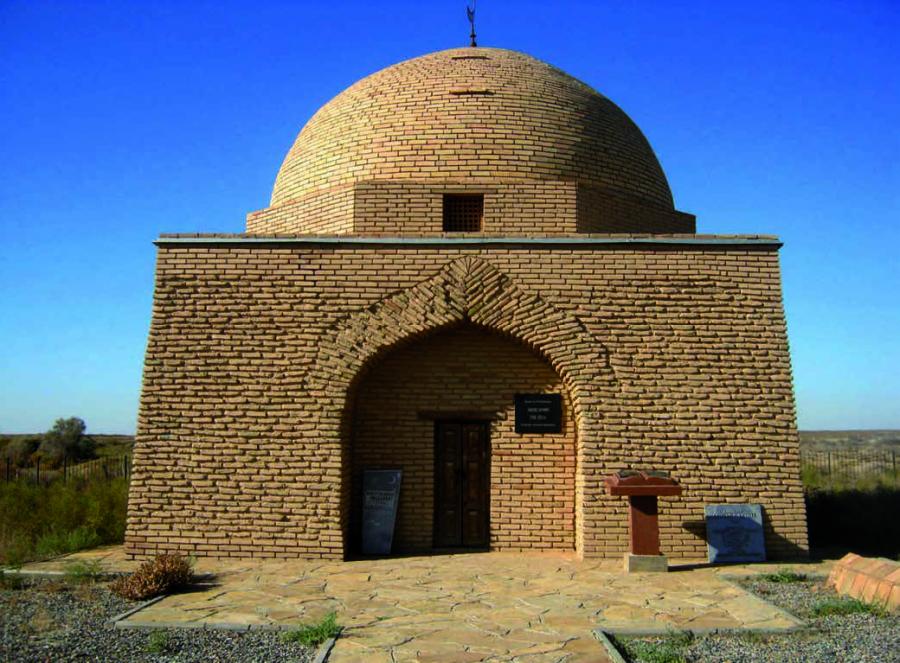
The parameters of the monument erected in honor of Aikozha are 9×9 m in height, 8 m, made of burnt brick. The dome is decorated with elements of the Kazakh ornament, there are four windows from which light falls on an octahedral dome with a drum, the canopy over the door is made of logs. Inside there is a tombstone in the form of a sagan, the headstone of which is the horns of an argali.
In front of the main facade of the building there are five tombstones, similar to each other. The one on the eastern side is the tombstone of Aikozha's wife, and the other four are in the western part (one of them has koktas) - ishaan's assistants. The dome over the tomb of Ishaan was erected by a master named Khamit, who came from Bukhara on behalf of his eldest son Ibadulla. Aikozha Ishaan was known not only in the Syrdarya region, but also to the believers of neighboring countries for his scholarship, piety and discernment, and his name gained fame by bequeathing to his sons to build a mosque. Ishaan along with teaching the people was engaged in cultivation of humanity and piety of people.
Aikozha Ishaan Mausoleum is an architectural monument of the XIX century. At one time his personality among the people was considered sacred. Nowadays, the mausoleum where he is buried is also perceived as a holy place.
The mausoleum is included in the list of objects of historical and cultural heritage of national importance. It is visited by pilgrims, for whom a special building is provided. There is a keeper (shyrakshy). Visitors can perform religious rituals, read namaz, ayats from the Koran in honor of the dead, there is also a place for animal sacrifice.