Information
- Location
- Karaganda Region, Ulytau District
- Period
- 0
- Type
- Сomplex
- Kind
- Archaeological sites
- Authors
- Байтілеу Дархан Айтжанұлы
Sources
- Қазақстанның киелі орындарының географиясы: Табиғат, археология, этнография және діни сәулет өнері нысандарының тізілімі / Жалпы редакциясын басқарған ҚР ҰҒА академигі Байтанаев Б.Ә. – Алматы: Ә.Х. Марғұлан атындағы Археология институты, 2017. – 1-шығарылым. – 904 б.
Description
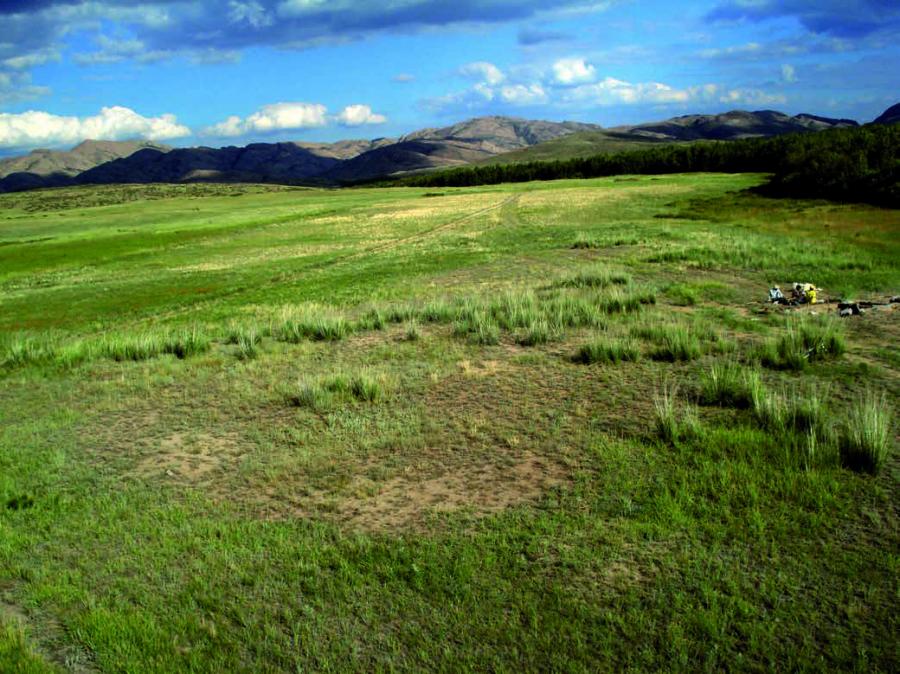
The monument is located on the western spurs of the Ulytau massif, 1 km from the northwestern foot of Mount Edyge (Ulytau district, Karagandy region).
Archaeological objects are mainly located on the right floodplain terrace of the Aybas mountain river. The archaeological complex is represented by various monuments, including Neolithic sites, a burial ground and a settlement of the Bronze Age, early Iron Age barrows, burial and memorial structures of the Middle Ages, in the depth of the gorge is localized fortified structure of the late Middle Ages - the ancient settlement of Aybas-Darasy.
The monument was unveiled in 1946 during the work of the Central Kazakhstan archeological expedition (CKAE) under the direction of A.Kh. Margulan. The systematic study of the complex began in 1972. Under the direction of A.Kh. Margulan, the monument started to study the mausoleum of Begazy-Dandybay culture and several burials located next to it. Since 2004, the archaeological research of the site was resumed by the CSAE team headed by J. Kurmankulov and S. Ishangali. The works were carried out within the framework of the State Programme "Cultural Heritage".
The central monument of the archeological complex is the barrow-fence Aybas-Darasy. It is a stone structure with a sub-square shape and funeral functions. The length of the stone walls, which were lined with the technique of horizontal laying of large slabs, is about 12 m on average. The walls of the building reach a height of 0.6-1.2 m and are erected from large blocks of limestone. The structure is oriented by walls on the sides of the world. In the center of the square fence there is a box made of slabs. The space between the stone walls and the box is divided into sectors by stone partitions, which form a radial, radial structure. The compartments may have been used for two purposes. In the first case, they probably served as an altar, a place of sacrifice, where ceremonial ceremonies were performed on the paved floor. The traces of ritual fire on the floor, traces of ashtrays and remnants of the ritual meal in the form of animal bones speak in favor of this situation. A large amount of ceramics was also discovered here. The second purpose of the compartments is practical. These compartments, in our case partitions, performed a construction function, i.e. they replaced the central support poles on which the entire ceiling was based. The compartments had transverse slabs made of massive oblong sandstone slabs fitted together.
According to A. Kh. Margulan, the complex is built in the technique typical for stone structures of Central Kazakhstan in the late Bronze Age. The masonry on the clay mortar with dressing of seams began directly from the ground. Large slabs were laid in the lower row. For dressing the corners of the building, according to the scientist, long slab-shaped blocks in the form of a parallelepiped were used. Local raw materials were used as a building material. In order to make the walls and the structure of the building as a whole more durable, the fence base was initially densely compacted with crushed stone and filled with muddy clay. Such technique is widespread in the late bronze structures of Central Kazakhstan: below they are strictly steep, in the upper part have a small roll to the center. In general, the mausoleum of Aybas-Darasy is defined by A.Kh. Margulan as one of the objects representing the western boundary of Begazy-Dandybay culture. Ceramic material obtained as a result of research is one of the largest collections. A total of 28 vessels of different shapes were found. Thin-walled and richly ornamented ceramic vessels are made at a high technological level and have largely completed our information about pottery of Begazy-Dandybay tribes of Central Kazakhstan. Besides, in the course of A. Kh. Margulan's researches fragments of a human skeleton and bones of animals were found here.
Among the significant finds on the Aybas-Darasy barrow-fence we can name a complex ornamental bracelet made of gold, which is a unique work of ancient art. The product is a two curved hollow bell (elongated and short), connected to each other with a thickened head. At the ends of the tubes there are two small golden nails, which probably served as fasteners to the wooden or bone base of the bracelet. The ends of the bracelet are decorated with ornaments in the form of drawn (shaded) triangles. Perhaps, this element was not accidentally popular among the ancient inhabitants of the steppe and mountain valleys. It could symbolize the sun, its eternal motion, the cycle of darkness and light, life and death. The metal itself - golden bronze and sparkling gold - strengthened or emphasized this meaning. Ancient pastoralists and metallurgists appreciated this metal and found its worthy use. In general, the spectral analysis of the discovery showed that the bracelet consists of 83% gold, 13% silver and 1% copper.
The archaeological complex of Aybas-Darasy is a tourist attraction.