Information
- Location
- East Kazakhstan Region, Ulan District
- Period
- 1601 – 1700
- Category
- Historical and cultural monuments of republican significance
- Type
- Сomplex
- Kind
- Archaeological sites
Sources
- Қазақстанның киелі орындарының географиясы: Табиғат, археология, этнография және діни сәулет өнері нысандарының тізілімі / Жалпы редакциясын басқарған ҚР ҰҒА академигі Байтанаев Б.Ә. – Алматы: Ә.Х. Марғұлан атындағы Археология институты, 2017. – 1-шығарылым. – 904 б.
Description
The ruins of Ablaikit are located 55 km south of Ust-Kamenogorsk on the right bank of the river Ablaketka.
For many centuries, the territory of Kazakhstan has been the "territory of dialogue" of three world religions - Islam, Christianity and Buddhism. Their long coexistence and interaction in a single geopolitical space has left a peculiar imprint on the development of material and spiritual culture of the peoples who inhabited Kazakhstan in the past. This important feature of the cultural and historical life of the local population is largely due to the central position of the region in the geographical space of inland Eurasia.
Ablaikit is a monument to the centuries-old history of one of the world's religions - Buddhism, which since ancient times has been widespread in Kazakhstan and has played a significant role in various aspects of life of the tribes (especially the ancient Turkic ones) that formed the basis of the Kazakh ethnos.
In this respect, Ablaikit, a sacred monument of religious and cultural history of Kazakhstan, is one of the brightest material evidence of the rich religious history of our country. It has become an integral part of the formation of a historically conditioned multi-religious nature of modern Kazakhstani society.
Buddhist monastery Ablaikit was founded in 1654 by the Oirat ruler Ablaitaji (died in 1764) in the upper reaches of the Irtysh in the Kalbin mountains. The first report on the construction of the Ablaikit was made by Fyodor Baikov, who was travelling as part of the first Russian embassy to China in 1655. In the 1650s-1660s, Ablaikit was one of the largest religious centers and a repository of the most valuable Buddhist manuscripts. Since 1720, after the foundation of the Ust-Kamenogorsk fortress and receipt by Peter I of manuscripts delivered from Ablaikit, this monument became known to science.
In the French weekly Gazette on October 18, 1721 was published a report on the amazing finds made east of the Volga, more precisely, between the Caspian Sea and Siberia, represented by manuscripts and sketches, silver and bronze lamps, figures of gods, riders. As for the manuscripts, they were the first of the religious contents written in Tibetan. This was the beginning of the study of Tibetan literature and almost unknown then Tibetan Buddhism.
The finds themselves came to France to the Academy of Sciences from the hands of the Russian Emperor Peter I with a request to determine the language of manuscripts, their content and other finds. To Peter the Great rarities got thanks to the Siberian governor Prince Gagarin, and they came from the Buddhist monastery Ablaikit, most likely, from the monastery of the Seven Chambers Dorjin hit. Materials from Ablaikit played an important role in the formation and development of Russian and Western European and later Soviet tibetology.
In 1735, the remains of the monastery were examined by the geodesist V. Shishkov, who removed the plan and made sketches of the monastery. Information about Ablaikit can be found practically at all scientists of XVIII and XIX centuries, concerning geography and history of the Upper Irtysh region, among them: F.I. Stralenberg, G.F. Miller, I.G. Gmelin, G.I. Spassky, V.V. Radlov, A.I. Levshin, A. Humboldt, J.A. Kastanye, P.P. Semenov-Tian-Shansky. The monument also attracted the attention of scientists in the XX century.
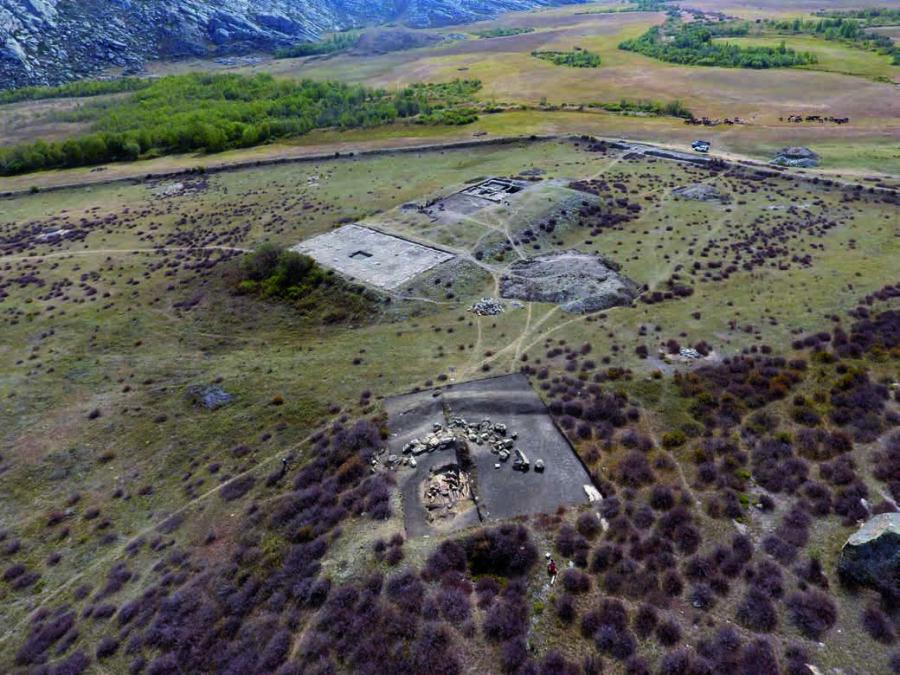
Ablaikit is a fortified monastery consisting of a group of buildings located on the south-eastern slope of a rocky mountain. The main site of Ablaikit is the remains of a rectangular platform measuring 80×45 m, oriented along the North-South line on which the temple was located. The platform is about 6 m high on the southern side and about 2 m high on the northern side. According to the available archive drawings and plans of the complex, as well as during the visual inspection of the site, the location of the premises and additional structures of the temple structure were determined. The temple itself was located in the northern part of the platform, approximately 45 x 20 m in size. The rest of the elevated area is occupied by a large covered prechurch space, separated from the temple by a free space, which forms a kind of corridor. From the south side, the staircase to the prechurch room led to the staircase, which is currently fixed in the form of a sloping ramp.
A residential complex was built to the north-east of the temple and a small utility room to the west. The buildings of Ablaikit are surrounded by a stone wall, which reached a height of 2-3 m. The continuous wall is drawn along the rocky massif that surrounded the monument from the north and west sides. In the northern part of the monument the wall rounds a small mountain lake. The gates were built on the eastern and southern sides of the monument.
Ablaikit is a monument of history and culture of the Republic of Kazakhstan of republican importance.