Information
- Location
- Ақтөбе облысы, Kobda District
- Period
- 1301 – 1950
- Category
- Historical and cultural monuments of republican significance
- Type
- Necropolis
- Kind
- Archaeological sites
- Authors
- Ажигали Серик Ескендирулы
Sources
- Қазақстанның киелі орындарының географиясы: Табиғат, археология, этнография және діни сәулет өнері нысандарының тізілімі / Жалпы редакциясын басқарған ҚР ҰҒА академигі Байтанаев Б.Ә. – Алматы: Ә.Х. Марғұлан атындағы Археология институты, 2017. – 1-шығарылым. – 904 б.
Description
The monument is located 13.5 km south-south-west of Taldysai settlement and is located on a flat area on the left bank of the Uly Khobda river, 3 km from the river canal (Khobda district, Aktobe region).
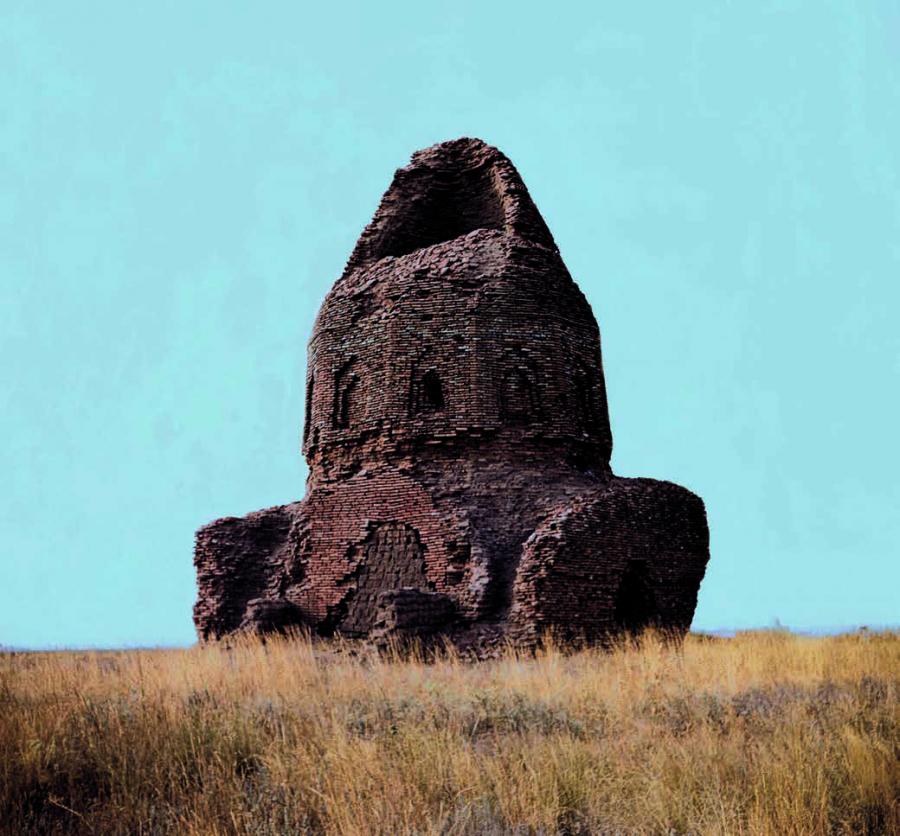
The complex was named after the mausoleum Abat-Baitak - an outstanding monument of medieval architecture, one of the few preserved baked brick mausoleums in the region with a conical tent-shaped dome. The monument was first mentioned in the “Topography of Orenburg” by P.I. Rychkov, where it is said that in 1750 a second lieutenant engineer A. Rigelman at the confluence of the Karasu river into the Big Khobda discovered and painted “considerable stone structures like pyramids made ...”.At the end of the XIX century, he was briefly described by D. Berkimbaev, as well as Ya.Ya.Polferov. At the beginning of the XX century, a graphic fixation of the “Baitak Mausoleum” was published for the first time in the work of Joseph Castagne “The Antiquities of the Kirghiz Steppe and the Orenburg Territory”. For many years, it was the only starting material for judging a unique structure. There was virtually no information about the existence of a large necropolis. In the postwar years, the Abat-Baitak Mausoleum was noticed by architectural historians M.M. Mendikulov, G.A. Pugachenkova and others, who correlated it with the monuments of Kok-Kesene and Kesene, but dated to Mongolian time (XIII century). At the same time, for a long time, experts considered the Baitak Mausoleum to be lost (unpreserved). In fact, anew the unique monument and necropolis was opened and comprehensively surveyed in 1979–1980 by an expedition of the Ministry of Culture of Kazakhstan (led by S.Ye. Azhigali). In 2004–2006 archaeological excavations were carried out in the mausoleum and repair and restoration works were conducted.
Folk legends are attributed to the mausoleum of Abat Batyr - the son of the famous XV century Utopian philosopher Asan Kaighy [the main version was recorded in 1980 by S. Baitleuov (Shaykym-aksakal), born in 1916, village Taldysay, Khobda district]. Abat was tragically killed here, in the Beskopa tract, when, on the instructions of his father, he was looking for free places to move: he was dropped by a yellow camel and crashed. The mausoleum was built in the shortest possible time by the entire population of the surrounding steppe (hence the second part of the name - baitak: wide, immense; here - nationwide). The legend obviously has an indirect relation to the monument, since such grandiose structures in the steppe were erected, mainly, over the burials of the royal persons of the khan's family. In particular, during excavations in the chamber of the mausoleum, one of the main male graves was accompanied by an iron top of the type of “mace” or “scepter” - a symbol of the high status of the buried. At the same time, the question of the attribution of the mausoleum still remains open.
The monument is a huge steppe memorial complex with an area of up to 600 m in diameter, which is based on the monumental mausoleum of the end of the XIV - the beginning of the XV century. To the west, north and south of it in the XVIII - early XX centuries, a large Kazakh necropolis developed, including a “Uitam” mud mausoleum (sometimes referred to as “Kyzaulie”), built in imitation of the early monument, and an ensemble of magnificent carved steles-kulpytas, in total more than 200. The complex was formed as a large intergeneric cemetery with a high cult-ideological status, at which representatives of various clans of the Kazakh Junior Zhuz were buried: tabyn (tarakty), kete, ozhyrai, alshyn, baibakty, shekti, etc. Total number of traditions gravestones ionic structures has about 650-700 objects with considerably large number of buried here.
The main monument is the majestic portal-dome mausoleum Abat-Baitak (with an initial height of about 16 m), the central volume of which consists of a square in the plan of the skeleton (9.52 × 9.80 m) with slightly inclined walls, an 11-sided drum and an aspiring upward conical dome. The portal part of the building - according to the restoration version of the peshtak - stands for the line of the south wall at 3.0 m. The interior of the building is also square in plan, with characteristic successive transitions to the internal overlap: octahedron, 16-sided and constructive spheroconical dome. In the western and eastern walls of the chamber are arranged arched openings. On the walls of the room tamgoo-shaped signs are preserved. Decorative processing of the mausoleum mainly consisted in the device in the edges of the outer drum of paired, one in the other, false window openings with a stepped end. The monument is mainly lined with burnt bricks of square and rectangular formats, and raw bricks are also used. In addition, in the facing layer there are bricks with glaze greenish brown color.
The construction belongs to a special subtype of portal-dome mausoleums of the Kazakhstan-Central Asian region with a double covering (dome), the outer one of which is conical or pyramidal, to the "tent mausoleums." It occupies an intermediate place between the Khorezm mausoleums with hipped floors XII - the beginning of the XIII century (IlArslana, Tekesha) and portal-dome tent monuments of Kok-Kesene and Kesene of the XV-XVI centuries and is an outstanding example of the memorial architecture of the steppe Eurasia and Kazakhstan.
The special uniqueness of the AbatBaitak necropolis lies in the presence here of an outstanding ensemble of stone-cutting steles-kulpytases. First of all, high samples of the “graceful” school of Kazakh stone-cutters of the middle of the XIX century with the finest detailing are highlighted. Often, their volume-decorative elements are solved in the tradition of woodcarving. A large group of original monuments refers to a characteristic type of massive stelae with a pronounced volume-geometric solution of constituent elements (multi-level kulpytases). The archaic stelae types are interesting, for example, the kulpytas, remarkable for its simplicity, is a petrified tree, dug from the west of the grave mound. The outstanding masters of the Northern Aral-Caspian Sea worked on the creation of the unique kulpytas of Abat-Baitak, the arabographic epitaph knows the name of only one - Myktybai-tasshy.