Information
- Location
- Zhambyl Region, Korday District
- Period
- 3300 BCE – 1500
- Type
- Petroglyph
- Kind
- Archaeological sites
Sources
- Қазақстанның киелі орындарының географиясы: Табиғат, археология, этнография және діни сәулет өнері нысандарының тізілімі / Жалпы редакциясын басқарған ҚР ҰҒА академигі Байтанаев Б.Ә. – Алматы: Ә.Х. Марғұлан атындағы Археология институты, 2017. – 1-шығарылым. – 904 б.
Description
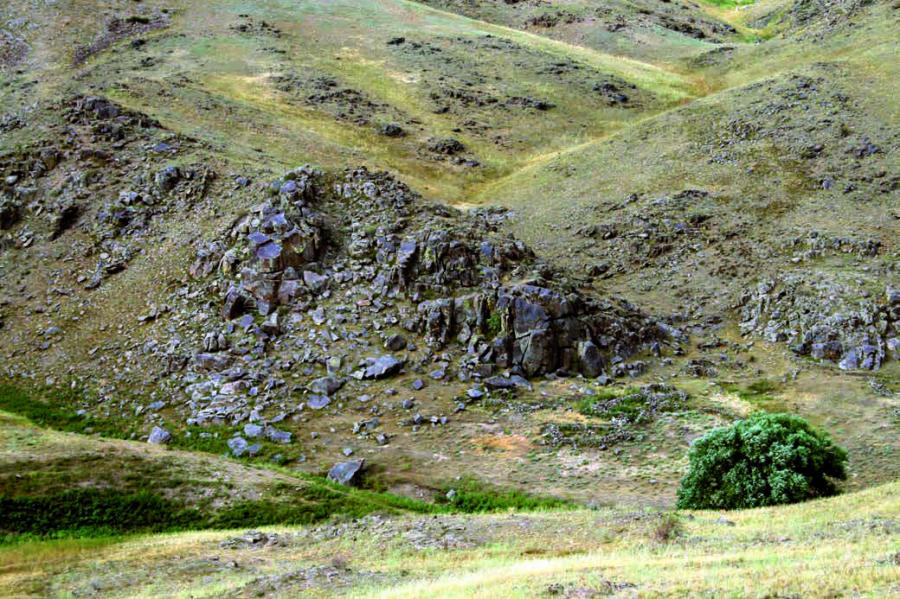
Petroglyphs of the Bronze Age, Early Iron Age, Middle Ages. Petroglyphs of the Oizhailau tract are located in the Kindyktas mountains 27 km north-west of Kenen village (Kordai district, Zhambyl region). The sacral significance of the monument lies in the fact that all subjects are somehow connected with religious beliefs and ritual practices of the region's population in antiquity and early Middle Ages. A hill with petroglyphs and a platform in front of it played the role of a kind of family and clan sanctuary. Compositions of each chronological stage in this sanctuary are masterpieces of ancient rock art of Kazakhstan.
The monument was discovered in the 1970s by the regional specialist N.D. Cherkasov. The first copies of rock drawings of the tract were published by A.G. Medoev. As a result of systematic researches in 1980-1990 archeological expeditions of Abai KazPI (A.N. Maryashev) and the Institute of Archeology named after A.Kh. Margulan (Yu.A. Motov) found a complex of ancient and medieval burial grounds and settlements in the tract. 52 rock slabs with petroglyphs from the Bronze Age to the Middle Ages were found.
The oldest group is represented by five multi-figured compositions of the Bronze Age, representing scenes of buffalo and bull sacrifice, the battle of horse riders armed with embossed horsemen or pickles, as well as ritual plots with images of bulls, goats, dogs, men with their hands up, archers on foot. Among the most vivid early petroglyphs of the Saka time is a composition with images of deer in the Arzhan-Mayemer tradition: large stylized figures of two deer are made "standing on tiptoes". The composition with three chains of goats and a mask-lyn in the religious traditions of ancient peoples is connected with the cult of pets.
A masterpiece of the world rock art is a composition of the Turkic time with three horsemen, the standard-bearers. The scene is carved on a saucer-shaped "concave" surface of a blue-grey granite block of a rocky ridge with a southern exposition. Here the characteristic feature of the medieval ideology is expressed, which brought to the fore the heroic image of the horseman. The unique scene is marked by A.G. Medoev under the name "Glory of the Great Turks". Separate groups of Turkic drawings represent the figures of goats, arches, camels at people' leading reins, a scene of archers' hunting, an anthropomorphic figure with a stick. The variety of techniques in the transmission of details, horns and movements allowed the artists of that time to convey the dynamism and expressiveness of beautiful images and a special sacral meaning of the drawings.
A tourist destination.