Information
- Location
- Zhambyl Region, Merki District
- Period
- 601 – 900
- Category
- Historical and cultural monuments of republican significance
- Type
- Temple
- Kind
- Archaeological sites
Sources
- Қазақстанның киелі орындарының географиясы: Табиғат, археология, этнография және діни сәулет өнері нысандарының тізілімі / Жалпы редакциясын басқарған ҚР ҰҒА академигі Байтанаев Б.Ә. – Алматы: Ә.Х. Марғұлан атындағы Археология институты, 2017. – 1-шығарылым. – 904 б.
Description
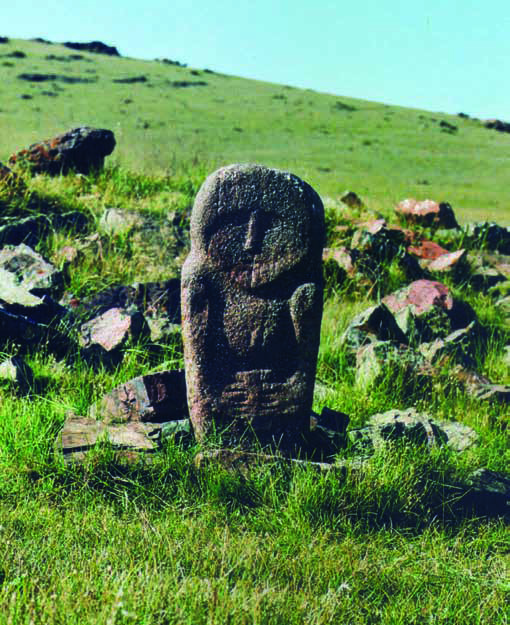
Located near the village of Merke (Zhambyl region). The area of the sanctuary is about 250 km2. The study of sanctuaries - places where barrows, stone sculptures and stone constructions around them have been preserved - plays an important role in the study of Turkic culture. These were sacred places of worship and holding cult rites and ceremonies. Of particular interest are the sanctuaries located in remote areas of high mountains, where the monuments have not been disturbed: sculptures stand, as well as hundreds of years ago, in their original places.
The main cluster of monuments is located on the Sandyk plateau. A large number of sculptures were known here back in the late XIX century, but they were introduced into the scientific circulation by E.A. Novgorodova, who explored these places together with the regional specialist A.N. Pechersky in the 1980s. A.M. Dosymbaeva has been studying the Merke complex for many years.
The tradition of sacralization of this space by the Turkic nomads has almost a thousand years. The sanctuary is located at an altitude of 3,000 m on the territory of several plateaus: Sandyk, Shaisandyk, Araltobe, Kashkasu, Ulysai, Belsaz, Karasai. There are about 170 barrows and fences of the VI-XIV centuries on the territory. 70 of them are singular or multiple (up to four) complexes with anthropomorphic sculptures. Anthropogenic monuments are organically synthesized with local flora and fauna of Tien Shan into a single natural-historical complex, embodying mythopoetic perception of the unity of nature and man.
The sculpture on the tomb of the ancestor for the Turks was a kind of spiritual link between those living on earth and God in heaven. In combination with the fencing the sculpture was a sacred space, protecting the clan, tribe, family from chaos and evil spirits. The stone sculpture was an image of a dead and deified ancestor, expressing the main idea - the memory of the deceased. Of the items left on stone sculptures, special semantics have attributes in the form of vessels, birds, jewelry and stylized features of the face.
In the Turkic ethnocultural pantheon, the dead ancestors endowed with a patronizing function became a kind of sacred "system of protection" of the clan, performing also the function of donors of life. And death itself was sometimes perceived sacral. Dead ancestors existed in the sacred space of the ritual complex (sanctuary), the semantics of which was embodied in the consecration of the place of burial by the erection of temples, burial mounds or stone sculptures, as well as by prayers and sacrifices, in the protection of the real life space, conceptual cosmicism of the Kaganate and the symbolic connection of generations. The cult of ancestors, which played an important role in the ancient Turks, has been preserved as one of the central leitmotifs of Kazakh culture.
Stone anthropomorphic statues of the Merke sanctuary are depicted with a vessel. Most researchers interpret this as "the presence of a deceased ancestor at his funeral. Other researchers think it is connected to the custom of sacrifice to heaven, earth and spirits. There are also female stone sculptures. This is explained by the fact that the ancient Turks developed the cult of a mother, ancestor, patroness of the home and children. Ethnocultural peculiarities of the development of Turkic art were organically intertwined with their utilitarian needs, determined by the type of economic life and environment. Decorativeness, which is one of the main components of the aesthetic impact of folk art, in all its diversity becomes a means of artistic expression of traditional aesthetics. Stone statues of Turks Merke's sanctuaries are a vivid testimony They concentrate centuries-old traditions of decorative and ornamental and plastic solutions. Stones, mainly granite and basalt, were used as the material for the sculptures; in the opinion of ancient Turks, they were considered to be difficult to process and "eternal stones".
On an example of sanctuary Merke it is possible to assert also that protections and the stone calculations similar to barrows, existed in Kazakhstan up to XI century. This monument is characterized by stone statues of a column-shaped form with schematically transferred faces, which are marked with hryvnia, hats and vessels. Sculptures of Merke close a single chain of monuments of all Turkic-speaking peoples of Eurasia, testifying to the original culture of the Great Steppe.