Information
- Location
- Zhambyl Region, Taraz city
- Period
- 1201 – 1300
- Category
- Historical and cultural monuments of republican significance
- Type
- Mausoleum
- Kind
- Monuments of urban planning and architecture, Buildings of monumental art
Sources
- Қазақстанның киелі орындарының географиясы: Табиғат, археология, этнография және діни сәулет өнері нысандарының тізілімі / Жалпы редакциясын басқарған ҚР ҰҒА академигі Байтанаев Б.Ә. – Алматы: Ә.Х. Марғұлан атындағы Археология институты, 2017. – 1-шығарылым. – 904 б.
Description
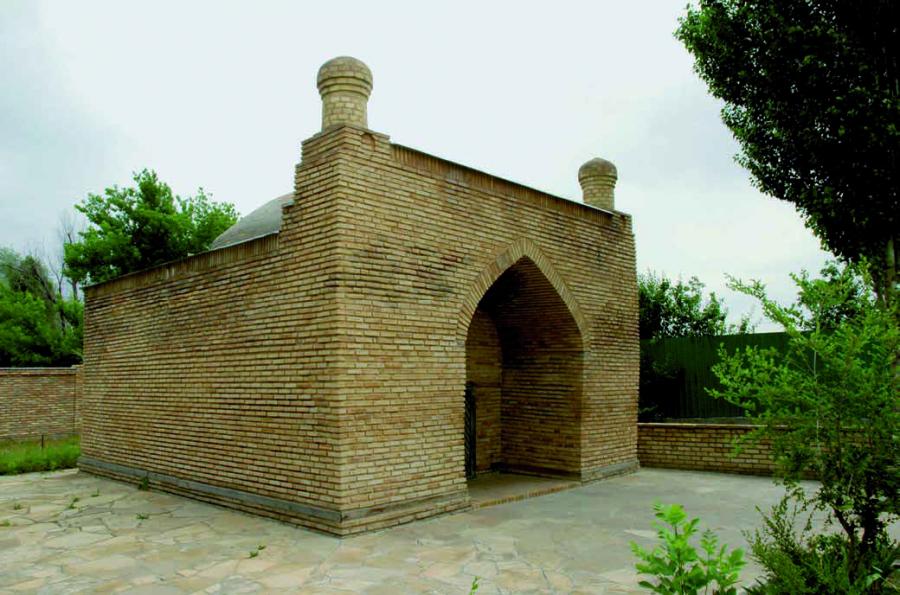
It is located in the central part of the modern Taraz city (Zhambyl region). It is erected over the grave of one of the Mongolian military leaders of Turkic origin - Ulug-Bilge-Ikbalkhan-Dauydbek (Davudbek) on the territory of the ancient Taraz rabad. Architects are unknown.
A brief prehistory is this. In 1248, on his way to Mongolia, the city of Taraz was visited by the Mongolian viceroy who ruled the Caucasus - Argun. He visited Taraz again in 1251, when he went to Mongolia to go to kurultai, and there he learned about the election of Mengu as a great kagan. Passing through Taraz in 1253 Rubruk left a detailed description of these lands. Approximately with this time it is necessary to connect board in Taraz of the local aristocrat of a Turkic origin Ulug-Bilge-Ikbalkhan-Dauydbek, under the legend who has lost in one of fighting collisions. After his death, a uniquely shaped mausoleum was erected over his grave.
The object is significant in the context of the military and political history of Kazakhstan as a sacral burial place of the first Turkic commander in the era of Mongolian dynasties in Central Asia. Dauydbek's mausoleum is one of the first evidence of the assimilation process of Mongol dynasties in the Turkic ethnocultural environment. Undoubtedly, these events are one of the most significant in the history of Kazakhstan. The mausoleum belongs not only to the crosscultural monuments of anthropogenic character, but also forms a special type of natural and cultural landscape on the territory of the modern city of Taraz.
In the center of the mausoleum there is a three-stage stone tombstone with a carved Arabic inscription. The inscription on the top slab says: "This is the garden (resting place) of the great melik (prince), scientist, just, generous, possessor of the sword and pen, mine of generosity and mercy, purifier of faith and morals, patron of scientists, protector of Islam and Muslims, support of the weak, ennobled faith, chosen Khakans, chosen Lord of the worlds, the meeting of virtues, the source of justice, who obeyed the commandments of Allah, the guarantor of time".
The inscription on the second slab sounds as follows: "The fields of mercy, virtues of Muvvalig Bariké, the great sage, the happy Ik-Belhan-Dad-Bek Isfahasal son of noyon (prince) Uchul-Bek Ashshagid (who died for his religion) on the night of Friday of the 8th month of Jemad (the year 660 (1262) of the year of the chronicle)".
The time of wide spread of Islam among the Turks of Central Asia V.V. Bartold considered the epoch of the Golden Horde - XIV century: "Thus, we can say that thanks to the Mongolian empire the victory of Islam was finally solved, already in the XIV century. Islam was the state religion in the entire space conquered by the Mongols, from Southern Russia to the borders of Mongolia and China" [Cited by: Bartold, 1968].
For the first time a layer of Mongolian time on the monuments of Southern Kazakhstan was allocated by A.N. Bernstam during excavations of the Taraz hillfort. Later the same layer was fixed on the territory of shakhrestan of Taraz by G.I. Pacevich and E.I. Ageyeva. The layer of the XIII-XIV centuries and the lifting material of this time give more than a dozen other hillforts in the Talas valley, especially in the upper reaches of the river, where silver mines were intensively developed.
The spread of Islam in the socio-cultural reality of Kazakhstan is largely due to Sufism, one of the most interesting forms of Muslim mysticism. The proximity of some ideas and elements of Sufism's ritualism to local pre-Islamic beliefs and cults allowed Sufism to gain popularity among the general population of Central Asia and medieval Kazakhstan.
Since the middle of the XIX century the mausoleum has been repeatedly examined by historians, art historians and architects. The epitaph on the mausoleum allows to correlate the mentioned personality with one of the major military leaders of the XIII century.
Initially, the mausoleum consisted of four semicircular arches on which the dome was erected. The arches were held on the butterfly foundation. The mausoleum acquired its modern appearance at the end of the XIX century, when the arched passageways were laid with bricks. Two minarets were built near the southern passageway, which is now a small portal.
The mausoleum is a portal-dome construction made of burnt bricks. The doors are decorated. The basis of the stocky dome are the arches and walls of the mausoleum.
In 1982 it was reconstructed and included in the list of monuments of history and culture of national importance and placed under the protection of the state within the framework of the object "Monuments of ancient Taraz". In 2008, it was separated into a separate object.