Information
- Location
- Zhambyl Region, Zhualy District
- Period
- 200 BCE – 301
- Category
- Historical and cultural monuments of republican significance
- Type
- Necropolis
- Kind
- Archaeological sites
Sources
- Қазақстанның киелі орындарының географиясы: Табиғат, археология, этнография және діни сәулет өнері нысандарының тізілімі / Жалпы редакциясын басқарған ҚР ҰҒА академигі Байтанаев Б.Ә. – Алматы: Ә.Х. Марғұлан атындағы Археология институты, 2017. – 1-шығарылым. – 904 б.
Description
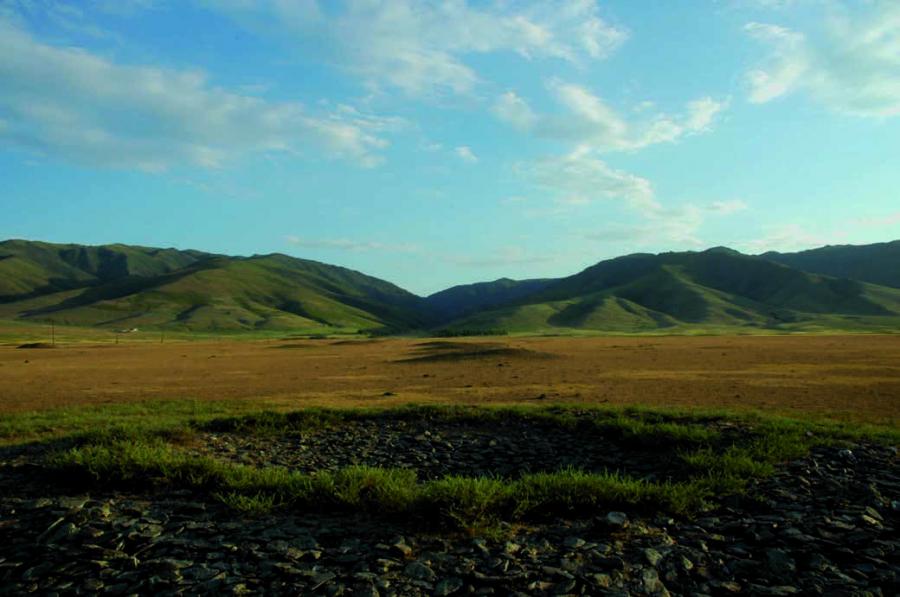
It is located 85 km west of Taraz, under the northern slope of the Karatau mountain range, between the ridge and the southern shore of Bilikul Lake.
Berkkara necropolis is a ritual and memorial complex of Saka culture. It was discovered at the end of the XIX century by the famous traveler and scientist V. Oshanin. Archaeological research was carried out by archaeologists A.N. Bernstam, A.G. Maximova and others.
The largest number of barrows is located near the Berkkara Gorge. Here a grandiose burial ground with stone embankments with a diameter of 1.5 to 35-40 m and a height of 0.1 to 6-7 m is registered and described. The barrows are located in the form of chains stretching from north to south. The total number of registered barrows is over 500. Barrows with larger embankments are located in the middle of chains. Some embankments are surrounded by stone rings and sickle-shaped lining. Several embankments are covered with white quartz from above. As a result of excavations of barrows the accompanying stock was received: clay vessels, gold, bronze and copper earrings, pendants, a bronze buckle in the form of a head of the lion, iron knives, lamellar rings from a harness, hooks for quiver, two- and three-lobed petiole arrowheads, an ephese of a sword.
In terms of size, burial mounds are differentiated into three groups, reflecting the social stratification of society:
I. Large barrows, 25-41 m in diameter and 2.50-3.20 m high.
II. Medium barrows, diameter 12-24 m at a height of 0.40-1.50 m.
III. Small barrows, diameter from 4-5 to 9-12 m, with a height of 0.10-0.25 m.
The construction of each barrow has been thought out in advance. The multi-layered embankments contributed to the creation of a microclimate inside the barrow, the preservation of structures and the preservation of the shape of the barrow itself - the sacral monument of ancestors.
Among the numerous artifacts obtained in the course of the study, the bronze belt buckle of the IV-III centuries BC is of interest. It contains a symbolic scene of torment: the neck and head of a horse, which is a crooked buckle, protrude from the lion's mouth. A cat's predator, a lion holding a herbivorous animal in his teeth, is a well-known plot of the Scythian-Saka animal style. It is widely spread in the monuments of the Scythian-Saka time in the monuments of Zhetysu, Central, Western and Eastern Kazakhstan. Especially numerous variants of a plot are revealed at excavation of barrows of Pazyryk culture of Altai, including known burial ground Berel.
The materials of the Berkkara burial ground enrich the understanding of the culture of the Saka tribes of Zhetysu. They testify to the fact that many years of experience were gained not only in the construction of burial tombs, but also in the construction of houses. It follows from that the Saks of Zhetysu were not "pure nomads". One part of them was nomadic, but spent the winter on stationary winterings, while the other, along with cattle breeding, was engaged in agriculture and lived in settlements. In the I millennium BC, the steppe tribes of Kazakhstan and adjacent regions formed the types of burial structures, which indicate the existence of complex architectural and construction techniques and skills of the Saka tribes. Sacred attributes are being developed. Projections of social, mythological and other structures of perception on artefacts and household objects are of great interest.
Berkkara burial ground is unique as a sacral monument of materialized mental culture, mythopoetical perception and system of social relations of Saka tribes. The object is a subject of large-scale historical and archeological researches, each day gaining more and more historical and cultural significance and relevance. It has a clear historical and cultural identity and is the most important monument of Saka-Scythian civilization. Saka culture is one of the origins of material and spiritual culture of the Kazakh people. Many symbols of the Saka-Scythian civilization become an organic part of the historical, cultural and state symbols of the Republic of Kazakhstan. The artifacts found on the territory of the object can serve as a source, a conceptual model of the concentrated focus of religious motifs of the worldview of tribes of the Iron Age in the cross-cultural context of the study of all religions of the designated period.Famous Kazakh scientist K.A. Akishev, noting the architectural peculiarity of the barrows of Berkkara, wrote that the stone calculations around the barrows "reflected the religious and cosmogonic ideas of the Saka tribes existing at that time.
Berkkara burial ground belongs not only to cultural and historical monuments of anthropogenic character, but also forms a unique type of natural and cultural landscape.